



Mekari Insight
- A clear travel policy builds consistency by defining what’s allowed, what’s reimbursable, and how business trips should be managed across the company.
- Strong travel policy compliance protects budgets and people by controlling costs, improving safety, and ensuring every trip is efficiently planned and properly documented.
- Mekari Expense as the best travel & expense management software makes compliance effortless with automated approvals, custom travel rules, and end‑to‑end visibility, so business travel stays controlled without slowing teams down.
When employees book travel without clear guidelines, costs don’t spiral all at once. They accumulate through last-minute flights, undocumented expenses, and reimbursement claims that no one scrutinizes closely enough.
The ACFE’s Occupational Fraud 2024 report found that expense reimbursement schemes appear in 13% of all fraud cases globally, rising to 20% among smaller organizations, with a median loss of $50,000 per incident.
A business trip policy closes these gaps by setting spending limits, defining non-allowable expenses, and building an approval workflow that finance teams can actually enforce.
The goal of this travel policy isn’t to make travel harder, it’s to make compliance the default. When written clearly, it removes the grey areas that most fraudulent claims depend on.
This article walks through the key components of an effective policy, a ready-to-use business travel policy template, and recommended tools built to enforce compliance at the transaction level.
Business trip policy key components
A clear travel policy helps employees understand what’s allowed, what’s covered, and how to stay compliant during business trips. Here are the key components typically included:
- Employees are required to get trip approvals in advance and submit an expense report upon return through a defined process.
- Travel expenses are usually covered through reimbursements, per diems, or corporate cards.
- Transportation costs like flights, trains, or car rentals should follow company guidelines, including class restrictions and preferred vendors.
- Accommodation should be booked within the company’s price range, with clear rules on upgrades or extended stays.
- Daily meals and snacks are either reimbursed or follow a fixed per diem allowance.
- Any costs related to currency exchange or international phone use should be documented and pre-approved
- Limited entertainment or client hospitality may be allowed with spending caps and receipts.
- Employees should follow safety protocols, especially when traveling to unfamiliar or high-risk areas.
- The policy should explain how medical emergencies are handled and what kind of insurance coverage is provided.
These simple but important rules ensure that business travel stays cost-efficient, safe, and well-organized for everyone involved.
Read more: Top Benefits of Business Travel Expense Card & RecommendationHow to create business trip policy
Creating a business trip policy requires more than just setting rules. It should balance company goals, traveler needs, and cost control. Follow these steps to build a policy that works in practice, not just on paper.
1. Define the objectives
Start by identifying what the policy needs to achieve. Common goals include reducing travel costs, improving employee safety, ensuring convenience, and increasing compliance across the organization.
2. Understand employee travel needs
Consider common travel patterns in your company, such as frequent destinations, preferred transport modes, and job-specific requirements to ensure the policy is practical and relevant for the people who will follow it.
3. Set clear guidelines and spending limits
Cover all areas of travel, from booking procedures and expense limits to less obvious topics like baggage policies, insurance, and non-allowable expenses.
Where possible, give employees approved choices for hotels, airlines, or booking platforms to maintain comfort while controlling spend.
Clarity at this stage prevents exceptions and compliance gaps later.
4. Build the approval workflow
Define who approves travel requests, how far in advance submissions must be made, and under what conditions a request can be rejected.
A well-structured approval workflow prevents bottlenecks and ensures every trip is reviewed consistently across departments.
5. Address international travel requirements
Global travel adds considerations that a domestic policy alone does not cover:
- Visa and passport requirements per destination
- Currency conversion procedures and approved payment methods for foreign expenses
- International per diem rates adjusted for local costs
- Country-specific safety advisories and emergency contact protocols
Addressing these upfront ensures employees traveling abroad are supported and the company’s duty of care obligations are met.
6. Include bleisure travel provisions
If the company allows employees to extend business trips for personal leisure, the policy should clarify which costs remain the company’s responsibility, which are the employee’s, and whether advance approval is required.
7. Define policy violations and consequences
Clearly state what constitutes a breach, such as booking outside approved channels, overspending without authorization, or failing to submit an expense report on time, along with the corresponding consequences.
This protects the company and sets clear expectations for all travelers.
8. Communicate the policy company-wide
Make the business travel policy easy to access through internal platforms, email, or onboarding documents, and ensure everyone understands it, especially managers who approve or enforce travel decisions.
Read More: How to Set Company Expense Policy to Prevent 21% Fraud Reimbursement SchemesBusiness trip policy checklist: What to include?
When writing a corporate travel policy, make sure it covers these essentials:
- Booking rules for flights, trains, hotels, and rental cars
- Guidance on using taxis or ride-hailing services
- Daily spending rules for meals, entertainment, and phone use
- Personal safety and protection of company property
- Policies around giving or receiving gifts during travel
- A clear approval process for all business trips
- A defined system for paying and reimbursing expenses
Purpose and benefit of clear travel policy compliance
Having a clear and well-communicated travel policy is creating a system that benefits both the business and its employees. Here are the key reasons why travel policy compliance matters:
- Simplifies expense handling by explaining which costs are covered and how reimbursements work, reducing confusion for travelers and finance teams.
- Helps control costs by setting limits on flights, hotels, and other expenses, making it easier to stay within budget and forecast future spending.
- Increases travel efficiency by standardizing travel planning, allowing trips to be organized faster and with fewer errors or delays.
- Improves employee safety by outlining procedures for emergency situations and high-risk destinations, giving employees peace of mind while traveling.
- Supports employee satisfaction by making travel smoother, less stressful, and more predictable, something that can boost retention.
- Enhances employer branding by showcasing organized and thoughtful travel policies that can attract new talent, especially for roles involving frequent travel.
Clear policy compliance ensures that business trips are not only cost-effective but also smooth, safe, and valuable for everyone involved.
According to Deloitte’s 2024 Corporate Travel Study, 55% of travel managers rank booking compliance as their single most effective cost-control measure — ahead of negotiating cheaper flights or hotel options.
Beyond structure and consistency, the right tools can take policy enforcement a step further through automation.
AI-powered fraud detection software, for instance, can analyze every transaction in real time, flagging anomalies before they reach the approver and reducing the manual review burden on finance teams.
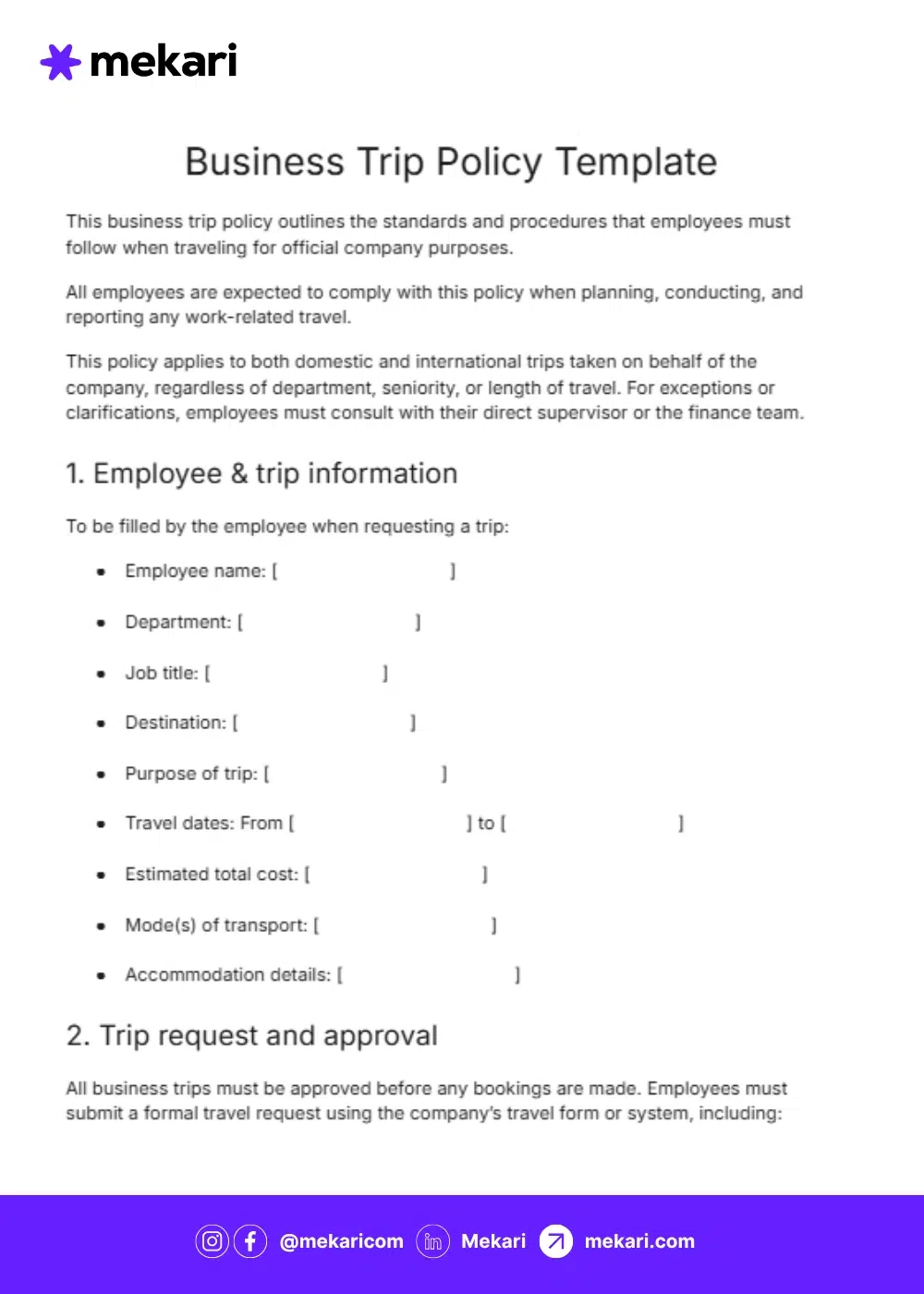
Business trip policy template sample
Need a ready-to-use business trip policy for your company?
Download this complete and customizable business travel policy template to set clear travel guidelines, streamline approvals, and ensure full policy compliance.
Best travel policy compliance tools
To streamline business travel while staying fully compliant, companies need more than just a written policy, they need the right tools.
Mekari Expense is a spend management software designed with built-in travel and expense (T&E) capabilities, helping businesses automate, enforce, and monitor travel policy compliance with ease.
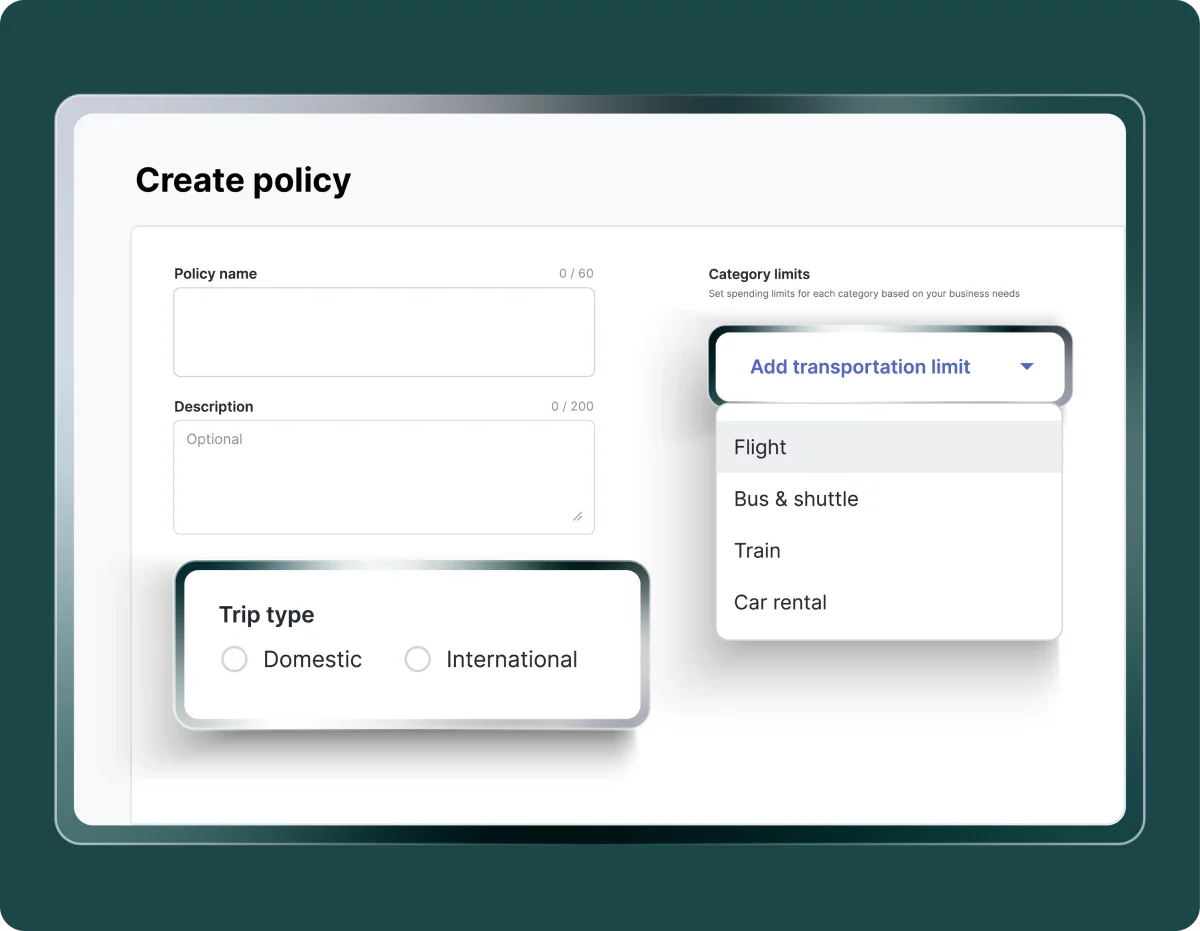
With Mekari Expense, companies can customize their travel workflows and ensure every trip, from planning to reporting, is tracked, approved, and accounted for. Here are some of its key T&E features:
- Submit trip requests with detailed travel purpose, destination, and estimated costs.
- Apply for reimbursements and cash advances directly linked to approved business trips.
- Set up multi-level approval workflows for both trip requests and post-trip reports (LPJ).
- Submit trip reports including receipts and settlement of any advance payments.
- Request refunds for unused cash advances with full documentation.
- Gain real-time visibility across teams, employees, managers, finance, and HR.
- Configure mandatory fields like department, travel purpose, or transport mode.
- Add custom fields to collect specific data based on your company’s needs.
Mekari Expense also automatically analyzes every submitted transaction through Fraud AI Checker, flagging unusual amounts, unverifiable vendors, and duplicate submissions with AI-generated risk scoring before they reach the approver.
Beyond travel management, Mekari Expense is also part of Mekari unified software ecosystem that solves travel and expense management challenges for finance teams and business travelers through an integrated SaaS platform.
Enforce your business trip policy at every stage, from approval to transaction, with the best travel & expense management software from Mekari Expense.
