


Mekari Insight
- The global digital aviation market reached USD 47.81 billion in 2025, growing at 8% CAGR through 2034 (Fortune Business Insights).
- SITA estimates airline IT spend at $37 billion in 2024; 74% of airlines forecast further increases over the next two years.
- AI-powered disruption recovery platforms cut recovery costs by up to 30% in live airline operations (SITA OCCam).
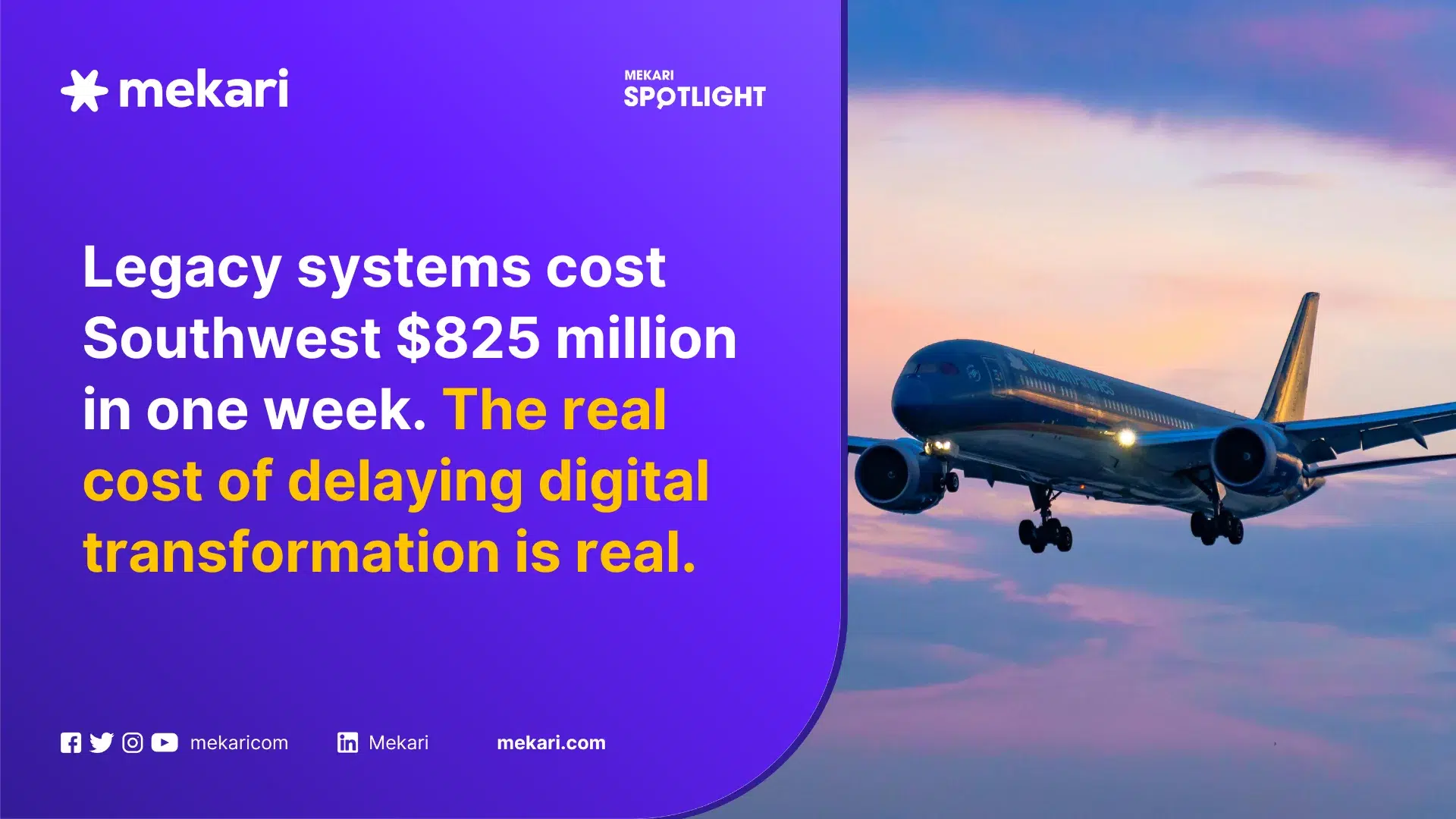
In one week, Southwest Airlines cancelled 16,900 flights because its scheduling system failed. The disruption stranded two million passengers and cost $825 million – the largest aviation penalty in history. Alaska Airlines followed with two IT outages in four months, losing another $50 million. These are not edge cases. They are the cost of standing still while the rest of aviation transforms.
Airline ticket yields fell 5.6% in 2024 and a further 3.7% decline was projected for 2025. Revenue growth that hit 44.1% post-pandemic has slowed to just 4.4%. Digital transformation is no longer a differentiation play – it is the only path to sustainable operations.

What is digital transformation in the airline industry?
Airline digital transformation means integrating AI, cloud, IoT, and advanced data analytics into every part of how an airline operates – from flight scheduling and maintenance to revenue management and passenger check-in.
IATA defines it as a deliberate move away from outdated processes and siloed legacy systems. The scope is enterprise-wide: it reshapes how airlines generate revenue, control costs, and serve passengers.
This is not a single technology project. It is a sustained, cross-functional shift that touches operations, finance, HR, commercial, and IT simultaneously.
Why airlines cannot afford to delay
The financial pressure is clear and quantified.
BCG’s 2025 Airlines Tech and Digital Benchmarking Survey – the first study of its kind – found that ticket yield decline and passenger revenue deceleration are forcing airlines away from traditional cost-cutting toward digital efficiency, automation, and proactive cost management.
The operational risk is equally concrete. Legacy scheduling and reservation systems have proven brittle at scale. Shopify’s 2025 airline industry analysis notes that Southwest’s $825M event and Alaska Airlines’ $50M losses were driven by the same root cause: aging, siloed systems that increase operational risk and quietly erode revenue.
On the passenger side, the shift is behavioral. SITA data cited by Moment.tech confirms that more than two-thirds of passengers (68%) are now digitally savvy – comfortable with self-service, mobile-first interactions, and real-time digital environments. They no longer tolerate a fragmented journey.
The investment signal confirms urgency. SITA’s Air Transport IT Insights 2024 puts total airline IT spend at $37 billion, with 74% of airlines forecasting continued increases.
Key technologies driving airline digital transformation
Artificial intelligence and machine learning
AI is the highest-ROI technology in aviation right now. SITA’s OCCam platform – acquired in 2026 and now being deployed globally – cuts disruption recovery costs by up to 30% by simultaneously optimizing aircraft, crew, passenger itineraries, and maintenance in a single coherent plan delivered in minutes.
American Airlines’ Smart Gating system uses machine learning to allocate gates dynamically, saving over 1.4 million gallons of jet fuel annually. 73% of airlines are now investing in AI-driven pricing and personalization tools to recover revenue as traditional fare structures lose power.
Predictive maintenance and IoT
IoT sensors combined with machine learning allow airlines to detect mechanical issues before they become critical – continuously analyzing engine performance, fuel consumption, and structural health.
IATA data cited by Coaxsoft shows a 30% reduction in aircraft reactivation times and 20% less maintenance-related ground time from these systems. LATAM Airlines converted this into 1,440 additional revenue flying days annually by using AI to schedule A, B, and C maintenance checks across a fleet of 380 aircraft.
Cloud migration and legacy modernization
Deloitte’s 2025 Tech Trends for Airlines highlights mainframe modernization as the critical unlock for airline digital transformation. Airlines face a structural choice: modernize on a new form of mainframe, or break up monolithic systems into cloud-native components. Both paths are valid; neither is fast without deliberate strategy.
Multi-cloud approaches add flexibility but also complexity. Airlines must balance specialized capabilities from different cloud providers against integration costs.
Dynamic pricing and revenue management
AI-powered revenue management platforms like PROS and Amadeus Revenue Management use statistical models analyzing historical booking data, search trends, and social signals to drive dynamic pricing – growing revenue by 6–7% compared to traditional static methods.
This matters because IATA acknowledges many airlines still rely on pricing models with only 26 booking classes, built for a pre-digital market.
Digital passenger experience
The passenger journey is now digital from end to end. SITA’s Baggage IT Insights 2024 recorded a drop in global baggage mishandling from 7.6 to 6.9 bags per 1,000 passengers even as air travel reached 5.2 billion passengers – a direct result of AI-driven automation in baggage handling. Qatar Airways’ Sama AI digital human delivers personalized booking assistance. Biometric boarding is reducing gate processing times across major international hubs.
BCG’s four technology imperatives for airlines in 2026
BCG’s 2025 Airlines Tech and Digital Benchmarking Survey identifies four capabilities that have shifted from competitive differentiation to table stakes:
| Imperative | What it means | Why it matters now |
| Personalize with AI | Real-time, individualized pricing and ancillary offers | Static fare models are losing revenue as yield declines |
| Optimize operations | Predictive maintenance, crew scheduling, disruption AI | Cuts unplanned costs as margin pressure grows |
| Modernize IT and cloud | Migrate from mainframes; adopt hybrid or cloud-native | Legacy systems are both a cost burden and an operational risk |
| Strengthen cybersecurity | Expand cyber resilience as AI widens attack surface | 74% of airlines forecast higher cybersecurity spend (SITA) |
These are not aspirational goals for 2030. BCG frames them as current requirements for any airline that intends to remain competitive through 2027.
Real-world examples of airline digital transformation
- LATAM Airlines provides the clearest 2026 proof point. By deploying AI across maintenance planning, the airline added 1,440 revenue flying days annually and grew net income by 49% YoY in 2025. Passenger volumes grew 8% to nearly 240,000 daily travelers.
- American Airlines achieved over 1.4 million gallons of annual jet fuel savings through its machine learning-powered Smart Gating system – combining cost reduction with meaningful carbon impact.
- Alaska Airlines deployed an AI route optimizer in April 2025 that saved 480,000 gallons of jet fuel in six months – a result that took traditional fleet management years to achieve.
- Qatar Airways launched Sama, an AI-powered digital human providing personalized booking experiences across its app and website – extending digital transformation from the tarmac to the first customer touchpoint.
- IAG (British Airways, Iberia, Aer Lingus, Vueling) appointed a Chief Information, Procurement, Services and Innovation Officer in 2023 and has since positioned itself as one of the industry’s most active transformation leaders across FTE’s 2026 Digital Transformation Power List EMEA.
Common challenges and how to navigate them
Digital transformation ambition frequently outpaces execution. IATA’s 2025 Data, Technology and Cybersecurity Adoption Survey found that 42.8% of airlines still consider themselves at an early stage of data strategy implementation. More striking: over 70% of AI proofs of concept do not advance beyond the PoC stage.
The barriers are structural:
- Legacy dependency: Mainframe-based reservation and operations systems are deeply embedded. Replacing them is costly; not replacing them is riskier over time.
- Data fragmentation: Passenger data, operational data, and back-office finance data sit in separate systems. Unifying them is the prerequisite for most AI use cases.
- Culture and talent gaps: BCG research on airline digital transformation emphasizes that airlines must build a digital product management culture – technology adoption alone does not drive outcomes.
- Cybersecurity exposure: Every new AI integration adds attack surface. Governance frameworks, data classification, and third-party risk management are not optional infrastructure for mature AI programs.
The airlines that are successfully scaling – LATAM, American, Alaska, IAG – share a common thread: they moved from experimentation to production by committing to data infrastructure and operational governance, not just new tools.
How Mekari helps aviation businesses transform faster
Digital transformation in aviation fails when the back office cannot keep pace. Procurement bottlenecks slow vendor onboarding for new technology. Manual expense workflows obscure transformation project costs. HR systems cannot handle rapid workforce changes. Paper-based document processes delay contracts that should be signed in hours.
Mekari is Indonesia’s leading unified software ecosystem, built to automate and integrate the operational and financial workflows that underpin enterprise digital transformation programs.
For aviation companies and aviation-adjacent enterprises, Mekari provides:
- Mekari Expense – automated spend management, AP, and procurement controls that give CFOs real-time visibility over transformation project budgets and vendor costs.
- Mekari Officeless – custom business applications and eProcurement workflows that can be configured for aviation procurement without custom development.
- Mekari Talenta – end-to-end HR and workforce automation covering crew administration, compliance, and payroll.
- Mekari Jurnal – financial management and reporting for accurate ROI tracking on digital transformation investments.
- Mekari Sign – digital document authorization to accelerate the contract cycles that gate every technology vendor engagement.
The Mekari unified software ecosystem integrates natively across all products, eliminating the data fragmentation that derails transformation programs at the back-office level.
Ready to eliminate the operational drag slowing your digital transformation?Explore Mekari unified software ecosystem.
References and methodology
Methodology
Methodology
Articles published by Mekari are developed using trusted sources, including official data, company reports, academic research, and insights from industry practitioners. Whenever possible, we refer directly to primary sources before drawing conclusions. Our editorial team reviews and verifies the information to ensure accuracy and relevance. All references are listed so readers can trace each piece of information back to its original source.
Our editorial standards
Our editorial standards
- Primary source first: We consult official product documentation and pricing pages directly, not secondhand summaries or aggregator sites.
- Fact-checking: All product features, pricing, and claims are cross-verified against each platform’s official website at the time of writing.
- No paid placement: Tools are selected based on relevance and fit for Indonesian businesses, not commercial arrangements. Mekari Expense is included as a first-party product and is transparently labeled as such.
- Regular review: Articles are periodically updated to reflect product changes or shifts in market relevance.
References
References
BCG . ”From Turbulence to Transformation: How Airlines Can Win with Digital (2025)”
