





Mekari Insight
- Enterprise application platform is not software licenses, but wasted developer time, slow delivery cycles, and unmet business needs caused by limited engineering capacity.
- Many Indonesian enterprises struggle with mismatched systems and workflows that off-the-shelf software cannot fully support, leading to manual processes, fragmented spreadsheets, and unmanaged shadow IT.
- Mekari Officeless addresses this directly providing a low-code/no-code development environment that empowers non-technical teams to build enterprise-grade internal applications, while remaining fully integrated within the Mekari ecosystem.
Managing a modern enterprise is like running a city multiple departments, thousands of processes, and constant pressure to keep everything aligned. However, for many organizations, the technology that is supposed to help actually becomes a barrier.
This is where an enterprise application platform (EAP) comes in. Instead of replacing existing systems, an enterprise application platform provides a modular and flexible framework to build, connect, and automate applications based on business needs with enterprise-level speed and scalability.
In this guide, you will learn what an enterprise application platform is, why more companies are increasingly adopting it, the key features to consider, as well as recommendations for the best platforms available.
What is an enterprise application platform?

At its core, an enterprise application platform (EAP) is a centralized software framework designed to help organizations build, run, and manage business applications at scale without having to deal with the underlying infrastructure.
Simply put, an enterprise application platform acts as an “operational layer” beneath various enterprise systems. It connects different systems, automates workflows, and provides an environment for development teams to build and deploy applications faster, more securely, and more efficiently.
The key difference between an EAP and traditional ERP systems lies in their architectural approach. ERP systems are monolithic, combining all functions into a single, tightly coupled system. In contrast, an enterprise application platform follows a modular approach. Companies can adopt specific features, combine them into larger processes, and evolve their systems gradually without requiring massive overhauls.
This approach makes EAP highly relevant for enterprises looking to modernize without the risks and high costs of a full “rip-and-replace” transformation. In practice, modern enterprise application platforms are typically cloud-based, simplifying infrastructure complexity while still providing the security standards, compliance requirements, and scalability needed by large organizations.
Read more: 7 Best No-Code AI Integration Platforms for EnterpriseWhy do businesses need an enterprise application platform?
The pressure to build and manage internal applications continues to increase.
According to Gartner via Steltix, demand for technology talent now exceeds supply by 2:1, meaning most companies will never have enough developers to keep up with digital transformation needs using traditional coding approaches alone.
This is where an enterprise application platform (EAP) becomes a strategic solution.
1. Significantly lower operational costs
Building an internal platform from scratch can require 10 to 25 engineers with costs reaching millions of dollars per year. An EAP replaces this with a managed service model, making infrastructure costs more predictable and scalable.
2. Much faster time to market
With an EAP, applications can be deployed in minutes instead of weeks. At the enterprise scale, this speed has a major impact, from faster delivery cycles to the ability to respond to market changes more agilely.
The use of low-code and no-code approaches has been proven to reduce application development time by up to 90%, enabling companies to respond to business needs in real time. – Steltix
3. Increased developer productivity
Developers are no longer burdened by deployment configuration, server maintenance, or tool integration. They can focus on feature development, resulting in higher output, better job satisfaction, and improved talent retention.
4. Built-in compliance and security
Modern enterprise application platform come with built-in security controls, audit trails, and compliance frameworks such as GDPR, SOC 2, and HIPAA. Companies do not need to build everything from scratch across multiple separate systems.
5. Scalability without additional complexity
As the business grows, an EAP can scale automatically. Infrastructure adjusts to demand without manual intervention, allowing companies to expand without increasing technical debt.
Read more: Enterprise Automation: How to Build the Right StrategyKey features of an enterprise application platform

Not all enterprise application platforms have the same capabilities. To distinguish true enterprise grade platforms from lighter solutions, here are the key features to look for:
AI and automation
Modern EAPs integrate AI and automation across the entire application lifecycle, not just in isolated features. This includes workflow automation, real-time operational insights, predictive analytics, and AI-assisted development. Manual processes such as approvals, expense reporting, or document routing can be automated, allowing teams to focus on more strategic work.
Integration and apis
The strength of an EAP heavily depends on its ability to connect different systems. With pre-built connectors and open APIs, companies can integrate CRM, ERP, HR systems, and custom applications without rebuilding data pipelines. As a result, data remains consistent and errors from manual input can be avoided.
Security and compliance
Enterprise platforms are designed with security as a core foundation. This includes data encryption, role-based access control, secure authentication, and compliance frameworks such as GDPR, SOC 2, and HIPAA. For highly regulated industries, these features are not optional but essential.
Low-code and no-code development
One of the most transformative features of modern EAPs is low-code and no-code capability. With drag-and-drop interfaces and ready-made templates, even non-technical users can build or modify applications.
According to Gartner via Steltix, up to 65% of application development activity is expected to come from low-code and no-code platforms, and 91% of companies are already using or considering this technology.
Benefits of using an enterprise application platform
Beyond operational efficiency, an enterprise application platform (EAP) also delivers strategic advantages that continue to grow over time:
- Faster digitalization: Accelerates the process from business requirements to ready-to-use applications, from what previously took months down to just days.
- Cost efficiency: Reduces the need for large upfront capital investment (capex) and replaces it with a subscription-based model that is more predictable and scalable.
- Operational consistency: Standardizes processes across departments and locations, reducing errors, duplicated work, and operational inconsistencies.
- Composability: Enables companies to build custom solutions by combining ready-made modules with business-specific logic. This makes systems more flexible and easier to adapt without rebuilding from scratch.
- Data unification: Integrates data into a single source of truth, giving companies real-time visibility and enabling faster, more accurate cross-functional decision-making.
Read more: Enterprise Application Modernization: Guide & Key StrategiesTop 10 enterprise application platforms for businesses
Here is a list of the best platforms based on scalability, integration capabilities, development ease, security, and ecosystem strength:
1. Mekari Officeless
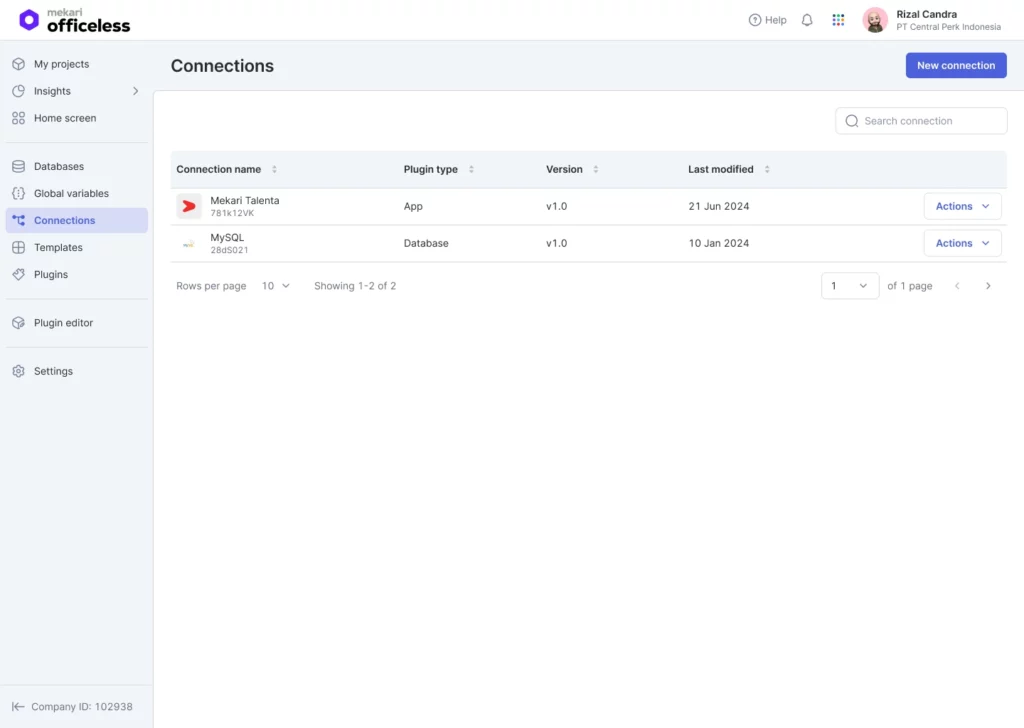
Mekari Officeless is an enterprise software development platform and part of Mekari. It is designed to help organizations build internal applications, automate workflows, and integrate systems within a single connected ecosystem.
With a low-code/no-code approach, Mekari Officeless enables even non-technical teams to develop solutions tailored to operational needs without heavy reliance on engineering resources. This makes it particularly relevant for enterprises in Indonesia that require both high flexibility and adherence to local regulatory requirements.
Key feature of Mekari Officeless:
- No-code database and form builder: Accelerate application development with a unified framework that combines structural data modeling and intuitive form design enabling teams to build and manage databases without engineering overhead.
- Rapid app configuration and deployment: Configure and deploy functional business applications through intuitive interfaces that ensure a consistent web and mobile experience, reducing delivery timelines without sacrificing quality.
- Visual workflow automation: Orchestrate complex business logic through a visual workflow engine that automates cross-system processes from approvals to integrations for autonomous execution across the entire enterprise.
- Self-service analytics and reporting: Configure professional-grade dashboards and reports through intuitive toolsets, transforming operational data into actionable insights without reliance on technical teams.
- OpenAPI, webhook, and native data integration: Establish a secure, unified data foundation by connecting Mekari Officeless with existing systems, third-party tools, and legacy infrastructure via API, Event, and Webhook support.
Best for: Enterprises in Indonesia that need a flexible platform to build internal applications and integrate systems within a unified, scalable business ecosystem.
2. AWS App Runner
Amazon fully managed container service removes the infrastructure burden from application deployment entirely. Development teams push code, and App Runner handles provisioning, load balancing, scaling, and certificates.
It integrates natively with the broader AWS ecosystem, making it a natural fit for organizations already running workloads on AWS.
Key features:
- Fully managed deployment that automatically provisions infrastructure, handles load balancing, TLS certificate management, and horizontal scaling from source code or container images
- VPC connectivity and private endpoints that provide secure access to databases, cache services, and other backend resources within a Virtual Private Cloud (VPC)
- Deep AWS AI/ML integration with native support for Amazon Bedrock, SageMaker, and other AWS AI services enabling AI-powered enterprise applications with minimal additional configuration
Best for: Organizations standardized on AWS infrastructure seeking simple, fully managed container deployment without Kubernetes complexity
3. Red Hat OpenShift Container Platform
Built on enterprise Kubernetes, OpenShift provides a consistent development and operations experience across on-premise, private cloud, and hybrid cloud environments.
Its enterprise security posture, supported by Red Hat open-source ecosystem, makes it a strong choice for large organizations managing complex multi-environment infrastructure.
Key features:
- Hybrid and multi-cloud deployment that delivers a consistent platform experience across on-premise, private cloud, and public cloud environments
- Enterprise-grade security and RBAC with built-in role-based access control, enterprise authentication through LDAP, Active Directory, and SAML, network policy enforcement, and an integrated image registry with vulnerability scanning
- Comprehensive backup, recovery, and high availability with enterprise disaster recovery capabilities, automated failover, and high-availability configurations for mission-critical workloads
Best for: Large enterprises managing complex, multi-environment infrastructure across on-premise and cloud
4. Northflank
Northflank unified development environment consolidates CI/CD, databases, caching, logging, and deployment into a single platform eliminating the context-switching that slows modern engineering teams.
Key features:
- Bring Your Own Cloud (BYOC) with multi-cloud support enabling deployment on managed Northflank infrastructure or integration with AWS, GCP.
- Unified CI/CD, databases, and deployment with built-in GitOps pipelines, managed databases such as PostgreSQL, Redis, and MongoDB.
- Enterprise security and compliance with audit logs, role-based access control, automated vulnerability scanning, enterprise SSO through SAML 2.0.
Best for: Engineering teams wanting to consolidate their CI/CD, infrastructure, and deployment toolchain into a single environment
5. Microsoft Azure App Service
Azure App Service is Microsoft’s PaaS offering for building and hosting web applications, REST APIs, and mobile backends in virtually any programming language.
Its deep integration with Microsoft DevOps, Active Directory, and the wider Azure ecosystem makes it particularly compelling for enterprises already invested in the Microsoft stack.
Key features:
- VNet integration and private endpoints with secure access to internal resources and isolated App Service Environment (ASE) deployment within a customer VNet
- Microsoft Entra ID and RBAC with native identity management, single sign-on, and centralized role-based access control
- GitHub Actions and Azure DevOps CI/CD with automated pipelines, deployment slots, and controlled rollbacks
Best for: Microsoft-centric enterprises with existing investments in Azure infrastructure, DevOps, and identity management
6. Salesforce
Salesforce has evolved from a CRM into a full enterprise application platform. Its Agentforce 360 environment enables teams to build AI-powered applications on top of a unified customer data foundation, bridging CRM capabilities with custom application development.
Key feature:
- Agentforce AI application development for building AI-powered apps and autonomous agents using natural language and visual tools with embedded Einstein AI capabilities
- Unified Customer Data Platform (Data Cloud) that consolidates data from multiple systems into a single real-time customer profile
- No-code Flow Builder for automating multi-step workflows across departments without writing code
Best for: Customer-experience-led enterprises extending CRM into AI-powered application development
7. OutSystems
OutSystems is a high-performance low-code platform designed for enterprise application delivery across CRM extensions, ERP customization, BPM automation, and bespoke applications.
Key features:
- AI-assisted development with Mentor that generates full applications from natural language input
- Full-stack low-code development covering web, mobile, APIs, integrations, and databases with enterprise-grade governance
- Built-in enterprise security with encryption, RBAC, MFA, and compliance including ISO, SOC, GDPR, PCI DSS, and FedRAMP
Best for: Enterprise IT teams needing to accelerate delivery of complex, mission-critical applications
8. Mendix (Siemens)
Mendix describes itself as the only low-code platform designed to address the full complexity of enterprise software development. Backed by Siemens, it has particular strength in manufacturing, industrial, and logistics contexts, where complex operational workflows require both business configurability and technical depth.
Key features:
- Dual-IDE development model enabling collaboration between business users and developers in parallel
- Cloud-native and Kubernetes-native architecture supporting hybrid, public, and private cloud deployments
- Mendix Data Hub enabling federated access to external enterprise data sources without complex migration
Best for: Industrial and enterprise organizations requiring complex workflow automation and deep system integration
Read more: Enterprise Software Development Guide: The 2.5-Year ROI PathBest enterprise application platform for businesses in Indonesia
Choosing the right enterprise application platform is ultimately a decision about how an organization wants to grow. Each platform covered in this guide represents different trade offs ranging from infrastructure control and development speed to ecosystem depth, compliance coverage, and the level of business user involvement in application development.
Mekari Officeless is a low-code/no-code enterprise application platform, part of Mekari unified software ecosystem, designed specifically to help Indonesian enterprises build custom internal applications, automate workflows, and integrate with existing systems without heavy development resources or long delivery timelines.
Mekari Officeless offers:
- Secure by design: Enterprise-grade security embedded at every layer ISO 27001 certified, with role-based access control and compliance built in to safeguard data privacy and business integrity.
- Scalable and reliable: Automatic resource scaling ensures system performance stays consistent under any load, supporting business growth without manual infrastructure intervention.
- Logical configuration: Declarative configuration over complex programming keeps the focus on business rules minimizing technical debt and reducing dependency on engineering resources.
- Amplified development: Configurable interfaces and pre-built components speed up solution delivery while maintaining architectural consistency across all enterprise applications.
- Data as a shared asset: API and database connectivity orchestrate real-time interoperability across systems, ensuring data currency and organizational alignment at every touchpoint.
For enterprises facing gaps between off-the-shelf software capabilities and real operational needs, Mekari Officeless provides a flexible development layer to close that gap while remaining fully integrated with the broader Mekari ecosystem, including HR, accounting, tax, CRM, and spend management solutions.
Consult Mekari Officeless to your existing infrastructure and start building the internal applications your enterprise actually needs.
References and methodology
Methodology
Methodology
Articles published by Mekari Desty are developed using trusted sources, including official data, company reports, academic research, and insights from industry practitioners. Whenever possible, we refer directly to primary sources before drawing conclusions. Our editorial team reviews and verifies the information to ensure accuracy and relevance. All references are listed so readers can trace each piece of information back to its original source.
Our editorial standards
Our editorial standards
- Primary source first: We consult official product documentation and pricing pages directly, not secondhand summaries or aggregator sites.
- Fact-checking: All product features, pricing, and claims are cross-verified against each platform’s official website at the time of writing.
- No paid placement: Tools are selected based on relevance and fit for Indonesian businesses, not commercial arrangements. Mekari Desty is included as a first-party product and is transparently labeled as such.
- Regular review: Articles are periodically updated to reflect product changes or shifts in market relevance.

