




Mekari Insight
- Technical debt management focuses on managing technical debt in a measurable and controlled way. Technical shortcuts can be a rational business decision as long as the debt remains transparent, measurable, and properly managed before it begins to hinder system scalability.
- Classifying issues is an important part of technical debt management. Companies need to distinguish technical debt from other types of problems such as features, UX, quality, or process issues so that improvements can focus on the root cause.
- Low-code and no-code platforms help reduce technical debt from the early stages of development. With a standardized and iterative approach, platforms like Mekari Officeless, which democratize the creation of business applications, workflow automation, and analytics, enable companies to build innovative and scalable solutions.
Behind applications that keep adding new features and systems that are expected to adapt quickly, there is a technical risk that often goes unnoticed: technical debt. It usually arises from quick decisions made to meet deadlines and short-term business needs.
At first, these shortcuts may seem helpful. But over time, they can slow down development, increase costs, and make even small changes more complicated much like financial debt that continues to accumulate interest.
This article explains what technical debt really is, how to identify and control it through technical debt management, and practical strategies to reduce it by up to 50% without sacrificing the speed of innovation.
What is technical debt management?
Technical debt refers to future costs caused by taking shortcuts in software development. The term was introduced by Ward Cunningham to describe the trade-off between delivery speed and code quality.
In this context, technical debt management refers to a set of practices used to identify, measure, prioritize, and reduce technical debt.
Just like financial debt, technical debt must eventually be “paid back,” often in the form of refactoring, bug fixing, or higher maintenance costs.
In practice, technical debt occurs when teams choose quick solutions such as hardcoding, skipping testing, or implementing minimal design to meet deadlines or launch products earlier.
These decisions are not always wrong, especially when the goal is to accelerate time-to-market and validate products quickly. However, it is important to recognize that:
- Technical debt can hinder long-term development
- It can make systems increasingly difficult to modify
- It requires gradual repayment through code improvements
If left unmanaged, technical debt can make development more complex and expensive over time. Therefore, teams need to make this debt transparent, communicate it to non-technical stakeholders, and create realistic repayment strategies.
The goal is not to eliminate it immediately, but to reduce it consistently over time. A technical debt management approach helps organizations control the accumulation of debt gradually without disrupting product delivery.gi.
The most common causes of technical debt
Technical debt often forms without being noticed. It usually doesn’t come from one major decision, but from the accumulation of many small decisions made under operational pressure and fast-changing business dynamics. Some of the most common causes include:
- Tight deadlines: Pressure to release products quickly often leads teams to choose temporary solutions. The problem is that these quick fixes are rarely revisited and eventually accumulate into technical burdens.
- Compromised testing: Skipping or minimizing testing may save time in the early stages, but bugs that slip through often create repeated work and slow down development in the long run.
- Misaligned communication: Unclear requirements, sudden scope changes, or assumptions that are never validated can cause developers to build solutions that do not fully match business needs.
- Skill or experience gaps: When teams work with technologies they have not fully mastered, the solutions implemented are often not optimal and require significant improvements as technical understanding grows.
Constantly evolving product direction: Code that is relevant today may not align with future product strategies. Without proper adjustments, that code can eventually turn into technical debt.
Types of technical debt and what is not considered technical debt
With clear classification, companies can manage each type of debt proportionally within a technical debt management framework, rather than treating every issue as technical debt.
1. Types of Technical Debt
Technical debt refers to technical issues that progressively slow down development. In practice, it can appear at different layers of the product development process.
Based on components in the development process
- Non-scalable architecture: System designs that are too monolithic, tightly coupled, or not modular, causing even small changes to have wide-reaching and risky impacts.
- Inconsistent code structure: Different naming conventions, coding patterns, or standards across modules or teams make the code harder to understand and maintain.
- Duplicated logic: Business logic copied into multiple places instead of being refactored into reusable components, making updates repetitive and inefficient.
- Excessive code complexity: Layered conditionals, tightly interconnected dependencies, or execution flows that are difficult to follow increase the risk of errors during changes.
- Low or irrelevant test coverage: A lack of unit tests or integration tests, or tests that do not reflect real scenarios, makes refactoring more costly and risky.
- Minimal or outdated technical documentation: Insufficient documentation for architecture, APIs, or technical decisions slows onboarding and traps knowledge within specific individuals.
- Ignored code smells: Code patterns that technically work but are unhealthy, such as overly long methods, classes with too many responsibilities, or unnecessary dependencies.
Based on how technical debt occurs:
- Deliberate debt: Shortcuts taken intentionally to speed up delivery. These decisions are usually based on clear business considerations but still create work that must be addressed later.
- Accidental debt: Technical debt that arises unintentionally due to miscommunication, incorrect assumptions, or limited technical experience.
- Bit rot: Code that was initially healthy but gradually deteriorates due to dependency changes, feature additions, or system evolution without sufficient maintenance.
Issues that are not technical debt
It is important to distinguish technical debt from other types of “debt” so that the solutions applied target the right problems.
- Feature debt: Occurs when features are delayed, reduced in scope, or need to be rebuilt. For example, a feature that must be redesigned entirely because market response does not match initial expectations.
- User experience debt: Arises when the UI/UX fails to support user workflows or business goals. The system may function technically but does not deliver an effective user experience.
- Quality debt: Bugs, errors, or crashes caused by defective code or insufficient testing.
- Process debt: Inefficient, inconsistent, or poorly defined work processes within the development workflow.
Baca Juga: Enterprise Application Modernization: Guide & Key StrategiesStrategies to reduce technical debt
Technical debt cannot be resolved through a single large initiative. An effective technical debt management approach is usually built through consistent technical practices across both team and organizational levels.
1. Prioritize and triage technical debt
Not all technical debt has the same level of urgency. Some can be postponed, while others may threaten system stability if left unresolved.
These issues are often found in parts of the codebase that are frequently modified, frequently problematic, or consume the most development time. With clear prioritization, improvement efforts can focus on areas that pose the greatest risk to both the system and the business.
2. Refactor continuously
Whenever code is modified whether for adding features or fixing bugs—it presents a good opportunity to clean it up.
Small improvements made consistently can prevent larger technical issues from accumulating in the future.
3. Allocate dedicated time within sprints
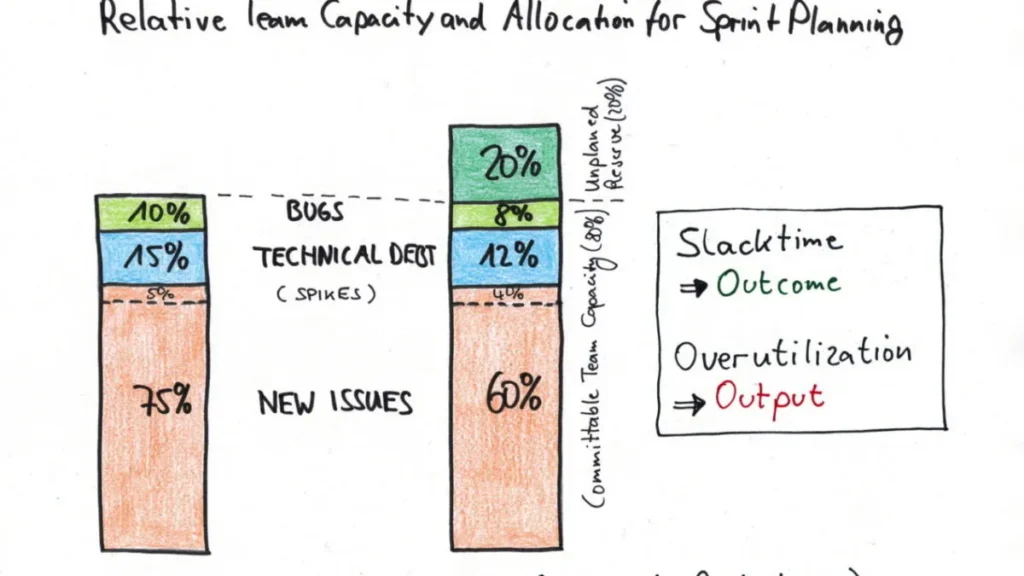
Technical debt should be included in planning, not just listed in the backlog.
By allocating a portion of sprint capacity or workflow time regularly, teams can gradually reduce technical debt without sacrificing product delivery.
4. Reduce manual work through automation
Automation helps teams detect issues earlier and maintain consistent quality. Tools for testing, code analysis, and deployment accelerate feedback loops while reducing the risk of new technical debt entering production unnoticed.
5. Build technical awareness across the team
Technical debt is not the responsibility of a single individual or role. Organizations need to educate teams about how technical debt can affect profitability and long-term performance.
When all team members understand its impact on development speed, system stability, and long-term costs, technical decisions become more disciplined from the start.
6. Keep technology relevant and well documented
Outdated dependencies and neglected documentation are common sources of technical debt.
Regular technology updates help maintain system security and performance, while clear documentation simplifies maintenance, onboarding, and technical decision-making.
7. Consider adopting low-code and no-code with proper governance
Low-code and no-code platforms can help reduce and control technical debt through more structured development, especially for internal applications and operational workflows.
Development becomes faster and changes are easier to implement. However, without clear rules and governance, this approach may create new debt at the architectural and system control levels.
Baca Juga: Enterprise Data Integration: Methods & SolutionsHow low-code and no-code can reduce technical debt
Low-code and no-code platforms are not a replacement for engineering they are a force multiplier. With proper governance, this approach helps companies move faster without accumulating excessive technical debt.
1. Healthier iterative workflows
Low-code and no-code enable faster iteration without compromising the technical foundation. Teams can generate production-ready code from design, evaluate it, then improve and repeat the process easily.
Because iteration is no longer expensive or complex, teams are less likely to take technical shortcuts that typically lead to technical debt.
2. Democratizing application development
With low-code and no-code platforms, application development is no longer exclusive to engineering teams. Product managers, business analysts, and designers can directly participate in building and validating solutions.
As a result, business requirements are captured more accurately from the beginning, miscommunication is reduced, and engineers no longer need to patch solutions that were built in the wrong direction one of the most common sources of technical debt.
3. More efficient IT team workflows

Low-code and no-code help IT teams allocate resources more effectively. Internal application backlogs can be reduced, delivery becomes faster, and engineers can focus on architecture, integration, and system security.
With a more balanced workload, technical quality is better maintained and the risk of accumulating new technical debt is reduced.
4. Rapid Application Development (RAD) without technical shortcuts
Low-code and no-code support Rapid Application Development (RAD) by providing ready-to-use components and automated production code generation.
Teams can build applications much faster than with traditional hand-coding, without sacrificing structure and maintainability. Development speed improves while technical debt remains under control.
Baca Juga: Top 10 Enterprise Workflow Automation SoftwareOptimizing technical debt with low-code and no-code app builders
Low-code and no-code platforms help companies reduce technical debt by making application development more standardized and sustainable, without relying on technical shortcuts.
From a business impact perspective, this approach has already been supported by data:
- Up to 70% cost reduction compared to traditional development methods, based on a Mendix study
- 50%–90% faster development time, according to 451 Research, while also reducing reliance on limited IT talent
From a technical standpoint, low-code/no-code app builders contribute by:
- Reducing complexity and excessive custom code
- Maintaining consistent architecture and development practices
- Enabling easier iteration without creating new technical debt
- Lowering long-term maintenance costs
For a more controlled implementation, Mekari Officeless can be a relevant solution.
Mekari Officeless is a low-code/no-code app builder platform that democratizes the creation of business applications, workflow automation, and analytics. It enables companies to build innovative and scalable solutions that support measurable growth.
With Mekari Officeless, companies can:
- Reduce backlog and the workload of IT teams
- Accelerate internal application delivery
- Manage technical debt from the design and development stages
Learn more about the solutions offered by Mekari Officeless.
References
Atlassian. ”Say ‘bye’ to tech debt: Agile solutions for clean development”
vFunction. ”How to Reduce Technical Debt: Key Strategies”
