



Mekari Insight
- Multi-site operations present unique challenges that multiply as businesses grow. Without proper systems, organizations face inconsistent service delivery, communication breakdowns, and limited visibility all of which directly impact customer satisfaction and profitability.
- The shift from manual to digital operations management delivers measurable results. Organizations that digitalize checklists report 75% fewer operational errors and 30% productivity gains, while gaining real-time visibility across all locations.
- Looking to bring consistency and control to your multi-site operations? Mekari Officeless Operations Checklist Management provides standardized checklists, automated issue tracking, and real-time dashboards purpose-built for organizations managing distributed locations.
Managing multiple business locations has become a defining challenge of modern organizational growth. As companies expand across regions — whether through retail chains, manufacturing facilities, restaurants, or service centers — the operational complexity grows faster than the headcount managing it.
Yet 23% of c-suite executives still plan to expand their operations internationally within the next 3–5 years, even amid rising economic and geopolitical uncertainties.
Without a coherent system to hold everything together, each location tends to develop its own way of working–workflows, shortcuts, and interpretation of company standards. This may lead to uneven service quality, compliance risks, operational inefficiencies, and inconsistent customer experiences across locations. Moreover, communication delays, limited visibility, and inconsistent standards make this issue worse.
Multi-site operations management is the strategic approach that addresses this directly. This guide covers everything you need to put this framework into practice, from common challenges and key strategies to the right tools and best practices for every location.
What is multi-site operations management

Multi-site operations management is the process of organizing, coordinating, and operating multiple business locations from a central point while maintaining consistent standards, productivity, and brand identity across every site while addressing the unique challenges each location brings.
Rather than letting each location run independently, this approach creates a unified operational framework that applies across the entire network.
In practice, multi-site operations take many forms, including:
- Retail chains with stores spread across regions
- Manufacturing facilities operating in diverse locations
- Contact centers distributed across different time zones
- Restaurant chains managing multiple branches
- Service companies with regional offices serving different markets
What all these operations share is the same core challenge, which is how to keep every site aligned without sacrificing the speed and adaptability that local teams need.
That’s precisely what multi-site operations management addresses. Multi-site operations management could enable businesses to maintain consistent branding, enhance productivity, and scale efficiently, all while responding to each location’s unique circumstances.
Whether you’re already managing distributed locations or planning expansion, it’s the foundational approach that determines whether growth adds real value or simply more complexity.
5 common challenges in multi-site operations
Managing multiple locations without the right systems in place creates a predictable set of problems. Here are five of the most common challenges businesses face — and why they tend to get worse the longer they go unaddressed.
1. Operational Inconsistency
Without written standards, every team in a multi-site operation develops its own way of working. One location may follow procedures closely while another cuts corners, leading to uneven service quality, compliance risks, and frustrated customers.
However, this inconsistency is rarely intentional. It emerges gradually as each team across different sites adapts processes to their own context, fill in gaps left by unclear guidelines, or simply develop habits over time.
The result is a network of locations that share a brand name but operate independently, undermining the consistency that effective multi-site operations are built to deliver.
2. Communication breakdowns
Keeping distributed teams informed and aligned is harder than it looks.
Email chains and in-person meetings may work when you only have one or two sites — but these channels become increasingly inadequate as the network grows, particularly when expanding overseas.
Common communication breakdowns in managing multi-site operations include:
- Time zone differences that make it difficult to schedule real-time meetings or get timely responses to urgent issues
- Information buried in email chains that get lost or ignored overnight, leaving site teams acting on outdated guidance
- Language and cultural barriers in international operations that add another layer of complexity to even routine communication
With 23% of c-suites executives planning on international expansion, these communication challenges are becoming increasingly relevant for businesses that previously only operated domestically.
Without structured communication systems, the gap between what headquarters intends and what sites actually do widens with every location added.
3. Limited Real-Time Visibility
Leaders often “fly blind” without knowing what’s happening on the ground. Reports arrive late or not at all, and by the time leadership reviews performance, problems have already grown larger across multiple locations.
The danger of limited visibility isn’t just that problems go undetected, but also that management is forced to react rather than act.
Decisions get made based on incomplete information, and by the time the full picture emerges, the cost of fixing the problem has already multiplied across sites.
4. Performance tracking difficulties
Without the right systems, measuring performance across multiple sites is very difficult and complicated.
It becomes challenging to compare vendor costs, repair times, and service quality in any consistent way across locations.
Moreover, when data is fragmented or reported inconsistently, insights get skewed and making it even harder to identify where problems actually lie, let alone resolve them.
5. Employee Engagement Issues
Another problem in having a business with several offices is that staff at remote sites often feel disconnected from the larger company.
This disconnect leads to low engagement, which in turn drives up turnover and training costs.
Beyond that, employees who don’t feel connected to the broader organization are also more likely to interpret instructions in their own way.
They default to local habits rather than company-wide standards, quietly undermining the consistency that multi-site management depends on.
Why these challenges compound over time
Almost all multi-site management challenges stem from the same root cause, which is decentralization.
The more sites added to the operations, the harder it becomes to maintain oversight, ensure consistency, and prove compliance.
Companies without proper systems risk fracturing into disparate pieces, and what worked with a handful of sites rarely scales to dozens or hundreds.
- The more locations added, the harder it is to maintain oversight
- Inconsistencies become entrenched habits rather than isolated incidents
- Visibility blind spots make course-correction increasingly costly
- Disengaged employees drift further from company-wide standards over time
Without the right systems in place, these challenges don’t just persist, they multiply.
7 Key Strategies for Effective Multi-Site Operations
Understanding the challenges is the first step toward building better multi-site operations. The second is having a clear plan to address them. The following strategies provide a practical framework for managing multiple locations in a way that is consistent, visible, and scalable, regardless of how many sites you oversee.
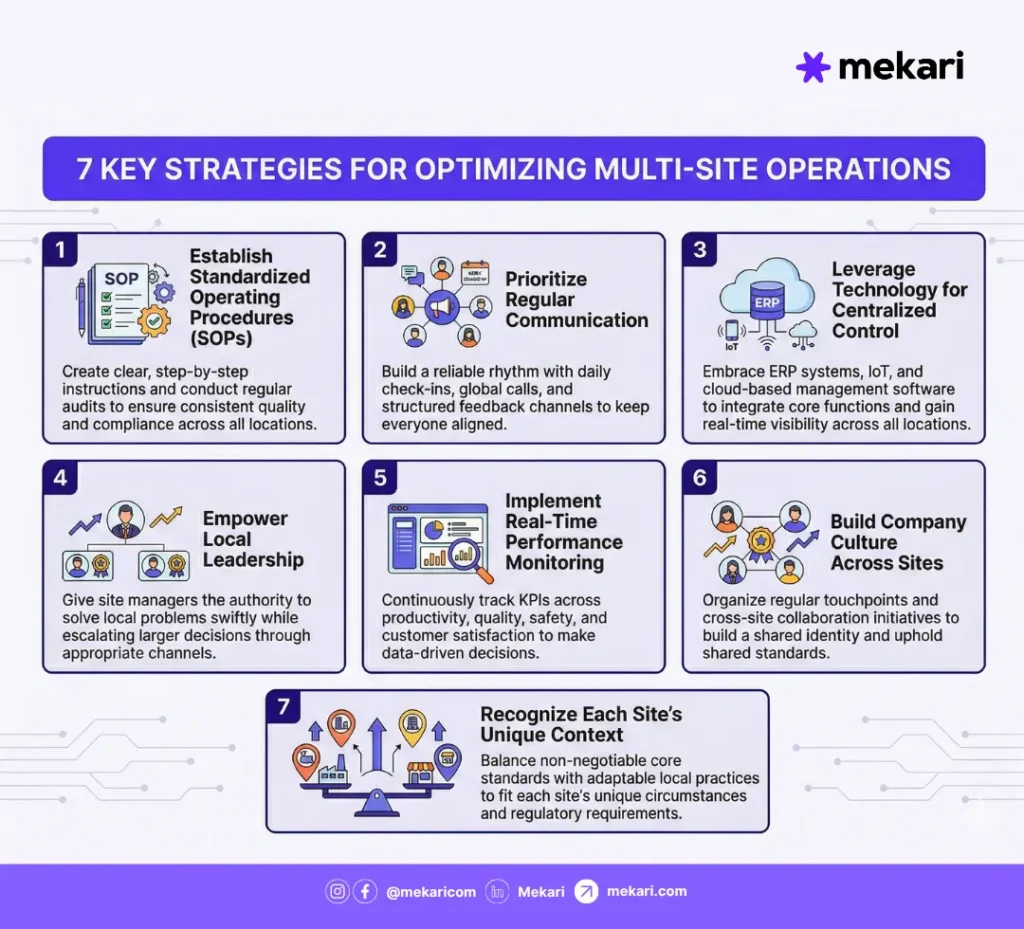
1. Establish Standardized Operating Procedures (SOPs)
Without written standards, every site develops its own way of working, leading to uneven service quality, compliance risks, and frustrated customers.
Standardized Operating Procedures (SOPs) are the antidote to that. By creating clear, step-by-step instructions for key processes, businesses ensure that tasks are completed the same way regardless of which location or employee is involved.
To be effective across a multi-site network, SOPs should:
- Cover the most critical operational areas including maintenance activities, safety checks, and customer interactions
- Be written in plain and accessible language that staff at any site can follow without ambiguity
- Require documented confirmation of completion, such as photos, timestamps, or digital sign-offs
- Include clear escalation paths so teams know who to contact when something goes wrong
- Be subject to regular audits to confirm compliance and surface gaps before they become habits
SOPs serve as a guiding framework, ensuring that the quality of products or services remains consistent regardless of the site location.
2. Prioritize Regular Communication
Regular communication between leadership and site teams is crucial for keeping everyone aligned. But as the network grows, informal updates and scattered email threads are no longer sufficient.
Therefore, building a reliable communication rhythm across sites becomes essential — and that means going beyond ad-hoc updates. A structured approach typically includes:
- Daily check-ins between site leaders and their teams to maintain alignment on immediate priorities
- Monthly global calls that bring all sites together to share updates, address shared challenges, and reinforce company-wide direction
- Dedicated feedback channels that give employees at every level a structured way to surface issues or ideas
- Video conferencing for more personal, face-to-face communication when in-person meetings aren’t possible
The goal isn’t just more communication, but more structured communication. When every site knows when and how information flows, fewer things fall through the cracks.
3. Leverage technology for centralized control
Technology is what makes it possible to manage complexity across multiple sites at scale. Various tools help teams stay connected, while ERP systems integrate functions such as inventory, finance, and sales into a single system, enabling cross-functional analysis for better decision-making.
Key technologies that support centralized multi-site control include:
- ERP systems that consolidate core business functions — inventory, finance, and sales — into a single, connected platform
- IoT devices that track inventory levels, monitor deliveries, and provide real-time operational data from the ground up
- Multi-site management software that gives leadership centralized dashboards for real-time visibility across all locations
- Cloud-based solutions that keep employees connected and data accessible from anywhere, at any time
Embracing technological integration empowers leaders to make informed decisions and ensures efficient coordination across all sites.
4. Empower local leadership
Centralized management sets the direction, but it’s local leaders who keep operations moving on the ground.
Hiring reliable site leaders and communicating with them regularly provides crucial insight into what’s actually happening at each location — the kind of detail that rarely surfaces in reports alone.
Equally important is giving those leaders real authority. Local leaders need the authority to solve smaller problems without waiting for corporate approval, as this reduces delays and helps operations move forward.
This means setting clear thresholds — spending limits, vendor decisions, operational adjustments — within which site managers can act independently, while escalating larger decisions through the appropriate channels.
The result is a management structure that moves at the speed the business needs, without sacrificing oversight.
5. Implement real-time performance monitoring
What gets measured gets managed — and in multi-site operations, measurement needs to happen continuously, not just at the end of the month.
Real-time monitoring helps compare operations across sites and allows management to respond before problems spread.
A robust performance monitoring approach should track KPIs across four key dimensions:
- Productivity: Output rates, task completion times, and throughput per site.
- Quality: Error rates, compliance scores, and service consistency metrics.
- Safety: Incident rates, inspection results, and corrective action completion.
- Customer satisfaction: Feedback scores, complaint volumes, and resolution times.
Pairing real-time monitoring with these indicators highlights trends across the network, reveals improvement opportunities early, and gives leadership the data needed to make decisions with confidence rather than guesswork.
6. Build Company Culture Across Sites
Operational consistency is easier to maintain when people feel connected to something larger than their immediate location.
Organizing regular touchpoints — both in-person and virtual — helps build that sense of shared identity across a distributed network. These can take several forms:
- Annual inter-facility events that bring teams together, whether business-oriented like conferences and knowledge-sharing sessions, or social like team gatherings and competitive activities
- Virtual team-building for geographically dispersed organizations where in-person events aren’t always feasible
- Cross-site collaboration initiatives that give employees from different locations the chance to work together on shared projects or goals
When employees across different sites feel part of the same mission, they’re more likely to uphold shared standards — not because they’re required to, but because they understand why those standards matter.
7. Recognize each site’s unique context
Standardization is essential, but it should never come at the expense of local relevance.
Each facility faces different challenges based on size, location, and equipment. For international operations, customs, cultures, and local regulations add another layer of complexity.
Effective multi-site management means knowing what to standardize and what to adapt. The distinction typically falls along these lines:
- Non-negotiables: Core standards, brand identity, compliance requirements, and safety protocols should be consistent across every location.
- Context-dependent: Scheduling practices, vendor relationships, community engagement, and local regulatory requirements should be adapted to fit each site’s unique circumstances
Getting this balance right is what separates organizations that scale smoothly from those that impose uniformity at the cost of local effectiveness.
Benefits of effective multi-site operations management
When multi-site operations are managed well, the results are measurable across every layer of the business. Key benefits include:
- Operational consistency: Uniform service delivery and brand experience across all locations.
- Improved compliance: Built-in rules enforce company policies and regulatory requirements automatically.
- Real-time visibility: Centralized dashboards provide instant insight into operations across all sites.
- Cost efficiency: Reduced overhead through centralized management and resource optimization.
- Scalability: New locations can be added without proportionally increasing headcount or complexity.
- Enhanced employee engagement: Connected teams with clear standards feel part of a larger mission.
- Better decision-making: Data-driven insights enable faster, more accurate management decisions.
- Stronger audit trail: Every action is logged for compliance, reporting, and continuous improvement.
The Role of Digital Checklists in Multi-Site Operations
The benefits and strategies outlined above don’t materialize on their own. They require consistent execution at the site level, and that execution depends on how well standards are documented, distributed, and tracked.
That’s where digital checklists make the difference for multi-site operations management.
From paper to digital
Paper-based checklists create more problems than they solve at scale. A recent study reveals that 23% of operators’s time is lost due to handling paper documents, through searching for misplaced files, manual data entry, and transcription errors.
Updates are slow, version control is unreliable, and by the time a completed paper checklist reaches the right person, the information is already stale.
The shift to digital changes this fundamentally.
Checklist digitalization reduces operational errors by 75% and delivers an average productivity gain of 30% after implementation, with a positive ROI observed in less than six months.
For organizations managing multiple sites, these gains multiply. This is because every improvement applied to one location can be instantly replicated across the entire network.
Key capabilities of digital checklist systems
A well-designed digital checklist system for multi-site operations should include:
- Standardized checklist templates that define questions, answer options, and scoring consistently across all sites
- Scheduled and ad-hoc inspection execution to handle both routine compliance checks and unplanned audits
- Real-time issue tracking and resolution so problems are flagged and followed up immediately, not buried in paper trails
- Automated compliance monitoring and reporting that removes the manual effort of compiling audit evidence
- Evidence documentation with photos and timestamps to create verifiable, audit-ready records for every inspection
Why digital checklists matter for multi-site operations
Individually, each of these capabilities is valuable. But together, they solve the core problem that undermines most multi-site operations, which is the gap between what standards say should happen and what actually happens on the ground.
Digital checklists also ensure every location follows the same inspection standards and automatically surface issues when those standards aren’t met. Moreover, they give leadership a real-time view of compliance status across every site, not weeks later but as it happens, while creating audit trails that keep the organization ready for regulatory review at any time.
For organizations managing distributed locations at scale, this also makes it possible to compare performance across sites meaningfully, turning visibility into a tool for continuous improvement rather than just damage control.
Multi-site operations management software: what it is and what to look for
Multi-site operations management software is a centralized platform that enables businesses to standardize, execute, monitor, and report on operational activities across multiple locations from a single system.
Rather than relying on scattered spreadsheets, email threads, and paper-based processes, organizations use this type of software to ensure every site operates according to the same standards.
Thus, multi-site operations management software provides full visibility into compliance, performance, and issues in real time.
For businesses managing distributed locations, the right software acts as the connective tissue between headquarters and the ground. It replaces guesswork with data, and reactive problem-solving with proactive oversight.
When evaluating options, these are the core features to look for in a multi-site operations management software:
- Centralized site database: The ability to store and manage all location information in one place, including operational status, addresses, area metrics, and assigned personnel
- Standardized checklist configuration: Tools to define categories, questions, answer options, scores, and mandatory evidence requirements that apply uniformly across all sites
- Scheduling and approval workflows: Structured processes for managing activity requests, approvals, and revisions to ensure all activities are formally reviewed before execution
- Digital checklist execution: The ability to perform inspections from any location, complete checklist forms, attach evidence, and automatically calculate scores
- Issue tracking and resolution: Automated issue generation from checklist failures, with tracking from detection through to resolution and SLA timers to ensure accountability
- Performance dashboards: Real-time visualization of compliance status, issue trends, resolution rates, and site-level comparisons for instant monitoring and analysis
- User access management: Granular control over who can view, execute, and manage operational activities across the organization
- Integration capabilities: The ability to connect with existing ERP, accounting, and HR systems to avoid data silos and support end-to-end operational workflows
How Mekari Officeless Can Streamline Your Multi-Site Operations
Managing operations across multiple locations doesn’t have to feel overwhelming.
Mekari Officeless Operations Checklist Management prebuilt software provides an integrated, end-to-end system to standardize, schedule, and execute operational checklists across all your sites, with real-time visibility and automated issue tracking built in from the ground up.
This prebuilt solution from Mekari Officeless comes with five core capabilities:
- Site database: Acts as a central repository for all location records, storing operational status, physical addresses, area metrics, and assigned personnel. It provides an overview of active versus inactive sites across the entire network, ensuring all location data is accessible and consistently managed.
- Scheduling management: Manages the entire lifecycle of operational activities from initial request to final reporting. Requests go through a formal approval process before checklists are generated and assigned, with status tracking across Draft, Awaiting Approval, Approved, and Rejected stages for full transparency.
- Checklist operations: The primary interface for executing inspections and updating operational status. Checklists can be generated automatically from approved schedules or created ad-hoc for immediate needs, with digital execution that allows users to answer questions, add remarks, upload evidence, and receive an auto-calculated final score upon submission.
- Issue management: Automatically generates a trackable issue whenever a checklist item fails, ensuring no problem goes unnoticed. Each issue moves through a documented resolution workflow from detection to corrective action, with resolved items archived to preserve a full audit trail of every problem and its solution.
- Dashboard and analytics: Provides a high-level visual summary of issue and checklist performance across all operations. Filters by site, schedule, category, and date range allow management to drill down into specific data, track issue growth and resolution rates over time, and identify which locations require immediate attention.
Beyond its core capabilities, Mekari Officeless Operations Checklist Management is part of the Mekari’s unified software ecosystem, enabling it to connect seamlessly with other Mekari products, giving organizations a unified operational foundation where data flows across functions rather than sitting in separate systems.
Ready to bring consistency and visibility to your multi-site operations? See how Mekari Officeless Operations Checklist Management can unify your operations with standardized checklists, automated issue tracking, and real-time visibility across every site.
References
Whale. “How to Manage Multi-Site Operations: A Comprehensive Guide”
Trilium. “7 Tips to Improve Multi-Site Operations Management”
Claromentis. “6 Common Multi-Site Management Challenges (And How to Fix Them)”

