




Mekari Insight
- Generative AI in financial services is a productivity infrastructure that automates credit decisioning, fraud detection, accounts payable, and compliance reporting through large language models (LLMs) at a scale and speed that manual operations cannot match.
- McKinsey estimates generative AI could deliver $200–$340 billion in annual value to the banking sector alone, equivalent to 9–15% of operating profits. Yet only 6% of finance functions have achieved scaled deployment, leaving the majority of that value unrealized.
- Mekari brings these generative AI capabilities to Indonesian financial services teams through its unified software ecosystem, combining operational automation, seamless connectivity across business functions, and intelligent reporting that turns financial data into faster, better-informed decisions.
Finance teams are under pressure to deliver more with fewer resources. Yet, most financial operations still rely on manual data entry, spreadsheet models, and rules-based systems that break under volume.
McKinsey estimates that this productivity gap could cost the banking sector up to $340 billion annually in unrealized value — equivalent to 9–15% of sector operating profits.
Generative AI for financial services offers a concrete path forward, enabling finance functions to automate credit decisioning, fraud detection, accounts payable, and compliance reporting at scale. This subfield of AI also helps accelerate digital transformation across the entire financial operation.
Unlike traditional rule-based automation, generative AI learns from patterns across structured and unstructured data, enabling it to handle novel financial scenarios that fixed rules cannot.
This article covers the highest-impact use cases of generative AI, the ROI data behind them, and a practical implementation roadmap for finance teams ready to move beyond manual operations.
What is Generative AI and What It Serves for Financial Services?
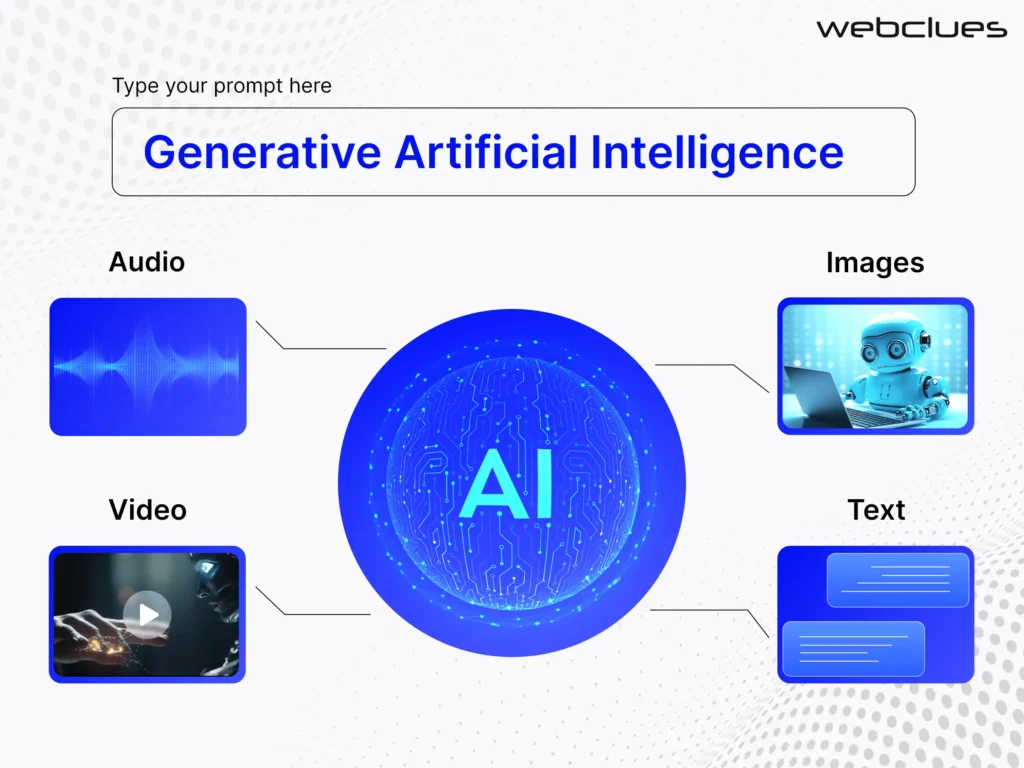
Generative AI is a subset of artificial intelligence that produces new outputs — text, analysis, recommendations, and structured data — from patterns learned across large volumes of input.
Unlike traditional automation that executes fixed rules, generative AI interprets context, adapts to novel scenarios, and generates responses that no predefined ruleset could produce.
In a financial services context, that capability translates directly into credit decisioning, fraud detection, accounts payable automation, compliance reporting, and financial forecasting— across banking, capital markets, fintech, and insurance alike. Financial services also sits in a unique position in this AI adoption curve.
No other industry combines this volume of structured transactional data with the regulatory density that banking, fintech, capital markets, and insurance operate under. That combination is precisely what makes financial sector both the most prepared for generative AI and the most cautious about deploying it.
Gartner predicts that 90% of finance functions will deploy at least one AI-enabled technology solution by 2026, yet only 1% of business leaders describe their generative AI rollouts as mature today.
There are three structural characteristics that explain why generative AI fits financial services better than almost any other sector.
First, financial institutions such as banks, fintech, or capital markets firms generate more structured data per transaction than virtually any other industry. That data density creates the high-quality training signal that generative AI models require to perform reliably.
Second, regulatory frameworks such as AML, KYC, and Basel III produce compliance workflows that are highly repetitive by design. That repetition makes them directly automatable without sacrificing auditability.
Third, the cost of manual errors in credit decisioning, fraud detection, and accounts payable is quantifiable down to the transaction level. That measurability makes AI ROI in financial services easier to justify than in almost any other context.
These conditions are common across financial services, but their intensity varies by organization. The finance functions that stand to gain the most from generative AI share a recognizable set of operational characteristics, such as:
- Your team handles high invoice or transaction volumes that require manual data entry
- Credit reviews or approval workflows regularly exceed three business days
- Compliance reporting consumes significant team hours each reporting cycle
- Fraud detection relies primarily on rules-based systems with high false positive rates
- Financial forecasting is built on spreadsheet models rather than real-time data signals
- Manual reconciliation between AP, procurement, and accounting creates recurring errors
If more than two apply, your finance function has immediate, measurable automation opportunities — the kind that Natural Language Processing (NLP) and Large Language Models (LLMs) are already solving for organizations globally.
Read More: Top 10 Enterprise Workflow Automation SoftwareTop Generative AI Use Cases in Financial Services
Generative AI delivers the most measurable impact in financial services when it is applied to workflows that are high-volume, data-intensive, and historically dependent on manual review.
The six use cases below represent the areas where finance teams are seeing the clearest ROI today — from credit decisioning and fraud detection to accounts payable automation.
1. Credit Risk and Underwriting
Credit decisioning across banking, multifinance, and capital markets has traditionally been constrained by the bandwidth of human analysts. Each application requires synthesizing borrower financials, credit history, market conditions, and increasingly, alternative data sources. That is a process that takes days even when the outcome is straightforward.
Generative AI compresses that cycle significantly.
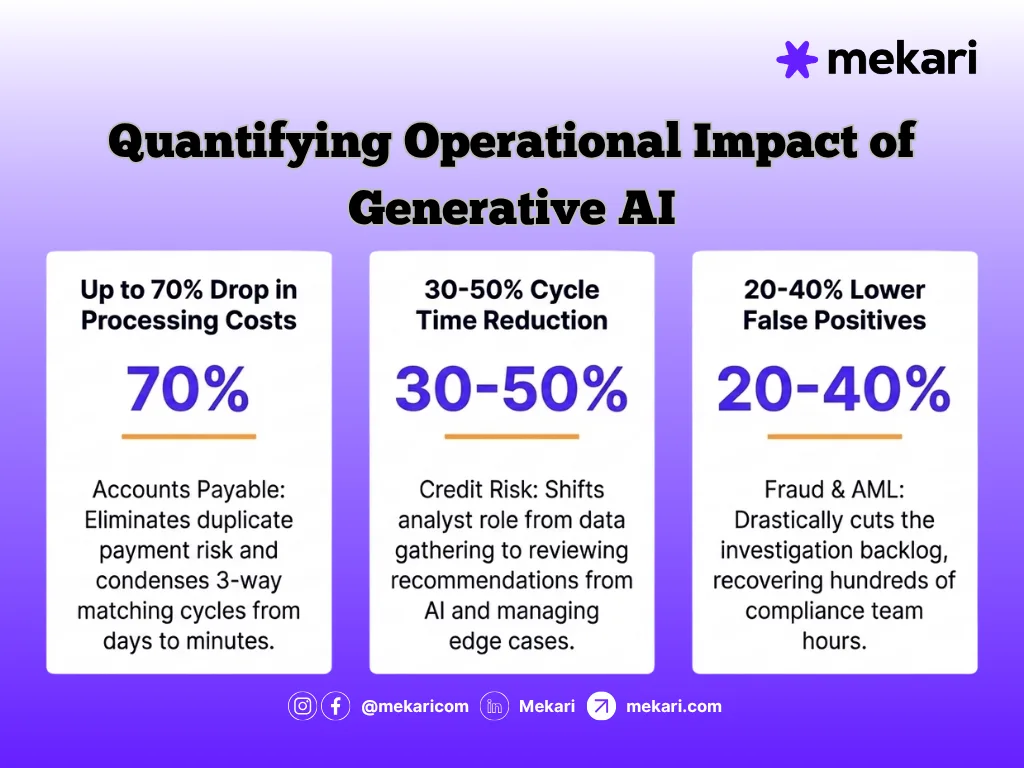
By synthesizing structured and unstructured borrower data into underwriting recommendations, AI-assisted credit systems compress loan decisioning and credit scoring cycles time by 30–50% while improving portfolio quality.
The analyst’s role shifts from data gathering to reviewing AI-generated recommendations and handling edge cases that require contextual judgment.
2. Fraud Detection and AML
Rules-based fraud detection systems across banking, fintech, and payment institutions are built to catch known fraud patterns. The problem is that fraud evolves faster than rules can be updated. And every new scheme goes undetected until it is written into the ruleset.
Generative AI addresses this gap by creating synthetic fraud scenarios for model training, enabling detection systems to recognize novel patterns before they cause losses.
The operational impact is material.
AI-powered AML systems reduce false positive rates by 20–40%, directly cutting the investigation backlog that consumes compliance team capacity.
For institutions processing millions of transactions daily, that reduction translates into hundreds of analyst hours recovered per reporting cycle.
3. Accounts Payable Automation
Accounts payable is one of the highest-friction workflows in any finance function.
Invoices arrive in inconsistent formats, data entry is manual, and three-way matching — reconciling purchase orders, goods receipts, and invoices — is time-consuming enough that payment delays become routine.
AI-powered AP automation uses OCR combined with NLP and LLMs to extract, validate, and route invoice data without manual intervention. Processing costs drop by up to 70%, duplicate payment risk is eliminated through automated validation, and matching cycles that previously took days complete in minutes.
For finance teams managing high transaction volumes, AP automation typically delivers the fastest and most measurable ROI of any generative AI deployment.
4. Customer Service and Wealth Management
Customer-facing financial services have always faced a structural tension: personalized advice is valuable, but human advisors are expensive and finite.
Serving every client with the same depth of analysis that high-net-worth clients receive has never been operationally viable — until generative AI.
AI-powered wealth management tools analyze portfolio performance, market conditions, and individual client goals to produce tailored recommendations at scale. Virtual financial advisors handle routine queries around the clock, reducing cost-per-interaction by 30–60% while maintaining response quality.
The result is not a replacement of human advisors but a reallocation — advisors focus on complex, high-value client relationships while AI handles the volume.
5. Regulatory Compliance and Reporting
Compliance in financial services is not a periodic obligation — it is a continuous operational burden. Regulatory frameworks change frequently, reporting cycles are demanding, and the cost of errors in submissions is significant.
Generative AI addresses those regulatory and compliance problems at multiple points in the compliance workflow. It summarizes regulatory updates and flags gaps against current practices, reducing the time compliance teams spend monitoring changes.
GenAI also auto-generates regulatory reports directly from structured transaction data, cutting manual aggregation hours by 40–60% per reporting cycle. For institutions operating across multiple jurisdictions, where reporting requirements multiply with each market, the compounding time savings are substantial.
For institutions with mature model risk management frameworks, generative AI also creates a more auditable compliance trail — every output logged, traceable, and explainable to regulators.
6. Financial Forecasting and FP&A
Traditional FP&A operates on a backward-looking model. Spreadsheet-based forecasts are built from historical data, updated on fixed cycles, and rarely incorporate external signals in real time.
By the time a forecast reaches decision-makers, the conditions it reflects may already have shifted. Generative AI replaces that static model with dynamic, scenario-based forecasting that synthesizes internal financial data with live market signals.
Finance teams using AI forecasting tools report 10–20% improvement in forecast accuracy, and Gartner projects that 50% of organizations will replace bottom-up forecasting with AI-driven alternatives by 2028.
The strategic implication is significant: finance functions move from reporting on what happened to anticipating what is likely to happen next.
Manual Financial Operations vs. Generative AI-Enhanced Operations
The efficiency gap between manual and AI-powered financial operations is not marginal.
Across every major finance workflow — from invoice processing to fraud detection — the difference is measurable in days saved, costs reduced, and errors eliminated.
The table below maps that gap across the process areas where generative AI delivers the most direct impact.
| Process Area | Manual Operations | Generative AI-Enhanced Operations |
|---|---|---|
| Invoice processing | Manual data entry, 3–7 day cycle | AI OCR + auto-routing, same-day processing |
| Credit decisioning | Analyst reviews, 5–10 business days | AI recommendation + analyst sign-off, 1–2 days |
| Fraud detection | Rules-based, high false positive rate (20–40%) | Pattern-learning AI, 20–40% lower false positives |
| Compliance reporting | Manual data aggregation, error-prone | Auto-generated from structured transaction data |
| Financial forecasting | Spreadsheet-based, backward-looking | AI multi-scenario, real-time signal integration |
| Customer advisory | Human advisor only, office hours | AI-powered 24/7 + human escalation |
| Document extraction | Manual review of contracts and invoices | LLM-powered extraction at scale, seconds per doc |
| AML monitoring | Periodic batch processing | Real-time continuous monitoring with AI |
| AP error rate | High — manual entry errors common | Near-zero — AI validation before routing |
| Cost per transaction | High — manual labor intensive | McKinsey: productivity gains of 9–15% of operating profits |
The pattern across every row is consistent. Manual operations are constrained by human bandwidth, while AI-enhanced operations are constrained only by data quality and governance design.
For finance teams evaluating where to start, the rows with the largest cycle time gap — invoice processing and credit decisioning — typically offer the fastest path to measurable ROI.
How to Implement Generative AI in Financial Services
Deploying generative AI in a finance function is not a technology decision alone. It is an operational decision that requires clear prioritization, data readiness, and a governance structure that keeps human oversight intact.
The six steps below reflect the genAI implementation sequence that delivers the most consistent results across financial services organizations.
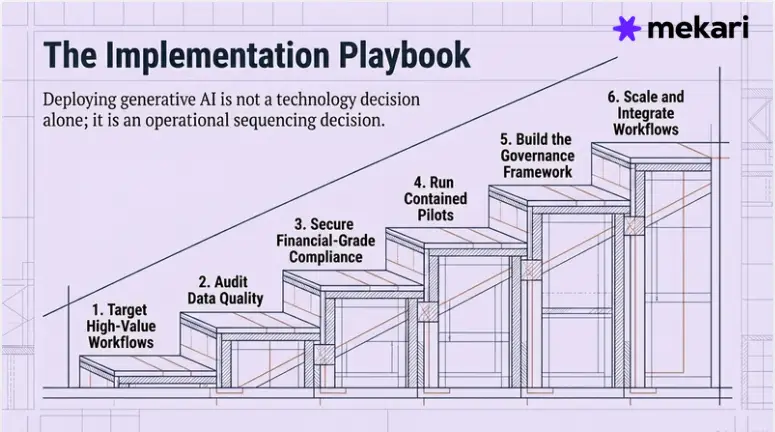
1. Identify the highest-value use case
Start with the workflow that has the clearest and most quantifiable manual cost. Invoice processing, credit review, and AML reporting are the most common starting points because their current cost per transaction and error rate are already measurable.
A use case with a clear baseline is a use case with a clear ROI target — and a clear success metric for the pilot phase.
2. Audit your data quality
Generative AI performs in proportion to the quality of the data it runs on. Before any implementation begins, assess four dimensions:
- Completeness — are all relevant fields consistently populated across your data sources
- Consistency — are formats standardized so data from different systems can be read uniformly
- Accessibility — can the AI platform connect directly to your ERP, banking, and AP systems
- Ownership — is there a clear person or team accountable for data quality decisions
Poor data infrastructure is the leading cause of AI underperformance in finance, and it is a problem that cannot be solved after deployment.
3. Select a solution with financial-grade compliance
Not all AI platforms are built for the regulatory environment of financial services. The AI solution you select must meet your requirements for data residency, model explainability, and auditability.
Explainability is non-negotiable for credit and compliance use cases — regulators require that automated decisions can be traced and explained to affected parties in plain language.
Any platform that cannot produce that audit trail is not suitable for production deployment in finance.
4. Run a contained pilot
Deploy in a single department or workflow before scaling. Define your success metrics upfront and run the pilot for 60–90 days before drawing conclusions. At minimum, track:
- Processing time — how long does the workflow take end-to-end compared to the manual baseline
- Error rate — how frequently does AI output require manual correction or override
- Cost per transaction — what is the per-unit cost compared to the manual process
A contained pilot limits risk, generates the internal evidence needed to justify wider rollout, and surfaces integration issues before they become enterprise-wide problems
5. Build a governance framework
AI in financial services requires structured human oversight, not full autonomy. Before scaling, define:
- Who reviews AI recommendations — particularly for credit, compliance, and high-value AP approvals
- How models are monitored for drift — performance can degrade over time as data patterns shift
- How errors are escalated — what happens when AI output is incorrect, ambiguous, or flagged by a reviewer
A governance framework that incorporates model risk management principles — including drift monitoring, human oversight, and escalation protocols — is what makes generative AI outputs defensible to regulators, auditors, and senior leadership.
6. Scale and integrate
Once the pilot meets its success metrics, expand to adjacent workflows. Integrate the AI outputs directly with your ERP, accounting, and reporting systems to eliminate manual re-entry between tools.
The compounding value of generative AI in finance comes not from isolated automations but from connected workflows where AI outputs feed downstream processes without human intervention at every handoff point.
Read More: SaaS Integration: Methods, Examples, and RecommendationsGenerative AI for Finance Teams in Indonesia
Indonesian financial services companies — banks, fintech, multifinance firms, and corporate finance teams — face a specific automation challenge: high transaction volumes, complex multi-entity structures, and financial workflows that span multiple systems without a single source of truth.
Mekari addresses this through a unified software ecosystem purpose-built for Indonesian businesses, where AI capabilities are embedded across products rather than bolted on as a separate tool.
For financial services teams, the most relevant products within the Mekari ecosystem are:
- Mekari Expense — AI-powered spend management and accounts payable automation, including invoice processing, 3-way matching, multi-level approvals, and cross-border payments
- Mekari Jurnal — accounting and financial reporting software with Mekari Airene embedded, enabling natural-language financial queries and AI-generated analysis of financial statements
- Mekari Airene — the AI intelligence layer across the Mekari ecosystem, allowing finance teams to surface insights, generate reports, and query financial data without manual report building
- Mekari Officeless — an enterprise development platform for teams across large companies that need to build custom AI-powered workflows beyond standard configurations, including document intelligence, automated decisioning, and compliance routing
These Mekari’s products are designed to work together seamlessly within a single unified ecosystem.
They automate repetitive operational workflows, connect every business function within a unified software ecosystem, and consolidate data into intelligent reports that support faster, better-informed decisions.
For fintech companies managing high transaction volumes and complex AP workflows, Mekari’s fintech software solutions bring AI-powered automation to every layer of the financial operation. Meanwhile, banking institutions navigating regulatory demands and credit workflows can rely on Mekari’s banking software solutions to embed AI across compliance, reporting, and decisioning processes.
Whichever corner of financial services your team operates in, Mekari’s finance team solution is built to take your finance function from manual to AI-powered — and the time to start is now.
References
McKinsey. “Capturing the full value of generative AI in banking”
McKinsey. “Banking on gen AI in the credit business: The route to value creation”
Gartner. “Gartner Predicts That 90% of Finance Functions will Deploy at Least One AI-enabled Technology Solution by 2026”
McKinsey. “The economic potential of generative AI: The next productivity frontier”

