



Mekari Insight
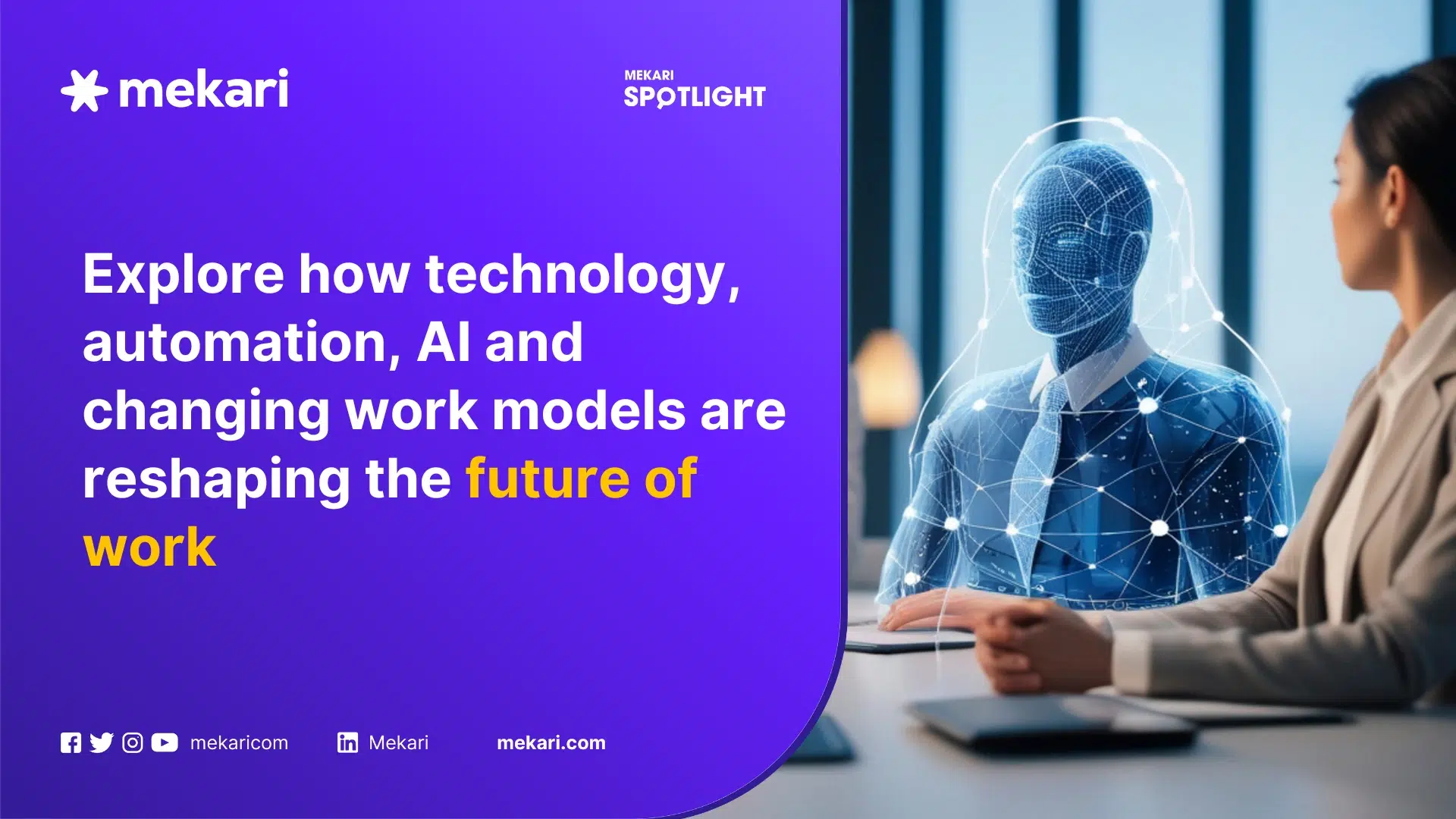
- The future of work describes how technology, workforce behavior, and business models are reshaping how people work.
- Key trends include remote work, automation, digital collaboration tools, and skills-based workforce management.
- Mekari enables the future of work through an integrated ecosystem of solutions for businesses that connects HR, finance, sales, and operations to streamline workflows and data-driven decisions.
In today’s fast-evolving workplace, employees still dedicate a significant portion of their time to repetitive, manual tasks—often as much as 57% in administrative-heavy roles like HR, according to industry benchmarks.
But the shift is accelerating: imagine an AI-powered assistant that automates routine processes, anticipates business challenges, and unlocks strategic opportunities for your team.
This transformation is already underway. Gartner predicts that by the end of 2026, 40% of enterprise applications will integrate task-specific AI agents (up from less than 5% in 2025), fundamentally changing how teams in HR, finance, operations, and beyond get work done.
Therefore, the future of work in 2026 is defined by AI and automation driving higher productivity, innovation, and more human-centric cultures. Businesses that proactively adopt these technologies will build resilience and competitive advantage.
In this article, we dive into the major trends shaping work this year, their real impact on jobs and company culture, and actionable strategies to help your organization adapt and thrive.
Automation and the future of work

SaaS platforms are rapidly becoming the backbone of workplace automation by enabling seamless software integrations that eliminate manual data handling and repetitive tasks across departments.
This creates smoother workflows, real-time data consistency, and significant operational efficiency gains.
Several data underscores this transformation. According to Gartner, 70% of organizations are set to implement structured automation to deliver greater flexibility and efficiency (Gartner).
Complementing this, 85% of organizations already automate some SaaS management processes, substantially reducing manual workloads and freeing IT teams for strategic initiatives. (BetterCloud State of SaaS reports)
In the industrial sector, where operational precision drives competitiveness, 55% of manufacturers plan to adopt industrial SaaS solutions specifically to fuel business growth and enterprise value creation (BCG analysis).
These adoption patterns highlight how SaaS integrations not only streamline day-to-day operations but also unlock broader business advantages—such as accelerated decision-making, reduced costs through minimized manual intervention, and enhanced scalability that supports revenue expansion without proportional resource increases.
By centralizing and automating across tools, companies achieve measurable productivity boosts and position themselves for sustained competitive advantage in an increasingly digital landscape.
Embracing SaaS-driven automation and integrations delivers these tangible efficiency and growth benefits, enabling organizations to operate more agilely and innovate at scale.
Baca Juga: Generative AI: The Game Changer in the Realm of Creative WorkTechnology’s impact on work models
Technology, especially Artificial Intelligence (AI), has the potential to significantly alter traditional job models. It enhances business productivity and provides greater job satisfaction. In addition to automating routine tasks, AI creates new job opportunities, allowing a focus on more strategic aspects and opening up exciting new career prospects.
The World Economic Forum estimates that new technologies will disrupt 85 million jobs globally between 2020 and 2025 but will also create 97 million new job roles.
Reported from Facilitate Magazine
The conveniences brought about by technology have also given rise to new work models, one of which is remote work. The traditional workspace paradigm has undergone significant changes due to the Covid pandemic, leading to the emergence of this work model. By 2025, it is projected that 32.6 million Americans will work remotely, equivalent to around 22% of the workforce.
The era of digital transformation is increasingly providing opportunities to break free from the limitations of conventional work and transition into gig economy roles. Unlike the conventional concept of permanent employment, gig economy workers do not work permanently. It is estimated that independent workers will make up 60% of the workforce by 2027.
In this context, flexible working hours have also gained popularity—64% are more inclined to consider roles that allow flexible working hours compared to those that do not.
These trends are reshaping traditional work models, offering individuals more flexibility, autonomy, and opportunities to align work with their lifestyle preferences. These changes also create new paradigms and opportunities, making it crucial for businesses and individuals to adapt and evolve with these transformations.
AI and work culture
Artificial intelligence is fundamentally reshaping work culture by augmenting human capabilities, shifting focus from routine tasks to higher-value creative and strategic work.
Yet, this shift demands more: stronger collaboration, rebuilt trust, and a sharper focus on well-being to keep teams connected and thrive.
Recent research paints a clear picture. BCG’s 2025 AI at Work survey reveals frontline workers hitting a “silicon ceiling”—only 51% use generative AI regularly, versus over 75% of leaders and managers. The good news? Leadership makes all the difference
When executives use and support AI visibly, positive employee sentiment surges from 15% to 55%, boosting job satisfaction and regular use.
PwC’s 2025 Global AI Jobs Barometer adds optimism. Wages in AI-exposed industries grew twice as fast—16.7% versus 7.9% in less-exposed ones, from 2018 to 2025. Skills change 66% faster in these roles, yet jobs expand, proving AI elevates human value rather than eroding it.
Challenges loom, too. Gartner’s 2026 Future of Work Trends flags “culture dissonance”—performance pressures without matching support erode trust and spark burnout. CHROs must safeguard human resilience amid AI’s always-on demands.
After all, AI doesn’t just boost output. It redefines roles, relationships, and rhythms. Ethical rollout, reskilling, and leader-led empowerment turn risks into strengths—sparking innovation, cohesion, and a truly adaptive culture.
Thoughtful AI integration mitigates pitfalls. It equips organizations to flourish, blending human ingenuity with intelligent tools for a vibrant, future-proof workplace.
Strategies to navigate the evolving landscape

These changes will influence the demand for skills, types of jobs, and work structures across diverse sectors and geographical areas. To tackle these challenges, businesses must provide actionable insights for both internal and external stakeholders, aligning with a clear and consistent vision of business objectives and values.
For instance, businesses can utilize AI to boost efficiency and productivity. This involves automating repetitive tasks, enhancing the speed and quality of decision-making, and innovating products and services to better meet customer needs.
In order to adapt to technological shifts, employees also need to acquire new skills relevant to upcoming job roles. Identify skill gaps by evaluating the current skill levels of employees, focusing on areas that require enhancement. Utilize data to pinpoint training needs and customize curricula to align with business goals.
Baca Juga: Generative AI Ethics: Managing Risks and Drive Good OutcomesExamples of companies using AI in the workplace
Generative AI is already reshaping how leading organizations work — across retail, professional services, and financial services.
| Company | Tool | What It Does | Impact |
|---|---|---|---|
| Walmart | My Assistant | Draft writing, document summarization, new hire onboarding support | Frees employees from repetitive tasks to focus on higher-value work |
| PwC | ChatPwC | Conversational AI trained on tax questions and regulations | Piloting with 1,000 employees ahead of broader rollout |
| JPMorgan Chase | LLM Suite | Firmwide generative AI platform for research, drafting, and analytics | 200,000 employees onboarded in 8 months; investment bankers generate decks in 30 seconds that previously took hours |
| Morgan Stanley | AI @ Morgan Stanley Debrief | Summarizes client meetings, generates follow-up emails, syncs to CRM | 98% advisor adoption; advisors save up to 30 minutes of admin work per meeting |
1. Walmart
Walmart rolled out “My Assistant,” an AI-powered generative tool, to its non-store employees throughout the United States. This innovative tool expedites draft writing, acts as a creative collaborator, and condenses extensive documents.
Walmart intends to deploy the AI tool during the orientation of new hires, aiding them in comprehending company benefits during the annual enrollment process.
The company firmly believes that generative AI functions as a tool to reduce repetitive work, not replace the people doing it.
2. PWC
PwC is among the Big Four accounting firms that have moved earliest on generative AI adoption. ChatPwC, the firm’s proprietary conversational AI assistant, functions similarly to well-known models like OpenAI’s ChatGPT but is trained specifically on PwC’s internal knowledge and client-facing tax data.
By securely accessing OpenAI’s technology, the company refined its model using data related to frequently asked tax questions and regulations.
Currently undergoing a pilot phase with approximately 1,000 employees, the tool is designed to scale across the firm as confidence in its output grows.
3. JPMorgan Chase
JPMorgan Chase launched LLM Suite, a proprietary generative AI platform, in the summer of 2024 — a model-agnostic tool that integrates large language models and connects to the bank’s internal databases and applications.
The platform was adopted by 200,000 employees within the first 8 months of its launch, with investment bankers using it to generate presentation decks in seconds that previously took junior analysts hours to complete.
The bank now has over 450 AI use cases in production, with targets to reach 1,000 by 2026.
4. Morgan Stanley
Morgan Stanley Wealth Management launched AI @ Morgan Stanley Debrief in June 2024 — an OpenAI-powered tool that, with client consent, generates meeting notes on a financial adviser’s behalf, summarizes key points, and creates a draft follow-up email.
98% of financial advisors actively use the tool, with advisers saving up to 30 minutes of administrative work per meeting — time reallocated directly to client engagement and business development.
Conclusion
The future of work is here—driven by intelligent automation, seamless SaaS integrations, and AI that augments rather than replaces human potential.
Organizations that embrace these shifts thoughtfully will unlock greater efficiency, foster innovative cultures, and build resilient teams ready for whatever comes next.
To navigate this transformation with confidence, partner with Mekari—Indonesia’s leading integrated SaaS ecosystem, designed to streamline operations and support growth:
- Mekari Talenta — HRIS software that automates HR, payroll, attendance, and performance management for a smoother, people-first workplace
- Mekari Jurnal — Accounting software that delivers real-time accounting, financial automation, and accurate reporting to eliminate manual work.
- Mekari Expense — Spend management software that simplifies business expense management, reimbursements, cash advances, and bill payments with full control and automation.
- Mekari Qontak — Powers customer engagement, sales, and omnichannel communication with integrated CRM tools.
- Mekari Officeless — Enables fast custom app development, seamless integration, and workflow automation with no-code/low-code platform.
- Mekari Airene AI features — Embedded across the platform to deliver smart insights and faster decision-making.
Ready to make this future work for your company? Contact us today and explore how Mekari can help your business operate more efficiently and adapt confidently!
References
Facilitate Magazine. ‘’AI will further ‘upend’ traditional workplace models’’
MIT Sloan Management Review and Boston Consulting Group. ‘’The Cultural Benefits of Artificial Intelligence in the Enterprise’’
