




Mekari Insight
- An enterprise software solution is a large-scale system built to solve organization-wide operational challenges, but most real-world systems are a patchwork of legacy, SaaS, and self-built tools rather than one clean platform.
- The strongest solutions share five traits: scalability, integration, real-time data, security and compliance, and a user-friendly, customizable interface.
- For businesses in Indonesia, Mekari brings these traits together in one ecosystem spanning platform, people, operations, finance, and customer functions.
Most large organizations don’t operate on a single, unified system. Instead, they rely on a patchwork of legacy infrastructure, built, layered, and connected over years, sometimes decades. While these systems may still function, they often introduce significant complexity, where even minor disruptions can trigger widespread operational impact.
This is exactly the challenge enterprise software solutions are designed to address. By unifying systems and streamlining operations, they help organizations reduce complexity and improve control at scale.
In this article, we explore what enterprise software solutions really are, why they matter, real-world use cases from companies like Intuit and Domino’s, the key features to look for, and a curated list of top solutions available today
What is an enterprise software solution?

An enterprise software solution is a large scale system designed to support and manage the complex operations of organizations, from businesses to government institutions. In theory, it represents the ideal of a unified platform that centralizes processes and enables everything to run seamlessly.
In practice, enterprise systems often become far more complex. Many organizations rely on a mix of legacy infrastructure, third party SaaS platforms, and internally developed tools that have been layered over time. This creates systems that are difficult to navigate, require extensive training, and can be fragile, where even small changes risk disrupting broader operations.
This complexity is not accidental. It is the result of years, sometimes decades, of incremental additions and integrations. Rebuilding such systems from scratch is rarely feasible due to the cost, time, and operational risk involved.
This is why consolidation matters. Giving employees a unified interface where data, tools, and workflows are connected can significantly improve efficiency, reduce friction, and strengthen overall organizational performance.
More broadly, enterprise software, or enterprise application software, refers to systems built for organizational use rather than individual users. These solutions typically cover functions such as customer support, business intelligence, communication, inventory management, marketing, payments, and enterprise resource planning, all working together to support scalable and efficient business operations.
Why is enterprise software important?

Enterprise software sits at the center of day-to-day business functions and mission-critical operations across many organizations. Here’s how it typically delivers value:
- Scale resources: Organizations rely on enterprise software to scale operations and allocate resources more effectively. This flexibility allows businesses to adjust capacity based on demand while keeping costs, resources, and budgets under control.
- Improve organizational efficiency: Enterprise applications introduce automation across functions such as HR, payroll, marketing, and data management. This reduces manual work and creates more standardized workflows, helping minimize silos and improve coordination between teams.
- Enhance employee productivity: Technologies such as automation, project management tools, AI, and data analytics make collaboration more seamless and provide actionable insights. This enables employees to work more efficiently regardless of location or team structure.
- Increase customer satisfaction: Solutions such as CRM, marketing automation, and contact center tools help organizations build a deeper understanding of their customers. With more centralized data, businesses can deliver more personalized and responsive customer experiences.
Use cases of enterprise software solutions
Some of the world’s leading enterprises have already integrated enterprise software into how they operate. A few examples illustrate the range of what it can do.
Customer service
Financial software company Intuit built an omnichannel cloud contact center that unifies voice, chat, messaging, and web communication into a single platform. This enables the company to handle millions of customer inquiries each year while giving agents a consistent and complete view of customer data.
Communication
Netflix replaced its in house email system with a cloud based solution to improve deliverability, reduce infrastructure overhead, and support global scale. This shift allowed the company to optimize communication performance across different internet service providers while reaching a broader audience.
Sales and marketing
Enterprise software helps reduce silos between sales and marketing teams, enabling faster response to new customer inquiries. Technology services provider World Wide Technologies improved sales efficiency through a centralized quote management system that streamlines coordination across teams.
Operational support
Domino’s uses machine learning models to predict customer orders and optimize its delivery and pickup processes. By leveraging this approach, the company reduced service time and improved overall customer satisfaction.
Key features of an effective enterprise software solution
Not every enterprise software solution is built the same way. Here are the features that consistently separate effective solutions from the rest.
- Scalability and flexibility: The software should grow with the business and adapt to changing needs, handling increased data volumes and new users without compromising performance.
- Integration capabilities: It should integrate with existing tools and technologies for seamless communication and data exchange, keeping relevant data accessible and actionable.
IBM Global AI Adoption Index found that 25% of organizations identify data complexity and integration challenges as key barriers to technology adoption.
This highlights the importance of enterprise software solutions that can connect systems, eliminate data silos, and provide a unified flow of information across business functions.
- Real-time data and analytics: Access to real-time data allows businesses to make informed decisions quickly and respond to changing market conditions, while analytics support data-driven strategic planning.
- Security and compliance: Robust security measures should protect sensitive data and prevent unauthorized access, while compliance with relevant regulations and industry standards maintains data integrity.
- User-friendly interface and customization: A straightforward, navigable interface improves adoption, while customization lets businesses adapt the software to their workflows. Headless ERP systems, which separate the data-processing backend from the user-interface frontend, are worth considering for businesses seeking advanced customization without compromising core ERP functionality
Top enterprise software solutions to consider
Here’s an overview of some of the most established options and what each one focuses on.
1. Ramco ERP
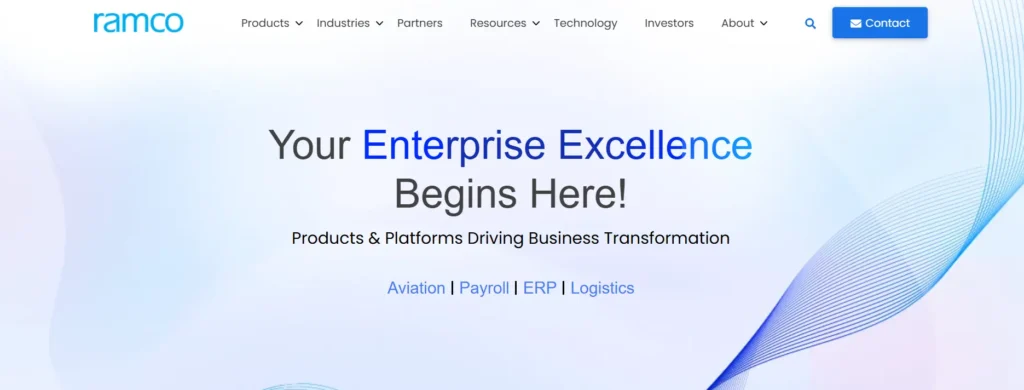
Ramco ERP is an enterprise resource planning solution designed to help businesses manage operations and automate processes across departments. It offers an integrated suite of modules covering financial management, supply chain, human resources, and customer relationship management.
Key features:
- Financial management
- Procurement and inventory management
- Production management
- Quality control
- Sales and distribution
Best for: Mid to large enterprises that need strong operational control across finance, manufacturing, and supply chain in a single system.
2. Mekari
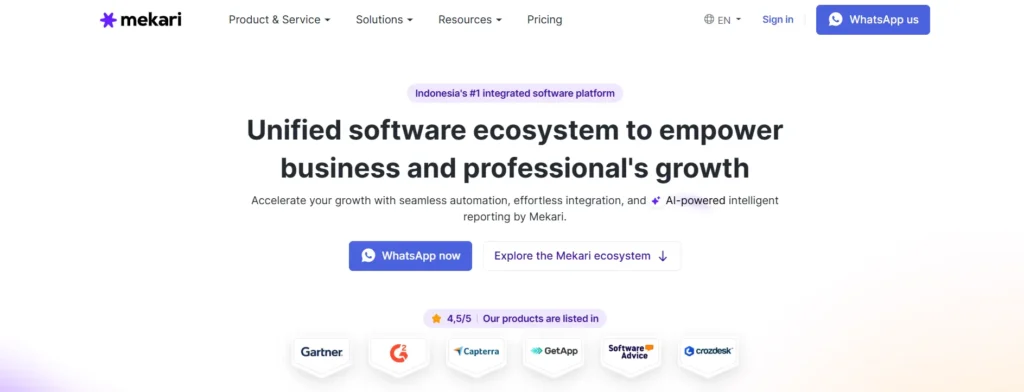
Mekari is an integrated business software platform built for businesses in Indonesia. It offers a unified ecosystem that supports growth through automation, seamless integration, and AI driven reporting. Mekari provides both enterprise grade solutions and modular tools that can be adopted based on business needs.
Key features:
- HR and payroll management
- Accounting and supply chain management
- Customer relationship management
- Tax management and compliance
- Expense management and employee benefits
- Digital signature and POS system
- Workflow automation and AI powered insights
- Identity and access management
- Custom application development
Best for: Growing businesses and enterprises in Indonesia that need a localized, integrated platform covering multiple business functions with strong compliance support.
3. Oracle NetSuite
Oracle NetSuite is a cloud based ERP solution that helps businesses manage financials, inventory, customer relationships, and e commerce operations within a single platform. It is widely used by mid sized companies but can scale to support larger organizations.
Key features:
- Financial management including general ledger and billing
- Inventory and supply chain management
- Order management and fulfillment
- CRM and customer service tools
- E commerce capabilities
Best for: Mid sized to large companies that want a scalable cloud ERP with strong financial and inventory management capabilities.
4. Crest ERP
Crest ERP is an enterprise resource planning solution designed to help organizations manage operations and automate key business processes across departments. It focuses on core operational areas such as finance, production, and supply chain.
Key features:
- Financial management
- Supply chain management
- Production management
- Quality control
Best for: Manufacturing and operations driven companies that require structured process management and production oversight.
5. Orion ERP
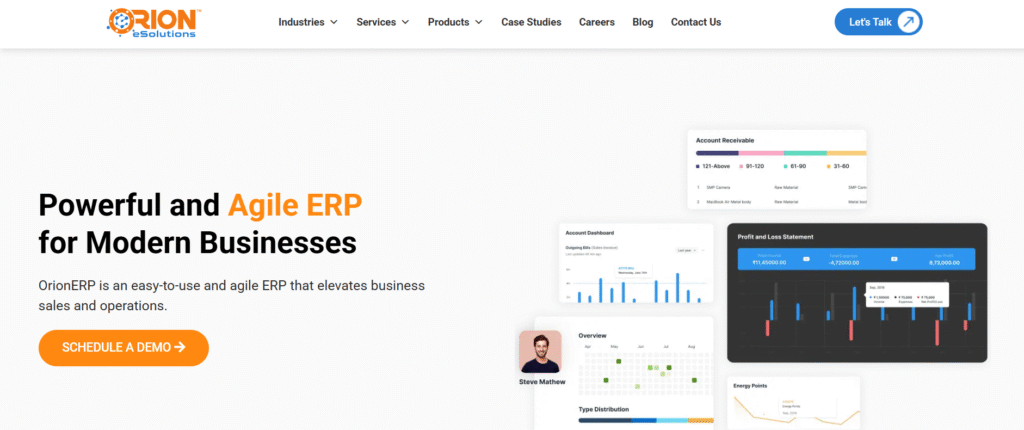
Orion ERP provides a comprehensive suite of modules that support various business functions, including finance, human resources, sales and marketing, manufacturing, and supply chain. These modules work together to deliver a unified operational system.
Key features:
- Financial management
- Procurement and inventory management
- Production management
- Quality control
- Sales and distribution
Best for: Enterprises that need a broad ERP system covering multiple departments with a focus on operational integration.
6. Salesforce
Salesforce is a leading customer relationship management platform that helps businesses manage customer interactions, improve sales processes, and deliver personalized experiences at scale.
Key features:
- Contact and lead management
- Opportunity tracking and sales forecasting
- Marketing automation
- Customer service and support tools
- Analytics and reporting
Best for: Companies that prioritize customer experience, sales performance, and marketing automation across multiple touchpoints.
7. Microsoft Dynamics 365
Microsoft Dynamics 365 is a suite of business applications that combines ERP and CRM capabilities into a unified platform. It integrates seamlessly with other Microsoft tools and offers flexible customization options.
Key features:
- Sales and customer service management
- Marketing automation
- Financial management
- Supply chain management
- Integration with Microsoft ecosystem
Best for: Organizations already using Microsoft products that want a unified, customizable platform for managing both operations and customer relationships.
Best enterprise software solution for businesses in Indonesia
Choosing the right enterprise software solution ultimately comes down to one key factor. How well the system integrates across your business. The most effective solutions are not just feature rich, but connected, scalable, and adaptable to local operational needs.
As one of Indonesia’s leading integrated software platforms, Mekari offers a connected ecosystem designed to support business growth through automation, seamless integration, and AI driven insights.
Instead of relying on fragmented tools, businesses can manage multiple functions within a single unified environment, whether through enterprise grade solutions or modular products that scale over time.
- Platform: Manage the entire ecosystem with unlimited customization. Build custom enterprise applications and specific workflows, and connect Mekari products with external systems through Mekari Officeless. Manage identity centrally and securely with Mekari Access, and make more accurate decisions with AI-driven insights from Mekari Airene.
- People: Reduce errors from manual systems and build a more productive work environment. Automate payroll, PPh 21 tax, and attendance with Mekari Talenta, and increase employee loyalty with flexible benefits through Mekari Flex.
- Operations & digitalization: Accelerate business operations by eliminating manual systems. Ensure instant contract legality with digital signatures and official e-Meterai through Mekari Sign, and synchronize multi-channel inventory management with Mekari Desty.
- Accounting & finance: Control company finances in real time to protect profitability and get automated financial reports with Mekari Jurnal. Get full control over every operational expense with Mekari Expense, and ensure tax compliance integrated directly with Indonesia’s DJP through Mekari Klikpajak.
- Customer: Build stronger customer relationships across every communication channel. Consolidate interactions from WhatsApp, social media, and email into a single CRM dashboard with Mekari Qontak, supported by AI chatbot capability and sales pipeline automation to improve conversion.
- Ecosystem integration: The Mekari ecosystem can be used as a standalone module, comprehensively across the whole organization, or combined with internal company systems. Real-time AI support automates reporting and detects anomalies, while ISO 27001 security standards paired with local infrastructure support faster, safer, and more precise decision-making.
Learn how Mekari can support your business transformation and bring your digital ecosystem together in practice.
References and methodology
Methodology
Methodology
Articles published by Mekari Desty are developed using trusted sources, including official data, company reports, academic research, and insights from industry practitioners. Whenever possible, we refer directly to primary sources before drawing conclusions. Our editorial team reviews and verifies the information to ensure accuracy and relevance. All references are listed so readers can trace each piece of information back to its original source.
Our editorial standards
Our editorial standards
- Primary source first: We consult official product documentation and pricing pages directly, not secondhand summaries or aggregator sites.
- Fact-checking: All product features, pricing, and claims are cross-verified against each platform’s official website at the time of writing.
- No paid placement: Tools are selected based on relevance and fit for Indonesian businesses, not commercial arrangements. Mekari Desty is included as a first-party product and is transparently labeled as such.
- Regular review: Articles are periodically updated to reflect product changes or shifts in market relevance.

