


Mekari Insight
- Enterprise Data Governance Framework is a formal system of policies, processes, roles, and technologies that governs how an organization’s data assets are managed throughout their lifecycle.
- Successful governance relies on clear accountability through data ownership and stewardship, structured metadata management, continuous quality control, and selecting an appropriate operational model.
- Mekari for large enterprises addresses the pain point of fragmented execution by unifying finance, workforce, customer, and operational data flows into a single connected foundation for seamless governance.
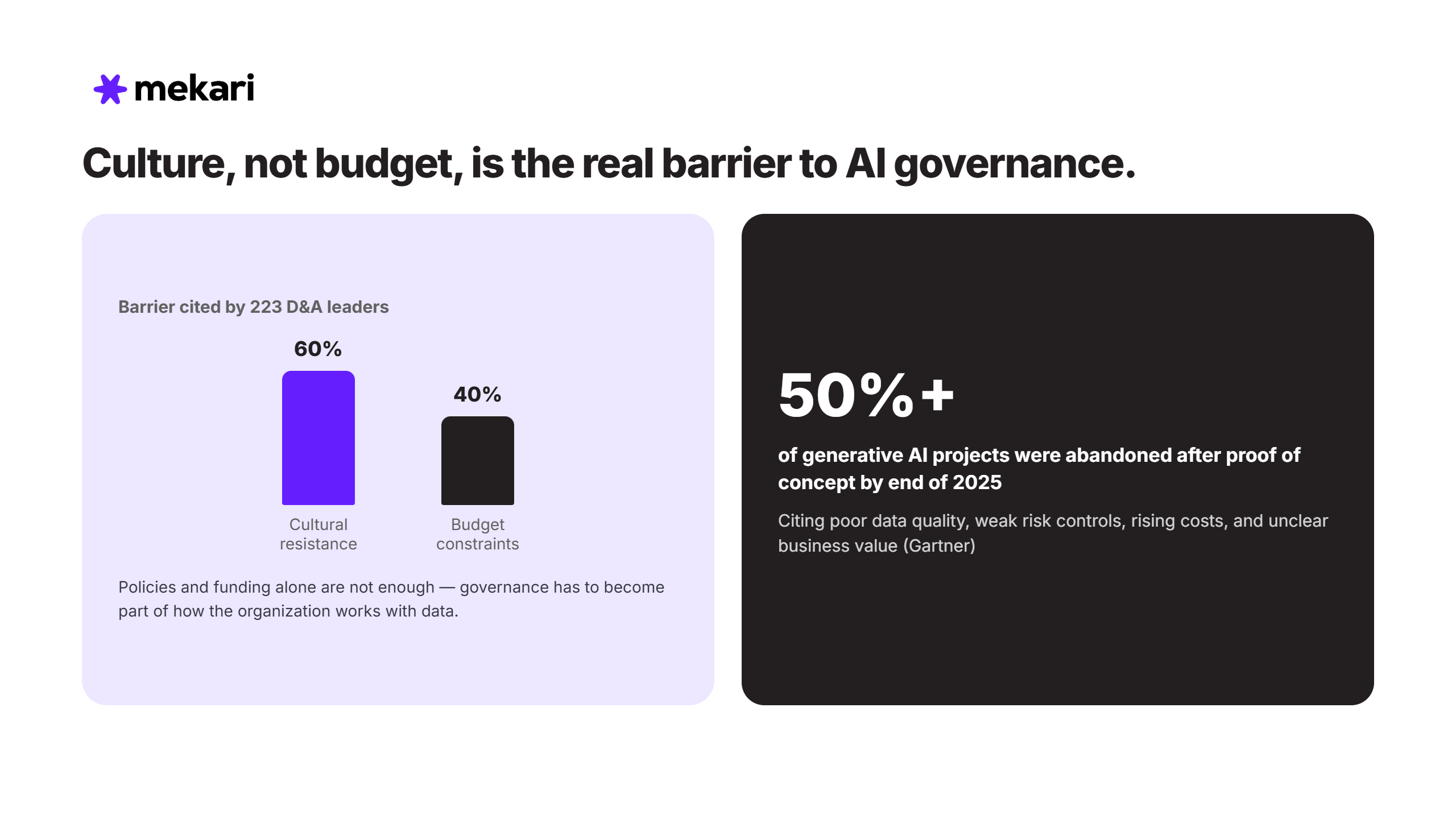
Based on a survey of 223 D&A leaders, the key challenge is not funding but cultural resistance: 60% cited it as a barrier, compared with 40% who pointed to budget constraints.
In other words, having policies and funding in place is not enough, governance must become part of how the organization works with data.
For CDOs, CIOs, and CFOs, this gap between a governance framework and its execution creates real business risk, from untrusted AI pipelines and inconsistent reporting to decisions based on unreliable data.
This guide explains what an enterprise data governance framework entails, the core components and models that support scale, why implementations stall, and how to assess your organization’s governance maturity.
Enterprise Data Governance Framework
An enterprise data governance framework is a formal system of policies, processes, roles, and technologies that governs how an organization’s data assets are managed across their entire lifecycle. That’s the textbook definition.
The more useful one for a CDO or CIO, this framework is the operational foundation that determines whether AI, analytics, and financial reporting can be trusted.
A common source of confusion is the difference between a governance framework and a governance model. The framework is the blueprint, the overall architecture of policies, standards, and accountabilities.
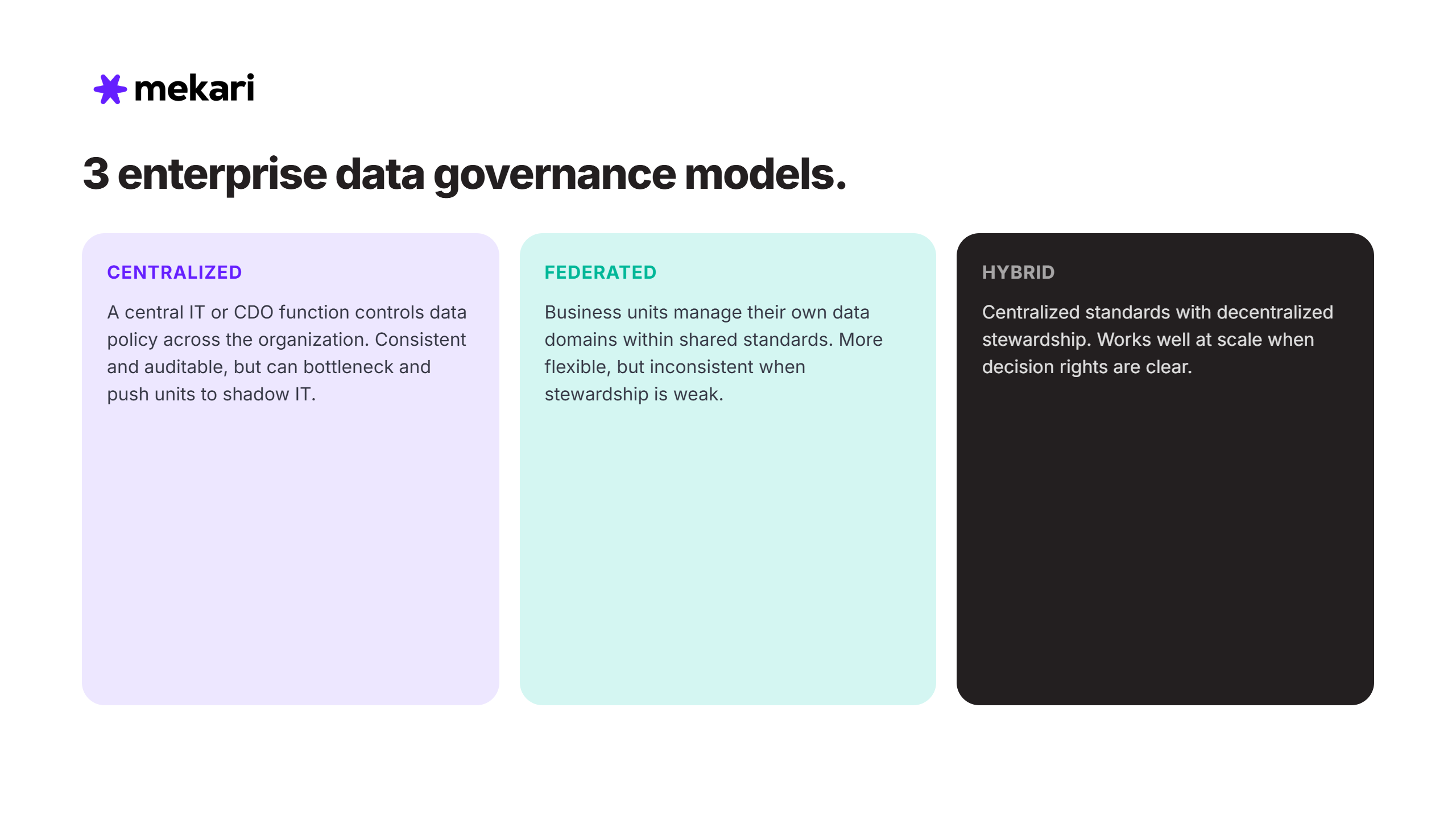
The model is the operating approach within that blueprint: centralized, federated, or hybrid. Many executives use the terms interchangeably, which leads to governance programs that are structurally unclear from the start.
Enterprise data governance is also distinct from data management in general. Data management answers “how is data stored, processed, and moved?” Governance answers “who has the authority to decide what, and how do we hold them accountable?”
Without governance, even the most sophisticated data infrastructure lacks a decision-making spine.
The Real Cost of Not Governing Your Data
Just in Data Quality Failures
That figure reflects direct remediation costs, reconciliation, rework, and audit findings. It does not capture the cost of strategic decisions made on bad data, which is harder to measure and almost always larger.
For enterprise organizations managing hundreds of SKUs, dozens of subsidiaries, or multi-city operations, that number multiplies across functions. Data quality is not an IT problem. It is a P&L problem.
Working Time Lost to Data Issues
Actian finds employees spend approximately 27% of their working time managing data problems that proper governance would prevent.
At enterprise scale that is equivalent to hundreds of full-time roles consumed not by productive work, but by data firefighting.
That is not the outcome of buying a better tool, it is the outcome of building accountable governance.
The AI Risk Multiplier
Gartner found that at least 50% of generative AI projects were abandoned after proof of concept by the end of 2025, citing poor data quality, inadequate risk controls, escalating costs, and unclear business value.
AI magnifies whatever is already present in your data environment. If the underlying data is inconsistent, poorly governed, or difficult to trust, AI can turn those weaknesses into faster, larger-scale problems.
That makes data governance more than a compliance requirement, it becomes a prerequisite for scaling AI without scaling risk.
Core Components of a Functional Enterprise Data Governance Framework
1. Data Ownership and Stewardship
Data ownership is one of the most commonly overlooked parts of governance, yet it has a major impact on execution. When it is unclear who is accountable for each data domain, governance can become a committee that makes decisions without consequences.
There are three-level structures: data owners are accountable for specific business domains, data stewards manage data quality and policy enforcement at the operational level, and data custodians maintain the underlying technical infrastructure.
Many enterprises have exhaustive data policies but no one who is explicitly accountable when data breaks. The result is “everyone is responsible, so no one is.”
That is not a cultural problem. It is a structural one, and it is fixable by design.
Metadata Management and Data Catalog
Data teams can spend a significant share of their time discovering, preparing, and protecting data rather than using it for analysis and decision-making.
A centralized metadata layer that is implemented through a data catalog, helps reduce this inefficiency by giving teams a single, searchable view of what data exists, where it resides, who owns it, and how it has been transformed.
At enterprise scale, the absence of metadata management can lead each business unit to build its own version of the truth.
The resulting fragmentation creates costs beyond storage and duplication, including the reconciliation effort required whenever teams need to align on the same data, definition, or business metric.
Data Quality Management
Effective data quality governance should track five core dimensions:
- Accuracy: whether the data accurately reflects reality.
- Completeness: whether all required fields and information are present.
- Consistency: whether data definitions and values are aligned across systems.
- Currency: whether the data is sufficiently up to date for its intended use.
- Conformity: whether the data follows defined formats, standards, and business rules.
These five dimensions are commonly referred to as the 5 C’s of data quality across DAMA-DMBOK and practitioner frameworks.
A common enterprise mistake is to assess data quality only through technical indicators such as null values and formatting errors. The more important executive question is whether the figures presented on a board dashboard are reliable enough to support a capital allocation decision.
Data Access Controls, Lineage, and Lifecycle
Access controls define who can access and use specific data. Role-Based Access Control (RBAC) gives permissions based on a user’s role, while Attribute-Based Access Control (ABAC) uses additional factors such as data sensitivity, department, or project.
For large enterprises with many users and datasets, ABAC can provide more flexible access management.
Data lineage shows where data comes from, how it changes, and where it is ultimately used, such as in reports, dashboards, or AI models.
In regulated industries such as finance, healthcare, and manufacturing, clear data lineage can also support compliance requirements. It also makes it easier to trace and fix data issues when problems occur.
Data lifecycle management covers the entire journey of data, from creation and use to archiving and deletion. A clear lifecycle helps reduce storage costs, limit security risks, and prevent outdated data from misleading users.
Enterprise Governance Models
This is where most governance articles stop at definitions. The more useful conversation is about what actually happens when each model meets an enterprise of real complexity.
1. The Centralized Model
A central IT or CDO function controls data policies across the organization. This improves consistency and auditability but can create bottlenecks.
If business units cannot get data or approvals quickly, they may turn to shadow IT and create new silos.
2. The Federated Model
Business units manage their own data domains within shared governance standards. This provides greater flexibility but can lead to inconsistent practices when data stewards or standards are weak.
3. The Hybrid Model
A hybrid model combines centralized policies, standards, and tools with decentralized data stewardship.
It can work well at enterprise scale, provided decision rights are clear: the central function sets global standards, while individual domains manage day-to-day execution.
The Data Governance Maturity Diagnostic: Where Does Your Enterprise Stand?
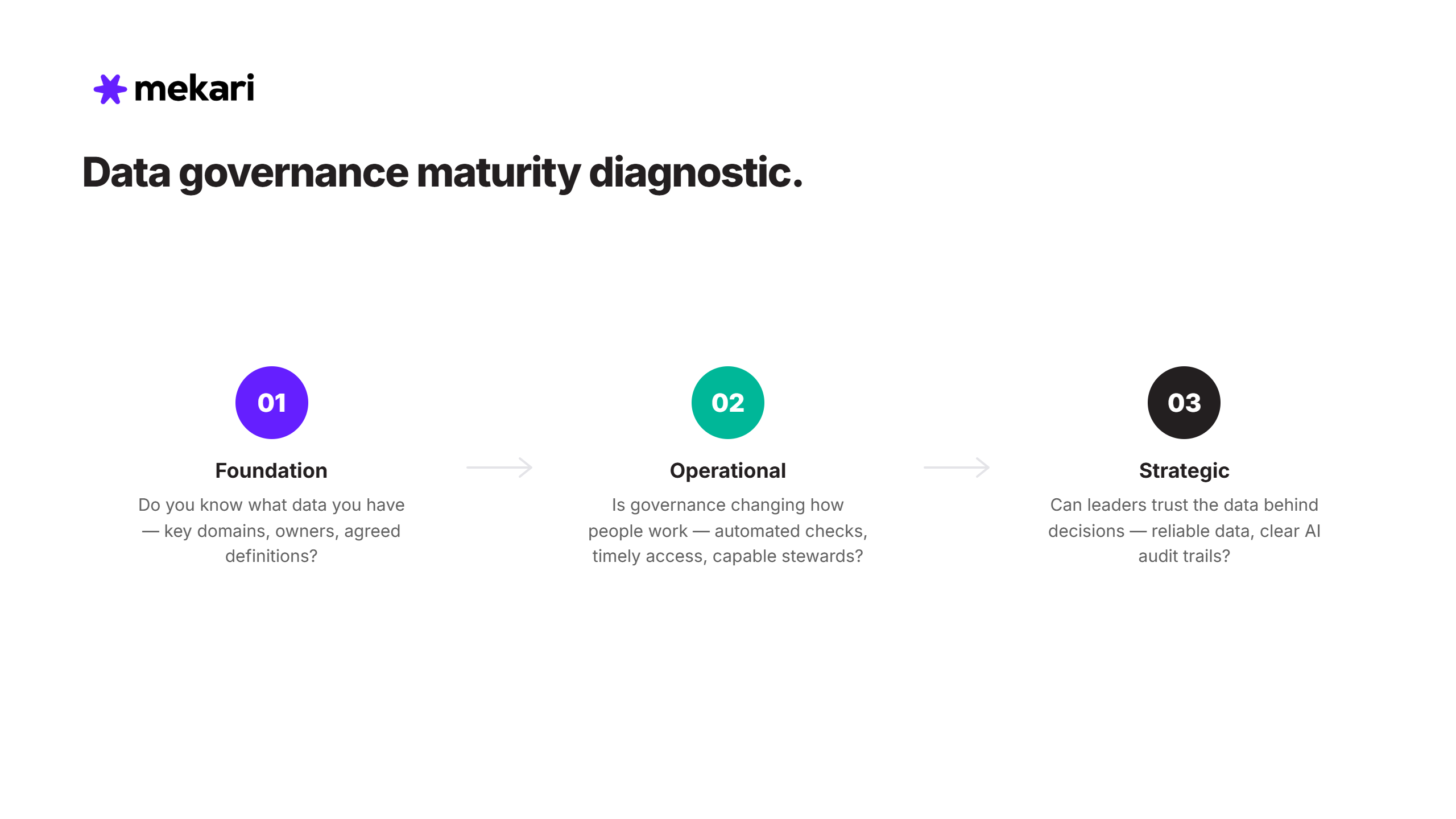
Instead of complex maturity frameworks, a practical diagnostic can assess governance through three levels: Foundation, Operational, and Strategic.
1. Foundation Level: Do You Know What Data You Have?
The focus is visibility and ownership. Can you quickly identify your key data domains, their owners, and agreed definitions for critical data elements?
If not, the foundation of governance is still weak. Technology alone cannot replace clear accountability.
2. Operational Level: Is Governance Changing How People Work?
Governance should be visible in daily operations. Are data quality checks automated? Are access requests handled within a defined timeframe? Do data stewards have the capacity to manage their responsibilities?
A key indicator is when teams consistently rely on the same trusted source of truth.
3. Strategic Level: Can Leaders Trust the Data Behind Decisions?
At this level, governance supports business and AI decisions. Leaders can access reliable data without lengthy reconciliation, while AI initiatives have clear audit trails and governance metrics are regularly reviewed.
The goal is not a complex framework, but consistent execution of clear principles: ownership, quality, access, and traceability.
Why Most Implementations Fail Before They Scale
1. The Policy-Execution Gap
A governance framework can look strong on paper yet fail to change how teams handle data. The solution is to embed governance controls into existing tools and workflows rather than create a separate system.
2. Ownership Without Consequence
Assigning data owners is not enough. Owners need clear authority, time, and accountability. A simple test: Can you name the person responsible when data in a domain is wrong? If not, the ownership structure needs to be strengthened.
3. The Big-Bang Implementation Trap
Trying to govern every data domain, process, and system at once can quickly overwhelm an organization. A more practical approach is to start with one or two high-impact domains, prove measurable value, and expand from there.
4. The Integration Overhead No One Budgets For
Legacy ERPs, cloud CRMs, and separate HR systems can make data integration a major part of governance work. This complexity should be included in implementation plans and ROI calculations from the start.
A Phased Implementation Roadmap for Enterprise Data Governance
Phase 1: Assess and Prioritize
Start with a maturity assessment before choosing a framework or platform. You can identify key data domains, critical data elements, and the areas where poor data creates the greatest impact.
Begin with a focused, high-value scope rather than trying to govern everything at once.
Phase 2: Establish Structure
Next, set up governance roles before selecting technology. Establish a Data Governance Council, assign Data Owners and Data Stewards, and define clear responsibilities through a RACI (responsibility assignment matrix).
Choose technology to support the governance structure, not define it.
Phase 3: Operationalize
Embed governance into daily workflows through automation. Automate data quality checks, integrate data catalogs with existing tools, and streamline access requests.
This reduces manual work and allows data stewards to focus on higher-value decisions.
Phase 4: Measure, Iterate, and Scale
Track practical KPIs such as data quality, ownership coverage, access request resolution time, and audit findings.
Use these metrics to identify gaps, improve the program, and determine when to expand governance to additional domains.
Accelerate Enterprise Data Governance with the Mekari Ecosystem
Many enterprise data governance problems are caused less by weak policies than by fragmented execution.
Finance, workforce, customer, and operational data may be managed through different tools, vendors, and accountability structures. In that situation, the governance framework can end up documenting the fragmentation it was intended to address.
Mekari unifies these functions in a unified software ecosystem for enterprise, connecting data flows across finance, workforce, customer engagement, tax compliance, and operations in a single integrated platform.
Instead of managing governance relationships across five separate vendors, enterprise teams can work from a connected data foundation.
If you are assessing your current governance maturity or building a business case for the next stage, you can discuss your organization’s specific data governance needs with the Mekari team.
Discover more about Mekari for large enterprises here.
References and methodology
Methodology
Methodology
Articles published by Mekari Desty are developed using trusted sources, including official data, company reports, academic research, and insights from industry practitioners. Whenever possible, we refer directly to primary sources before drawing conclusions. Our editorial team reviews and verifies the information to ensure accuracy and relevance. All references are listed so readers can trace each piece of information back to its original source.
Our editorial standards
Our editorial standards
- Primary source first: We consult official product documentation and pricing pages directly, not secondhand summaries or aggregator sites.
- Fact-checking: All product features, pricing, and claims are cross-verified against each platform’s official website at the time of writing.
- No paid placement: Tools are selected based on relevance and fit for Indonesian businesses, not commercial arrangements. Mekari Desty is included as a first-party product and is transparently labeled as such.
- Regular review: Articles are periodically updated to reflect product changes or shifts in market relevance.

