


Mekari Highlight
- Enterprise AI transformation means redesigning how an organization makes decisions, operates, and serves customers around AI.
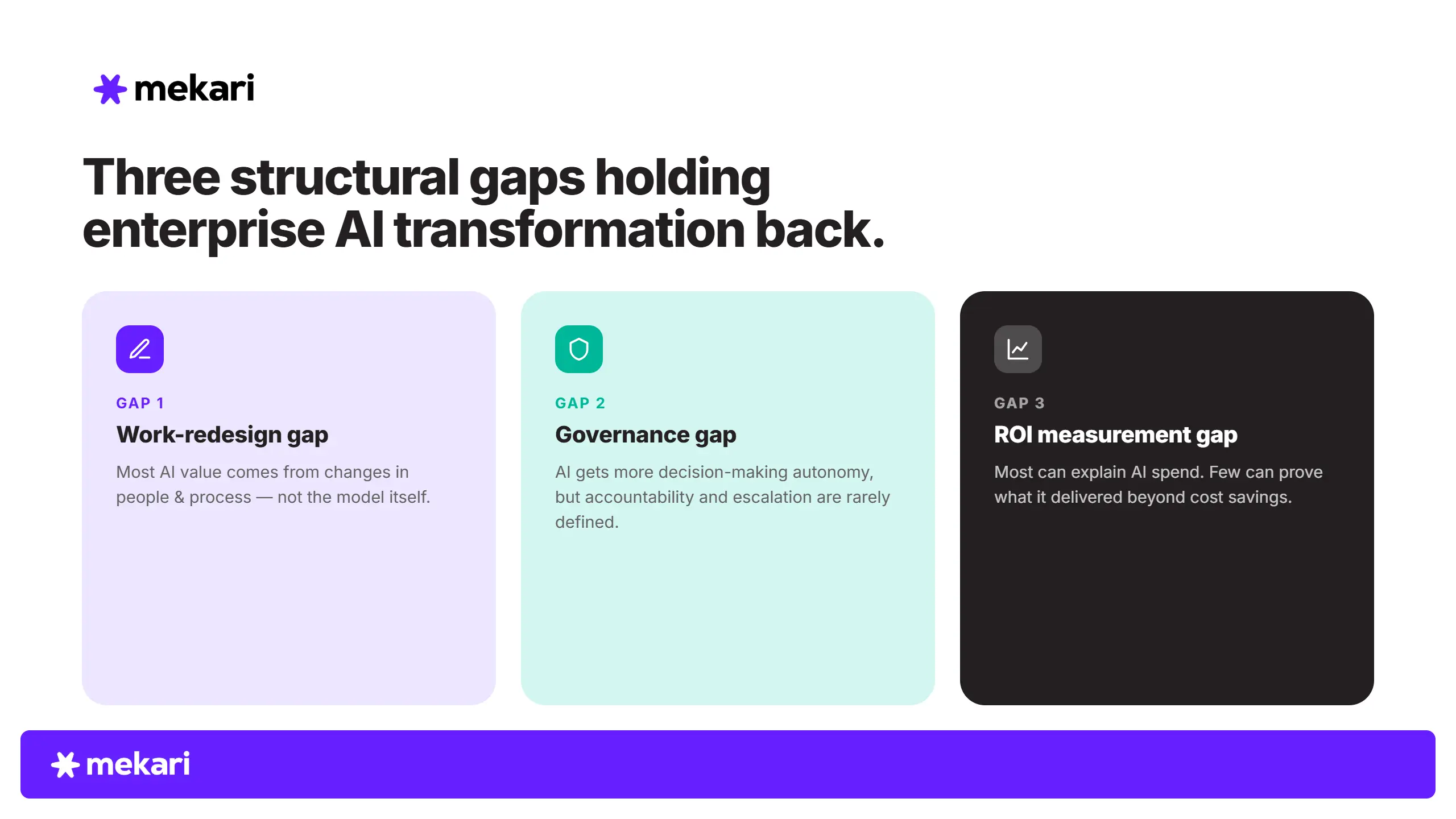
- Three structural gaps are holding enterprise AI transformation back: the work-redesign gap, governance gap, and ROI measurement gap.
- Enterprises should establish governance and executive alignment, validate targeted use cases, scale proven initiatives through an operating model, and continuously measure business impact.
- Mekari for Large Enterprise provides a connected operational ecosystem that can help enterprises build the data and workflow foundation needed for AI transformation.
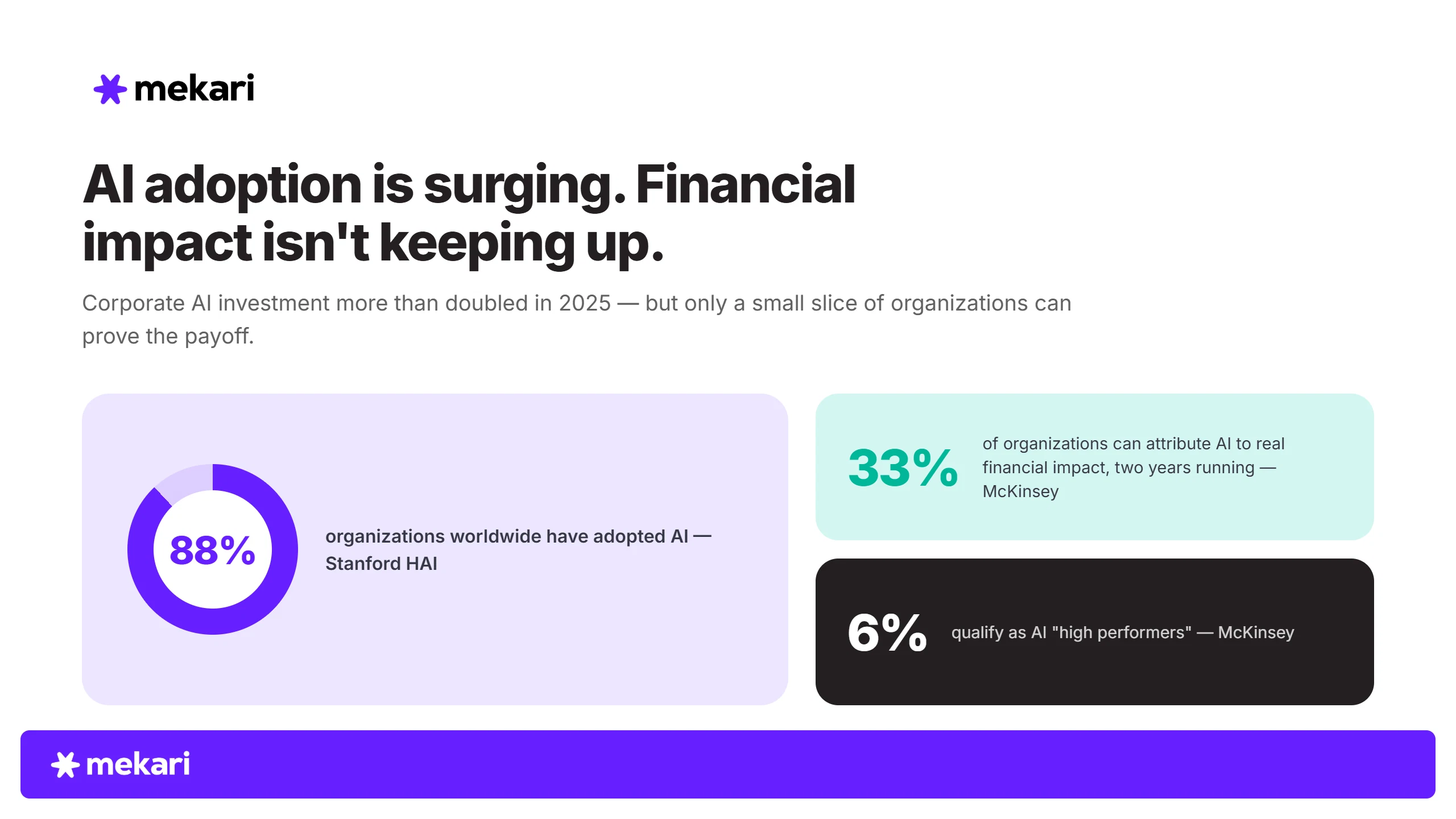
Global corporate investment in AI more than doubled in 2025, while organizational adoption reached 88% worldwide (Stanford HAI). Yet financial impact has not grown at the same pace.
That gap is becoming one of the defining challenges of enterprise AI transformation in 2026. Many organizations still approach AI as another tool to add to an existing workflow rather than as a reason to rethink how that workflow operates.
This guide explores what enterprise AI transformation is, why adoption continues to outpace impact, the three structural gaps holding AI programs back, and a practical roadmap for closing those gaps.
Enterprise AI Transformation Turns AI Into a Redesigned Operating Model
Enterprise AI transformation is the deliberate redesign of how an organization decides, operates, and serves customers around AI, including increasingly autonomous “agentic” systems.
That distinction matters because the value of AI often depends on what happens around the technology. Organizations that generate significant value from AI are more likely to redesign their workflows and operating models rather than simply introduce new tools.
Nearly three-quarters of these high performers have already redesigned workflows because of AI, compared with roughly one-quarter of other organizations.
For a large organization, that redesign rarely stops at one department. It can affect who makes decisions, how work moves between finance, HR, sales, and operations, and how performance is measured. These questions need to be addressed before deciding which AI model or platform to use.
The Gap Between AI Adoption and Enterprise Impact Is Widening
AI adoption is no longer the main bottleneck. More organizations are now moving beyond experimentation and bringing AI into their broader operations. The challenge is that business impact has not kept pace with adoption.
Many organizations are already using AI, and an increasing number are scaling it across the enterprise. Yet only a relatively small group is seeing substantial financial returns.
This suggests that simply deploying AI across more functions does not automatically translate into better business performance. The disconnect is also visible at the leadership level.
Though CEOs whose organizations built strong AI foundations first are three times more likely to report a meaningful return.
The message for enterprise leaders is straightforward: spending is increasing, but results are not keeping pace. The priority is therefore not to launch another pilot, but to address the structural reasons AI programs fail to create measurable value.
The Three Gaps Holding Enterprise AI Transformation Back
1. The Work-Redesign Gap
High-performing organizations are much more likely to redesign workflows around AI. Nearly three-quarters have already done so, compared with about one-quarter of other organizations.
The same pattern appears when looking at where AI value comes from. Most of the realized value is tied to changes in people and processes, while only a small portion comes directly from the algorithm itself.
Yet many AI programs still allocate most of their attention to the model and much less to redesigning the way work gets done. Without that redesign, AI may improve an individual task without changing the larger process enough to create measurable business value.
2. The Governance Gap
As organizations hand AI more autonomy over decisions, few have deliberately designed who is accountable when something goes wrong or what triggers an escalation.
The OECD’s due-diligence guidance for responsible AI gives enterprises an internationally recognized structure for building that accountability model, before a regulator, auditor, or customer forces the issue.
3. The ROI Measurement Gap
Most organizations can explain how much they spend on AI. Far fewer can clearly demonstrate what that investment has delivered.
Traditional ROI models can also overlook some of the value AI creates. For example, faster decision-making, shorter cycle times, and stronger customer retention may have significant business value without appearing directly as cost savings on a financial ledger.
This makes it important for enterprises to look beyond simple cost reduction when evaluating whether an AI initiative is delivering meaningful business results.
A Practical Roadmap for Scaling Enterprise AI Transformation
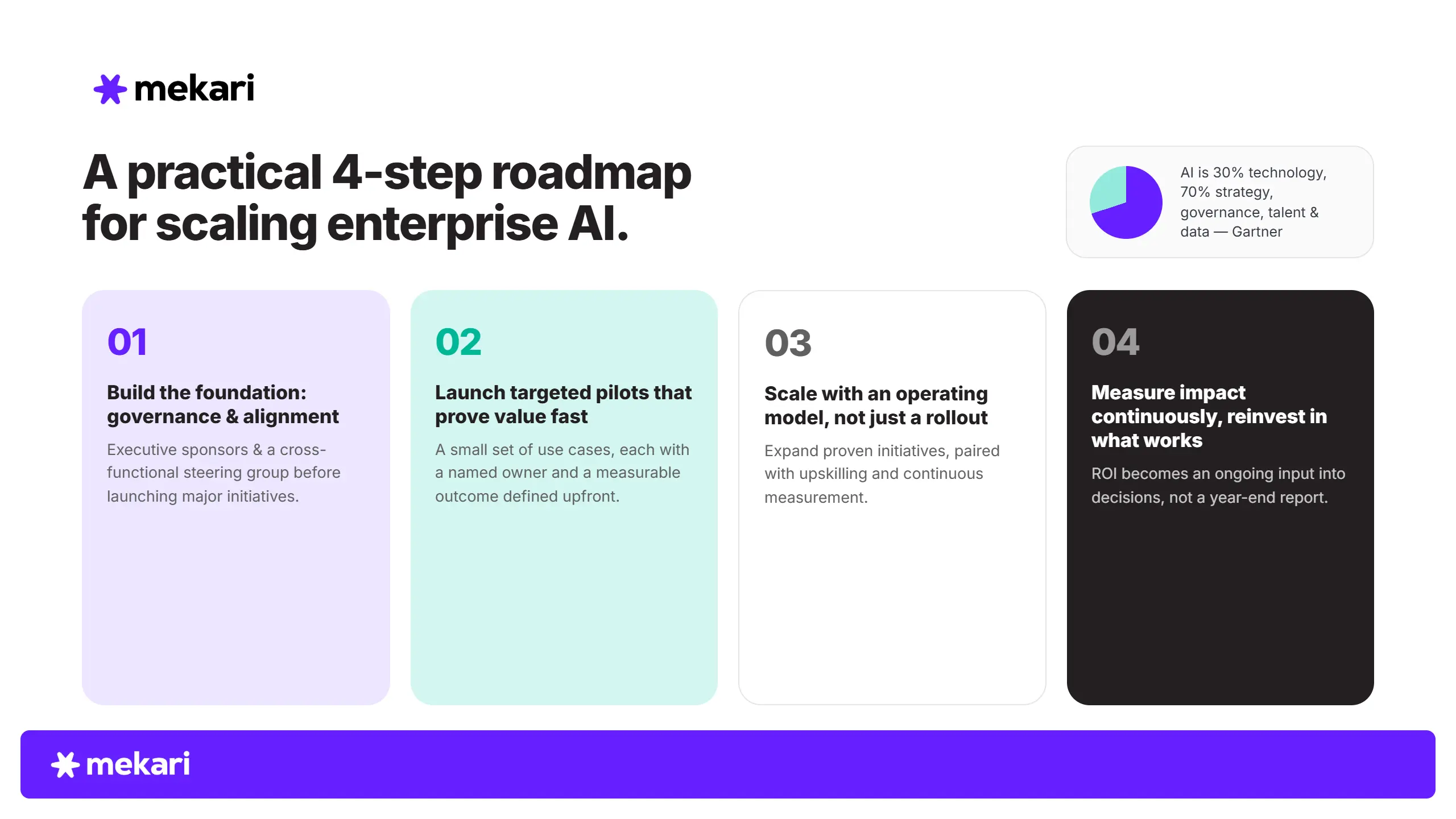
Closing these three gaps is less about picking better technology and more about sequencing.
The four steps below put that sequencing into practice.
Step 1: Build the Foundation: Governance and Executive Alignment
Start by aligning the AI strategy with broader business priorities. Establish executive sponsors and a cross-functional steering group before launching major initiatives.
This creates a clear decision-making structure and reduces the risk of projects getting stuck in approval processes later. It also ensures that AI initiatives have business ownership from the beginning.
Step 2: Launch Targeted Pilots That Prove Value Fast
Prioritize a small number of use cases, each with a named business owner and a measurable outcome hypothesis defined before the pilot starts.
Focus on running one workflow from end to end and measure business value from the start, rather than using adoption or usage alone as the success metric.
Step 3: Scale With an Operating Model, Not Just a Rollout
Organizations that create significant value from AI tend to scale a small number of proven initiatives quickly. They also combine that expansion with systematic upskilling and continuous measurement of operational and financial results.
This means scaling AI is not simply a software rollout. It is an organizational change program supported by technology.
Step 4: Measure Impact Continuously and Reinvest in What Works
ROI measurement should be treated as an ongoing input into decision-making, not a report prepared at the end of the year.
Track financial measures such as cost and revenue alongside operational indicators such as decision speed, customer retention, and employee adoption.
Use those results to determine where additional investment makes sense instead of committing future budgets before there is enough evidence from current initiatives.
AI Readiness Determines Whether an Enterprise AI Transformation Roadmap Succeeds
A roadmap is only as reliable as the foundation underneath it. Organizations looking to create value at scale need to invest in areas such as strategy, value management, organization, talent, governance, engineering, and data. Technology is only one part of the transformation.
Before funding an AI transformation roadmap, your organization should be able to answer four questions:
- Does every priority use case have a named business sponsor and measurable target?
- Is the underlying data clean and accessible enough for an AI system to work with?
- Is there a governance structure that can approve, monitor, and, when necessary, shut down an AI-driven process?
- Does the organization have — or can it access — the talent needed to move a pilot beyond the demo stage?
If the answer to any of these questions is no, that gap should become part of the roadmap itself rather than something to address later.
Global AI Transformation Playbooks Often Miss the Reality of Multi-Entity Enterprises
Much of the available AI transformation research is written from the perspective of single-entity organizations headquartered in the US or Europe. These organizations often have mature data warehouses and dedicated in-house AI engineering teams.
Large organizations operating across multiple legal entities, brands, or outlets in Indonesia and Southeast Asia can face a different starting point. The same transformation principles still apply, but the practical barriers can be very different.
The First Challenge Is Structural
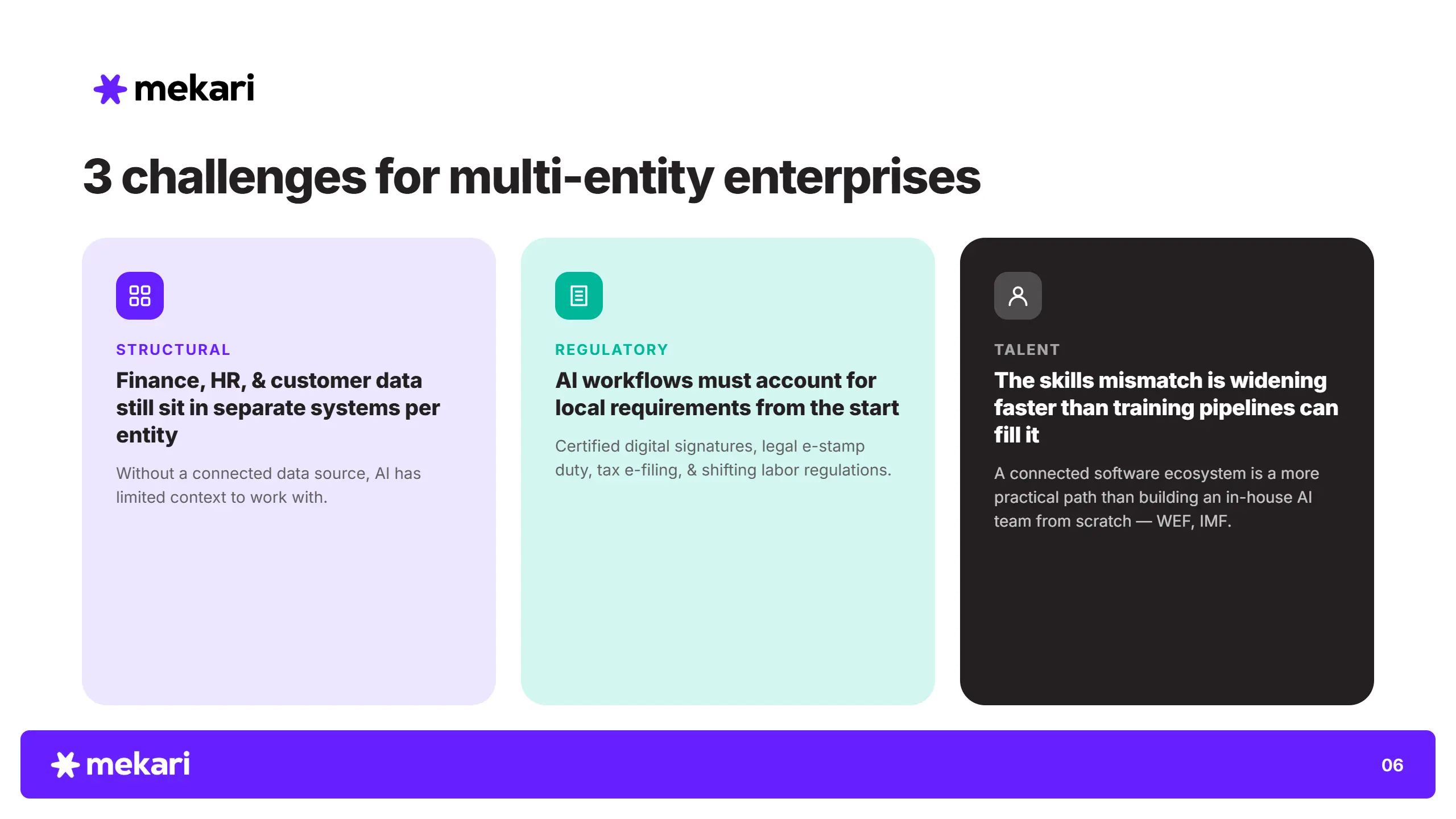
For a multi-brand or multi-outlet organization, the biggest obstacle may not be the AI model. Finance, HR, and customer data may still be stored in separate systems for each entity.
Without a reliable, shared source of information, an AI layer has limited context to work with. Before AI can support decisions across the organization, the underlying operational data needs to be connected.
The Second Challenge Is Regulatory
AI-driven document and finance workflows also need to account for local requirements, including certified digital signatures, legally valid electronic stamp duty, tax e-filing, and changing labor regulations.
For organizations operating across jurisdictions, compliance therefore needs to be part of the workflow design from the beginning rather than added after adopting a global transformation template.
The Third Challenge Is Talent
Global workforce research points to a widening skills mismatch ahead, as automation-exposed roles keep shifting even while demand for AI-literate talent rises faster than training pipelines can fill it (WEF), a pattern the IMF’s own research on reskilling gaps reinforces.
For most enterprises, a connected software ecosystem can provide a more practical path to AI transformation than building custom AI infrastructure and a large machine-learning team entirely in-house.
Mekari’s Enterprise Ecosystem Supports AI Transformation for Large Organizations
Closing the gap between AI adoption and business impact requires the right sequence: build the foundation first, validate use cases through focused pilots, scale what works, and continuously measure the results.
For multi-entity organizations, there is another requirement underneath all of this: a connected operational layer.
Mekari unifies these functions in a single, connected ecosystem for large organizations, so an AI transformation program starts from unified data instead of another disconnected pilot.
Discover how Mekari for large enterprise can fit into your organization’s AI transformation roadmap.

