




Mekari Insight
- Digital transformation in mining is a structural shift in how mining companies operate, connecting mine-floor technology with management systems across HR, procurement, finance, and compliance to generate value across the full operation.
- Mining sits 30 to 40 percent below the digital maturity of comparable industries, yet only 25 percent of operations run customized solutions built around their actual workflows, according to BCG.
- Mekari offers a unified software ecosystem that gives mining companies the tools to digitalize every layer of their operations without rebuilding from scratch, from fleet safety and workforce management to procurement and financial reporting.
Most mining companies have a digital strategy, but few have the results to show for it.
According to BCG’s Digital Acceleration Index, mining industry sits 30 to 40 percent below the digital maturity of comparable sectors, with only 25 percent of operations running solutions actually built around how their mine works.
Digital transformation in mining covers both the operational layer on the mine floor and the management layer across HR, procurement, finance, and compliance.
Getting both layers right is what separates companies that extract lasting value from those that keep cycling through pilots.
This article covers the key drivers, core technologies, and a practical implementation roadmap for mining companies ready to move past the pilot stage.
The Scope of Digital Transformation in Mining
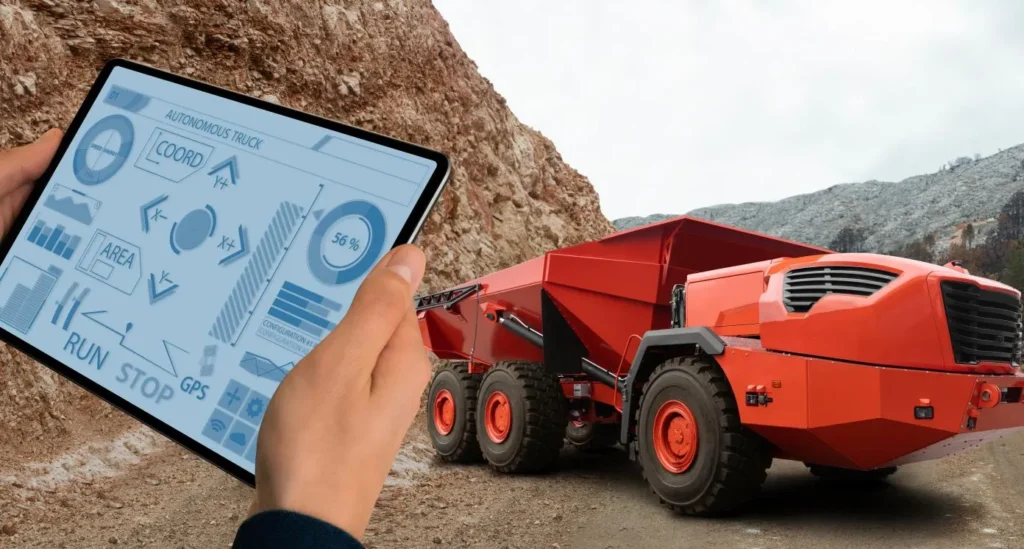
Digital transformation in mining is the integration of digital technology across the full mining value chain, from exploration and extraction to processing, logistics, and back-office operations, to improve efficiency, safety, and decision-making at every stage.
This shift operates across two connected layers:
- Operational technology (OT): Autonomous equipment, IoT sensors, predictive maintenance systems, and real-time production monitoring on the mine floor.
- Information technology (IT): Workforce management, procurement, financial reporting, compliance tracking, and other management systems that govern how the business runs.
Most digital initiatives in mining focus on the first layer. The companies that generate the most value treat both as part of the same program.
Digital transformation is also not purely a technology decision. It requires changes to workflows, data ownership, and how teams make decisions, which is why implementations that skip the people and process layer consistently underperform.
In the context of Industry 4.0, mining is one of the last major industries to fully integrate these capabilities at scale, which is precisely what makes the window for competitive advantage significant right now.
What’s Driving Digital Transformation in Mining?
Digital transformation in mining is not happening in a vacuum. Several compounding pressures are pushing companies to act, and the cost of inaction is rising faster than most operators anticipated.
- ESG and license to operate: Regulatory scrutiny and investor expectations around ESG performance are tightening across the sector.
- Workforce volatility: Aging workforces, talent shortages at remote sites, and a widening digital skills gap create operational fragility.
- Data silos: Disparate systems that cannot exchange data in real time leave management teams making decisions on information that is hours or days out of date.
- Cost pressure and manual procurement: Input costs are rising while ore grades decline, yet manual processes in procurement and supply chain remain widespread.
- Competitive window: Digital maturity across the sector remains low, meaning companies that move now can leapfrog rather than catch up.
The data reflects how acute these pressures have become:
- ESG and license to operate ranked as the top business risk in mining for the third consecutive year, with 41 percent of miners prioritizing a digital ESG tracking platform — EY Mining & Metals Survey 2024.
- 30 percent of mining companies have no digital upskilling plan at all — BCG Digital Acceleration Index.
- Nearly half of mining companies still rely on manual tools for supply chain visibility, despite digitized procurement delivering up to 50 percent productivity gains for those that have made the shift — BCG.
Together, these pressures make digital transformation less of a strategic option and more of an operational necessity for mining companies that intend to remain competitive.
Key Technologies in Mining Digital Transformation
Digital transformation in mining draws on a range of technologies, each addressing a different layer of operational and managerial complexity.
The most impactful implementations combine several of these rather than deploying them in isolation.
1. IoT and Remote Monitoring
Sensors embedded in equipment and infrastructure deliver real-time data on production output, equipment health, and site safety conditions.
This shifts maintenance from a reactive model to a predictive one, reducing unplanned downtime and extending asset life.
2. AI and Machine Learning
AI processes large operational datasets to optimize throughput, improve exploration targeting, and surface predictive insights that manual analysis cannot match.
Applications range from ore grade prediction to automated anomaly detection in processing plants.
3. Automation and Autonomous Equipment
Autonomous haul trucks, drills, and vehicles remove workers from high-risk environments while increasing output consistency and uptime.
Beyond safety gains, autonomy reduces the operational impact of workforce shortages at remote sites.
4. Digital Twins
Digital twins are virtual replicas of mine assets, facilities, or entire sites built from continuous sensor data and simulation models.
They allow operators to test scenarios, optimize extraction plans, and assess environmental interventions without touching live operations.
5. IT/OT Convergence
Connecting information systems with operational technology creates real-time visibility across the orebody, plant, logistics, energy, and workforce in a unified data environment.
This integration layer is where the highest-value outcomes in mining digitalization are consistently found.
6. Low-Code and No-Code Platforms
These platforms enable mining companies to build custom operational applications without long IT development cycles or large engineering teams.
Use cases include HSE compliance systems, fleet safety management, asset tracking, and custom reporting dashboards tailored to each site’s unique workflows.
7. Cloud and Edge Computing
Cloud infrastructure centralizes data management across multiple sites, while edge computing handles processing locally where connectivity is limited.
Together they solve one of mining’s most persistent infrastructure challenges: reliable data capture and analysis at remote locations.
What can mining companies gain with digital transformation: business case
Digital transformation in mining is a capital decision, and executives need more than a list of benefits to justify it. The data on what well-executed digitalization actually delivers makes the case more directly.
- Throughput and efficiency gains: Mining companies that have successfully scaled digital programs report throughput improvements of 10 to 20 percent and procurement productivity gains of up to 50 percent — BCG.
- Safety improvements: Companies that digitalized environment, safety, and workforce functions saw up to a 12 percent reduction in injuries — BCG.
- IT/OT convergence on profitability: A South African iron ore mine that integrated IT and OT systems across its processing circuit achieved a 30 percent increase in saleable product without equivalent new capital investment — Deloitte.
- Operational cost reduction: At China’s Dahaize Coal Mine, integrated digital systems cut coal production costs by approximately US$1.68 per ton and reduced annual labor costs by around US$2.8 million — Deloitte.
- ESG compliance visibility: Digital audit trails, emissions tracking, and automated reporting give companies the data infrastructure to meet growing investor and regulatory disclosure requirements.
- Scalability without proportional headcount growth: Automated workflows in HR, finance, and operations allow companies to expand output without adding headcount at the same rate.
The cost of not acting is equally quantifiable. Deloitte’s research shows that the global mining automation market was valued at US$5.7 billion in 2024 and is projected to reach US$8.7 billion by 2030.
This reflects how quickly the competitive baseline is shifting for companies that delay.
How to Implement Digital Transformation in Mining
Digital transformation in mining rarely fails because of technology. It fails because implementation is treated as an IT project rather than a business transformation. The following framework addresses both layers.
1. Assess Digital Maturity Across Both Layers
Before investing, map where you actually stand. Two layers need separate assessment:
- Operational layer (mine floor): Equipment sensors, plant controls, fleet management, autonomous systems
- Management layer (back-office): HR, payroll, procurement, financial reporting, compliance tracking
The output is a baseline gap map that shows where quick wins are available and where structural investment is needed before advanced technologies can deliver value.
2. Start With High-Value Quick Wins
Prioritize use cases with clear ROI and low implementation risk before tackling full IT/OT convergence. Practical starting points include:
- Sensor-based equipment monitoring and predictive maintenance alerts
- Digitized HSE compliance workflows and incident reporting
- Automated payroll and attendance tracking for remote field workers
- Fleet safety management with real-time operational status monitoring
Quick wins build measurable outcomes and executive buy-in, which are both necessary before larger programs can scale.
3. Address the People and Change Management Layer
Technology adoption in mining fails more often from cultural resistance than from technical limitations.
According to BCG, 30 percent of mining companies have no digital upskilling plan at all.
Deloitte’s work with mining clients consistently shows that the most successful transformations invest as much in leadership alignment and change management as they do in technology.
Field operators need to see digital tools as practical assets that improve their work. Without that buy-in, adoption stalls regardless of how well the technology is implemented.
4. Build for Adaptability, Not Universality
Off-the-shelf solutions consistently underperform in mining because each operation has unique processes, ore characteristics, and regulatory requirements.
BCG found that only 25 percent of mining companies use customized digital solutions, and those that do outperform peers in adoption and outcomes.
Low-code and no-code platforms allow mining companies to build custom operational applications and automate workflows without heavy IT dependency or long development cycles, and adapt those systems as operations evolve.
5. Expand Beyond the Mine Floor
Most mining companies begin digitalization where ROI is most visible: autonomous equipment, IoT monitoring, and predictive maintenance.
According to Deloitte’s Tracking the Trends 2026, the companies generating the most value from digital are those that connect operational data with back-office functions.
This connection is what turns efficiency gains on the mine floor into financial outcomes that actually appear on the balance sheet.
Accelerate Mining Digitalization with Mekari
Mining digitalization does not end at the mine floor. The management layer, from HR, procurement, financial reporting, and compliance, is where most companies still rely on manual processes and disconnected systems.
Mekari is a unified software ecosystem that provides mining operations with the integrated software layer to manage workforce, procurement, financial reporting, compliance, and custom operational applications across the full back-office.
At the core of Mekari’s mining offering is Mekari Officeless, an enterprise software development platform that enables companies to build, automate, and scale custom operational applications.
Mekari Officeless offers a ready-made Heavy Fleet Operations & Safety (HFOS) System, that is purpose-built for mining and heavy industry operations, that covers:
- Fleet asset management: Centralized unit records, hour meter tracking, and real-time operational status monitoring across the entire fleet
- Preventive and predictive maintenance: Scheduling based on usage intervals and manufacturer standards, reducing unplanned downtime
- Daily P2H inspection and incident reporting: Mobile-based field portal for pre-use inspections and on-site incident capture
- Operator SIO certification management: Automatic operational lock when certifications are expired or invalid
- Critical damage escalation: Automatically sets fleet status to “Down” when operators report critical equipment damage
- Real-time fleet health dashboard: Centralized visibility across healthy, warning, and down-status units for operations and HSE teams
- Role-based access control: Separate access levels for field operators, workshop managers, and HSE officers
Together with Mekari Officeless, the full Mekari ecosystem covers every operational layer a mining company needs to digitalize, such as:
- Mekari Talenta: Automates workforce management including geotagged attendance for remote sites, shift scheduling, and payroll with full regulatory compliance.
- Mekari Expense: Enforces budget controls and multi-level approval workflows to eliminate manual procurement and uncontrolled spending across cost centers.
- Mekari Jurnal: Delivers real-time financial reporting, inventory tracking, and supply chain management in one integrated accounting system.
- Mekari Sign: Enables legally valid digital contract signing and e-meterai for vendor agreements, operator certifications, and compliance documentation.
- Mekari Klikpajak: Automates e-Faktur, withholding tax, and e-invoice management per Indonesian tax regulations.
Manage fleet safety, automate workforce compliance, and digitize back-office operations end-to-end with Mekari’s mining industry software.
References and methodology
Methodology
Methodology
Articles published by Mekari Desty are developed using trusted sources, including official data, company reports, academic research, and insights from industry practitioners. Whenever possible, we refer directly to primary sources before drawing conclusions. Our editorial team reviews and verifies the information to ensure accuracy and relevance. All references are listed so readers can trace each piece of information back to its original source.
Our editorial standards
Our editorial standards
- Primary source first: We consult official product documentation and pricing pages directly, not secondhand summaries or aggregator sites.
- Fact-checking: All product features, pricing, and claims are cross-verified against each platform’s official website at the time of writing.
- No paid placement: Tools are selected based on relevance and fit for Indonesian businesses, not commercial arrangements. Mekari Desty is included as a first-party product and is transparently labeled as such.
- Regular review: Articles are periodically updated to reflect product changes or shifts in market relevance.
References
References
Metallurgical Systems. “A guide to digital transformation for mining and minerals processing”

