


Mekari Highlight
- An AI transformation roadmap gives enterprises a structured path for turning AI into execution, aligning use cases with organizational readiness, data, governance, and workforce capabilities.
- A successful roadmap follows five phases: readiness assessment and use-case prioritization, data and governance foundation, piloting under production constraints, production deployment and scale, and continuous improvement.
- Mekari Airene provides a shared AI layer for cross-functional adoption, it can turn selected datasets into summaries, descriptive insights, and actionable recommendations.
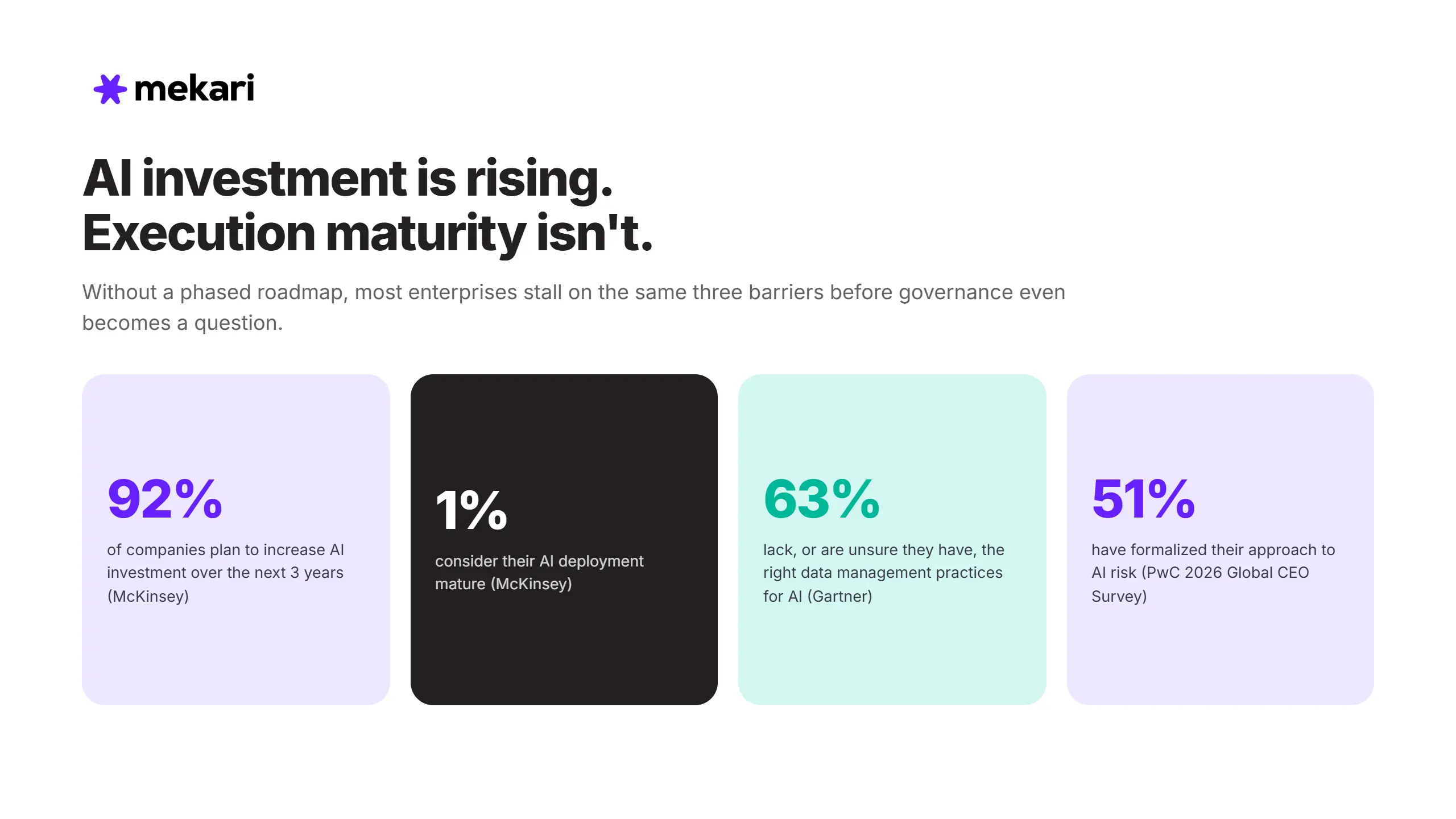
Enterprise leaders are increasing their AI investments, but execution still lags behind ambition.
Data readiness remains another major barrier. Gartner found that 63% of organizations either do not have or are unsure whether they have the right data management practices for AI.
Defining an AI Transformation Roadmap
An AI transformation roadmap is a phased, milestone-driven plan that sequences an organization’s AI initiatives across readiness, data, governance, workforce, and deployment. It is not simply a technology purchase or a static presentation deck.
It also differs from a digital transformation roadmap in its underlying assumptions.
Digital transformation typically focuses on modernizing the organization’s technology and data foundation. AI transformation builds on that foundation by embedding intelligent systems into decision-making and day-to-day workflows.
Organizations should revisit it as AI models, regulations, business priorities, and operating conditions change. Governance and organizational readiness should receive the same level of attention as the technology itself.
Why AI Transformation Roadmaps Are Now a Board-Level Priority
Gartner projects that task-specific AI agents will be present in 40% of enterprise applications by 2026, compared with less than 5% the previous year.
As AI adoption expands across enterprise applications, you need to establish clear boundaries for how AI is used in business processes. This includes defining when AI-generated outputs can be acted on automatically and when human review is required.
This makes AI adoption a structured business program rather than a series of independent experiments. Your organization needs clear ownership, a defined sequence of initiatives, and decision checkpoints to ensure each use case is ready to move from experimentation to production.
Most Enterprise AI Initiatives Fail Without a Structured Roadmap
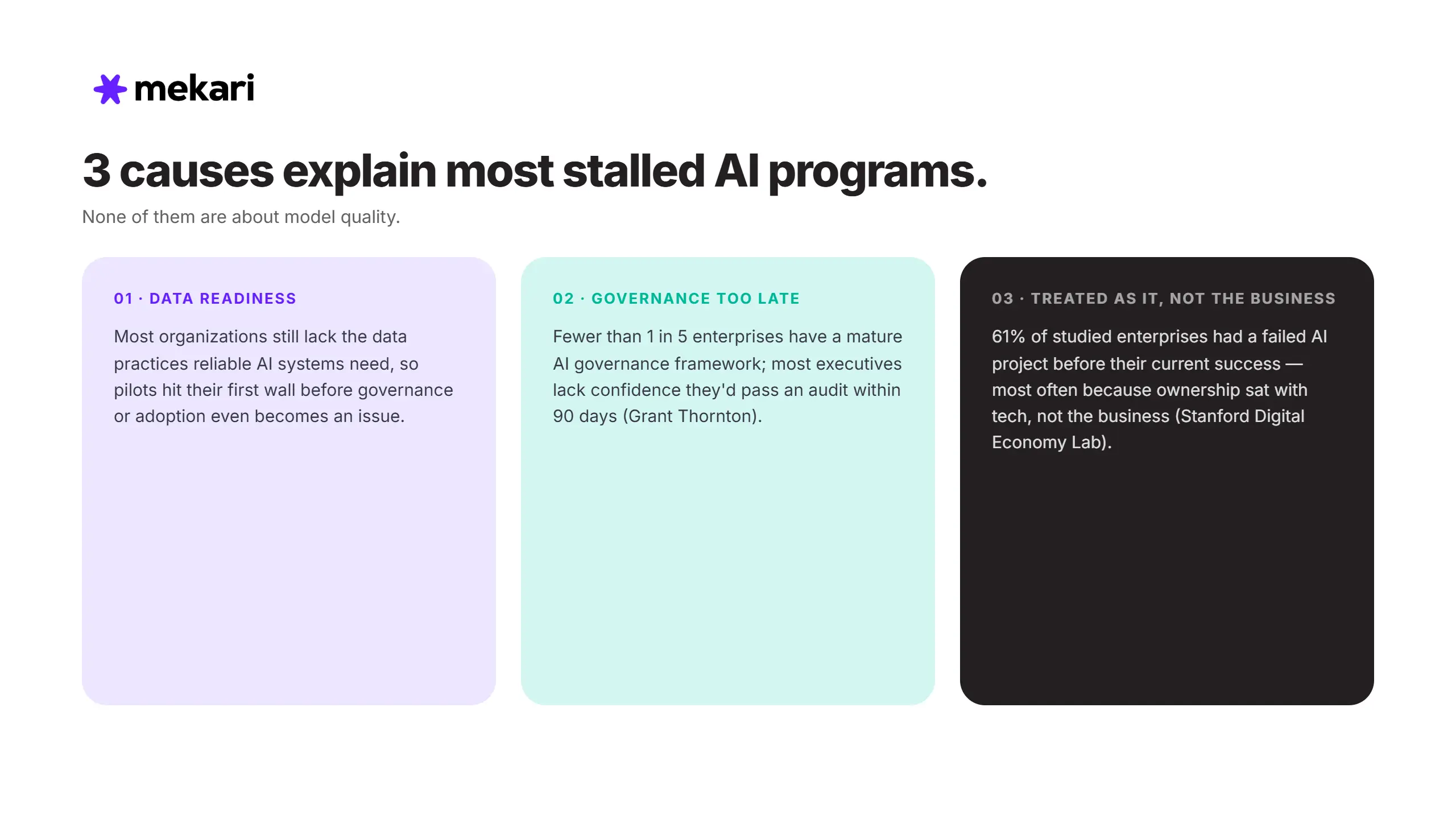
Three causes explain most stalled AI programs, and none are about model quality.
1. Data readiness
A majority of organizations still lack the data management practices required to support reliable AI systems, so pilots hit their first wall long before governance or adoption becomes an issue.
2. Governance that arrives too late
Once a pilot succeeds and the business is ready to scale it, the absence of a governance model can become a bottleneck that engineering teams cannot resolve on their own.
3. Treating AI as an IT initiative rather than a business one
Stanford Digital Economy Lab’s Enterprise AI Playbook, based on 51 enterprise AI deployments, found that 61% of the organizations studied had experienced at least one failed AI project before their current success.
The report found a recurring pattern, early attempts often failed when organizations treated AI as a technology project rather than a process and change management initiative.
Projects were also more likely to stall when technical teams operated without clear business ownership or when organizations expected AI to fix processes that first needed to be redesigned.
This means deploying a technically capable system is only part of the transformation. Without a clear business owner, redesigned workflows, and organizational readiness, an AI initiative can struggle to move from a functional pilot to sustained adoption.
The Phases of an AI Transformation Roadmap
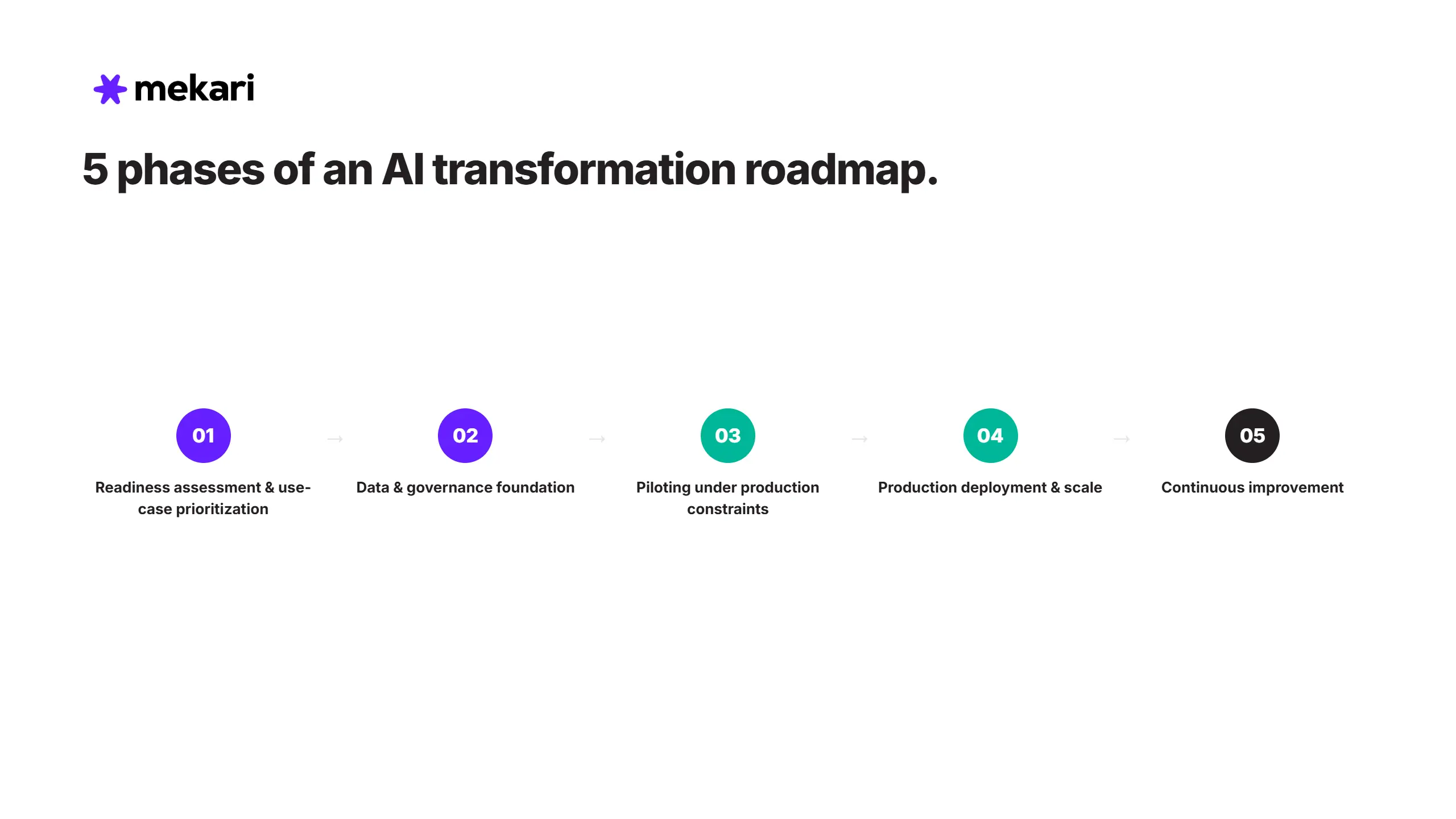
A well-sequenced roadmap moves through five phases, each building the foundation the next one depends on.
1. Readiness Assessment and Use-Case Prioritization
The first phase establishes a current-state view of data maturity, platform architecture, governance controls, and workforce readiness.
The goal is to identify the handful of use cases where conditions already clear a minimum bar, routing the rest into a remediation track instead of a pilot track.
2. Data and Governance Foundation
AI depends on data that is both trusted and accessible, as well as a governance model with clearly defined ownership. These foundations should be established before deployment begins.
Building them from the start helps avoid a common pattern in which governance is retrofitted only after a pilot succeeds and sensitive data has already entered unmanaged systems.
3. Piloting Under Production Constraints
An effective pilot should test the entire workflow rather than simply determine whether a model can generate accurate answers in a demonstration.
This includes the data pipeline, escalation process, monitoring requirements, and operating costs against predefined success criteria.
This makes the pilot phase an important point for identifying infrastructure gaps that should have been addressed during the earlier foundation phase.
4. Production Deployment and Scale
Moving a successful pilot into production is often more of an organizational transition than a technical one. The process typically involves security, legal, and business ownership.
Deployment pipelines, monitoring processes, and rollback plans must align with how the business will actually operate and use the AI system. Clear ownership also needs to remain in place after deployment.
5. Continuous Improvement
Production deployment does not mark the end of the AI lifecycle. Model drift, changing cost patterns, and new edge cases often become visible only after a system operates at scale.
For this reason, an AI roadmap should establish an ongoing review cadence rather than treating the launch date as the final milestone.
Decision Gates That Keep an AI Transformation Roadmap on Track
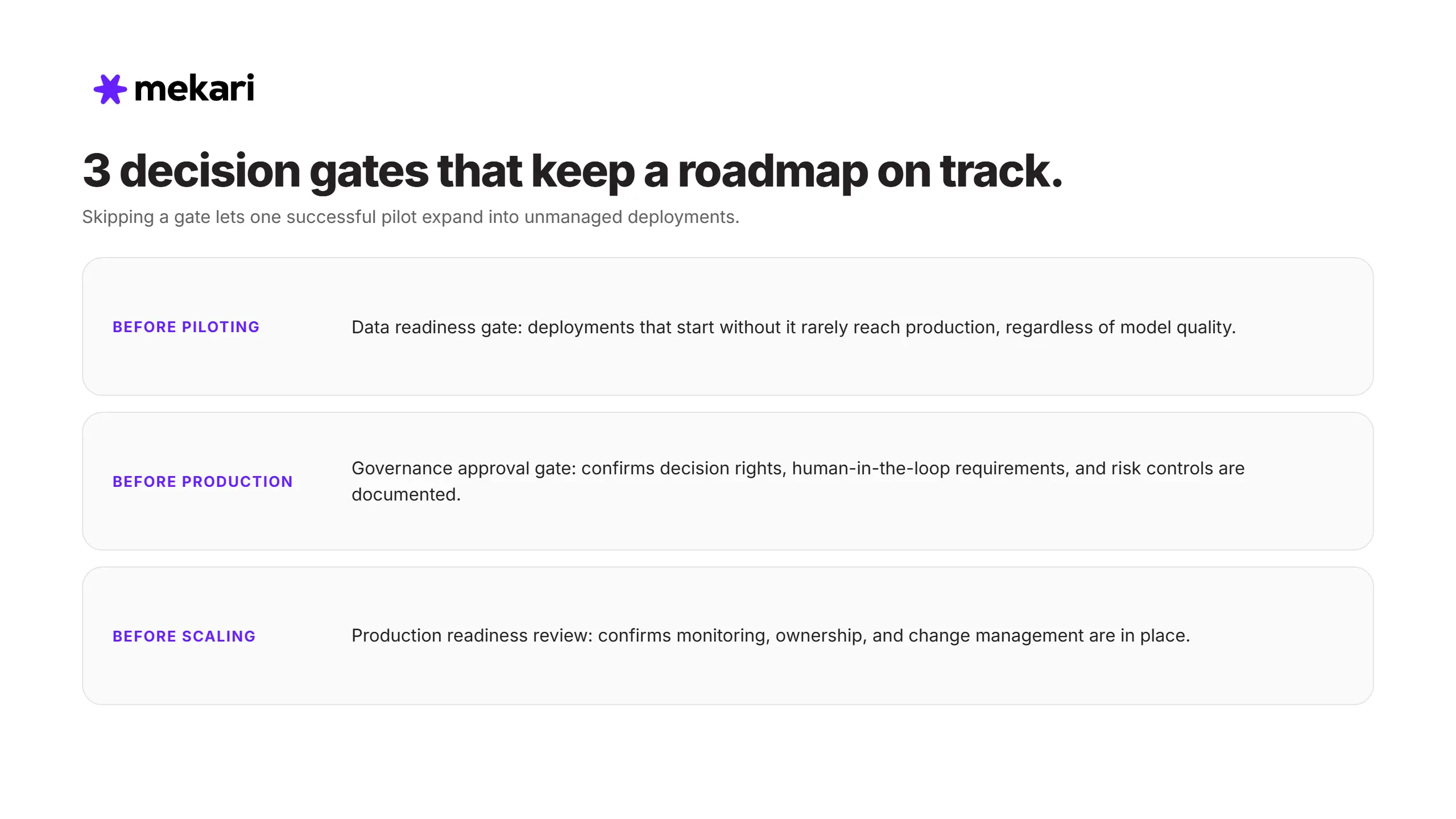
Between each phase, organizations should establish a decision gate to confirm that they are ready to move forward.
The data readiness gate, which should be cleared before a pilot begins, is one of the most important checkpoints in the roadmap. Deployments that start without adequate data readiness are unlikely to reach production regardless of model quality.
The governance approval gate, which should be cleared before production deployment, confirms that decision rights, human-in-the-loop requirements, and risk controls have been documented. This helps prevent a functional system from being deployed without clear accountability for errors or decisions.
The production readiness review, which takes place before further scaling, confirms that monitoring, ownership, and change management processes are in place. Skipping this checkpoint can allow one successful pilot to expand into multiple unmanaged deployments.
Centralized, Federated, or Hub-and-Spoke: Choosing an AI Operating Model
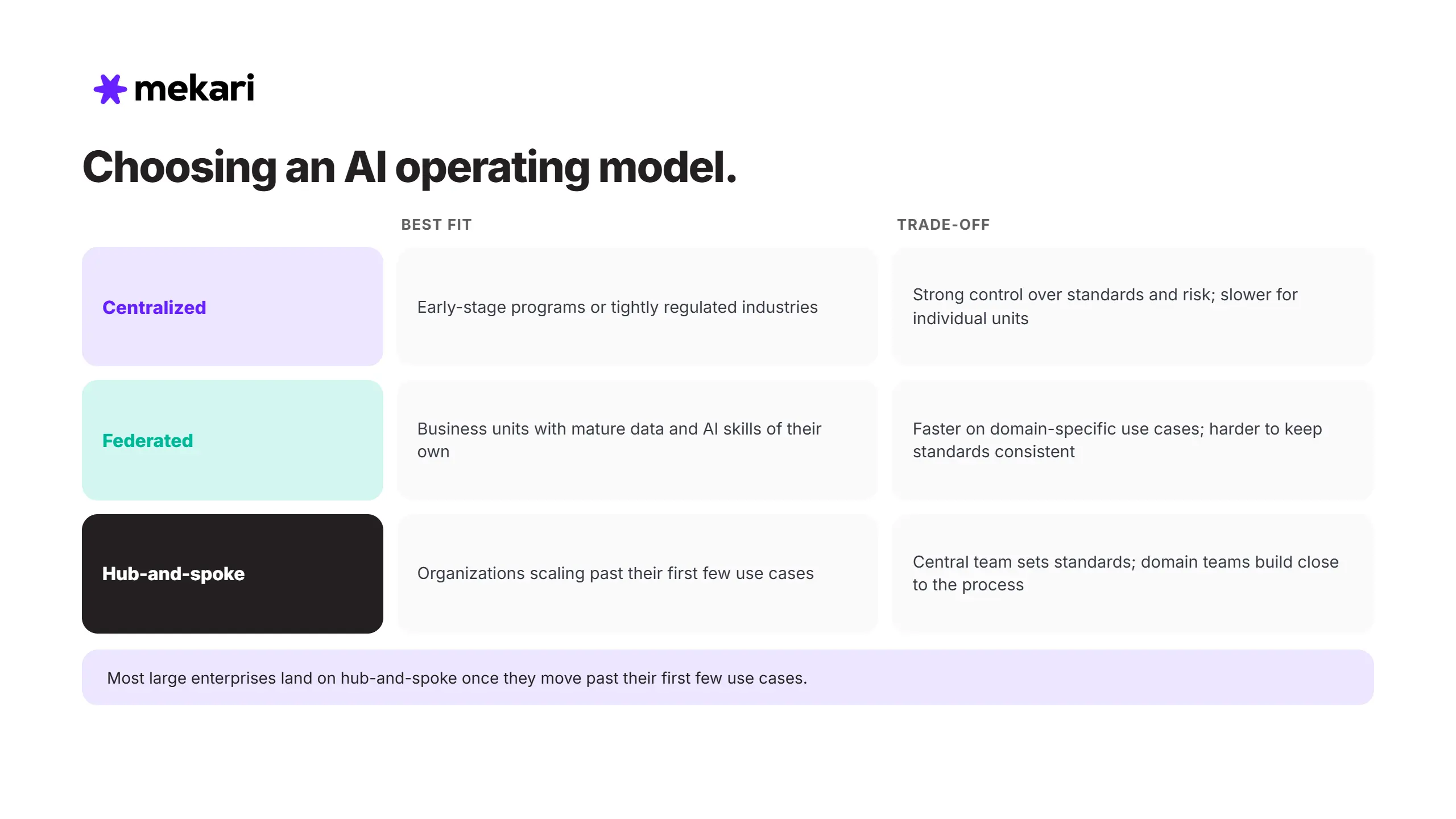
The operating model an enterprise chooses determines how much AI work is centralized versus pushed out to individual business units. Most organizations converge on one of three patterns:
| Model | Best fit | Trade-off |
|---|---|---|
| Centralized | Early-stage programs or tightly regulated industries | Strong control over standards and risk; slower for individual business units |
| Federated | Business units with mature data and AI skills of their own | Faster on domain-specific use cases; harder to keep standards consistent |
| Hub-and-spoke | Organizations scaling past their first few use cases | A central AI team sets shared standards; domain teams build close to the business process |
Most large enterprises land on the hub-and-spoke model once they move past their first few use cases, since it keeps evaluation methods and reusable components consistent without every business unit rebuilding the same foundation from scratch.
The Cross-Functional Blueprint for Putting the Roadmap Into Practice
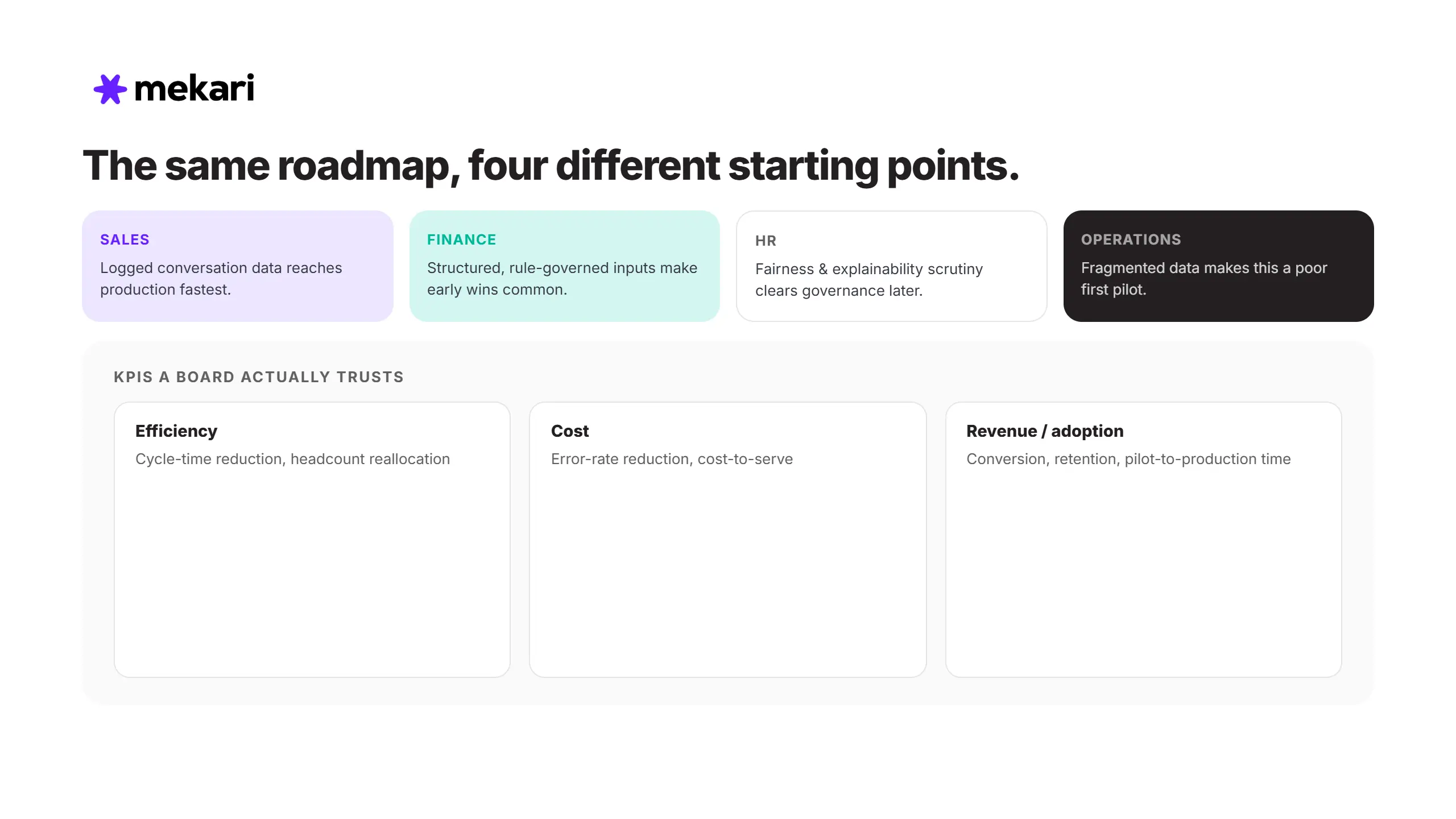
The same five phases look different depending on which function is running them, and the constraint that shapes the timeline differs by department too.
1. Sales and Customer Engagement
Conversation-level data, including chats, calls, and support tickets, is often one of the more accessible starting points because it is already logged, timestamped, and associated with customer records.
Conversational AI agents and pipeline scoring can therefore reach production faster than many other initial use cases, provided that data access and governance requirements are already in place.
2. Finance and Accounting
Finance reporting automation and anomaly detection are common early use cases because their inputs are generally structured and governed by established rules.
Scaling beyond these initial applications often depends on the same data and governance foundation established during Phase 2.
3. Human Resources
Workforce analytics and attrition prediction are attractive candidates on paper, but they carry higher scrutiny around fairness and explainability. As a result, they tend to clear the governance gate later than sales or finance use cases.
4. Operations and Supply Chain
Demand forecasting and inventory optimization can generate significant value at scale, but they often depend on data from fragmented sources across the enterprise.
This dependency makes these use cases less suitable as initial Phase 1 pilots unless the organization already has the necessary data foundation.
The KPIs That Matter to a Board When Measuring AI Transformation
A roadmap earns lasting executive trust when its KPIs map to metrics finance and operations already report on, not a separate AI dashboard only the AI team reads.
Three categories are particularly relevant:
- Efficiency: cycle-time reduction and headcount reallocation
- Cost: error-rate reduction and cost-to-serve
- Revenue or adoption: conversion, retention, and time from pilot to production
How Mekari Supports an AI Transformation Roadmap End-to-End
Building an AI transformation roadmap is ultimately a sequencing exercise: choosing the right first use case, governing it properly, and reusing what works instead of rebuilding AI separately for every department.
Mekari unifies this kind of cross-functional AI adoption through Mekari Airene, a shared AI layer that runs across multiple products rather than requiring a separate build per function.
- Turns a selected dataset into a default summary, a descriptive insight, and an actionable recommendation, cutting the manual work behind recurring reports.
- Runs as an add-on across Mekari Talenta (HR), Mekari Qontak (CRM and omnichannel), and Mekari Jurnal (accounting), giving Sales, HR, and Finance a shared AI layer instead of three separate initiatives.
- Applies encryption, access controls, and regular security audits to the data it processes, the kind of baseline control that helps a use case clear a roadmap’s governance gate.
For enterprises evaluating how data security fits into a broader AI governance strategy, a shared AI layer combined with enterprise-grade security can help translate the operating-model principles of an AI roadmap into an operational approach.
Explore Mekari Airene to see how it fits your first AI transformation use case.

