



Mekari Insight
- Enterprise workflow automation represents a structured approach to orchestrating cross-departmental business processes, ensuring consistency, governance alignment, and reduced manual dependency.
- Through workflow automation, organizations establish stronger operational governance, maintain end-to-end process visibility, and support standardized execution across distributed business functions.
- Mekari Officeless supports enterprise workflow automation through a low-code/no-code architecture, part of Mekari unified software ecosystem, enabling companies to configure integrated workflows without unnecessary technical overhead.
To manage increasing operational complexity, enterprises require structured workflow architectures that coordinate cross-functional processes, distributed teams, and multi-system environments.
Enterprise workflow automation provides a framework to standardize execution, reduce manual intervention, ensure policy adherence, and minimize operational risk associated with inconsistent processes.
To further understand its application, it is essential to examine how enterprise workflow automation operates within business environments, along with platform capabilities that support orchestrated and governed automation.
What is enterprise workflow automation?
Enterprise workflow automation is the application of automation technologies to reduce or eliminate manual intervention across large-scale organizational workflows.
This approach involves the orchestration of multiple systems and tools to ensure that business processes operate within a structured, standardized, and governed environment.
Within enterprise environments, operational complexity spans multiple departments, systems, and regions. Workflow automation operates through defined triggers, progressing through structured stages with predefined outputs aligned to business rules.
Unlike traditional automation tools that replicate manual execution, contemporary enterprise workflow automation incorporates AI-driven capabilities to:
- Interpret operational context
- Execute decision logic programmatically
- Adapt workflows based on evolving business requirements
Baca Juga: What Is a File Management System and Why Your Business Needs OneBenefit of enterprise workflow automation
The implementation of enterprise workflow automation contributes to measurable improvements in organizational performance.
1. Measurable ROI
Workflow standardization and automation contribute to optimized resource allocation, reduced operational expenditure, and improved process governance.
Leading organizations have demonstrated automation completion rates of up to 84%, alongside significant cost optimization through the transition from reactive IT operations to intent-driven service models. – Aisera.
2. Accelerated task execution
Structured workflows reduce processing time across operational tasks, minimizing bottlenecks and improving process throughput.
3. Strengthened governance
Centralized monitoring and workflow visibility support access control, process validation, and adherence to operational standards across the organization.
4. Structured cross-team alignment
Defined workflows establish clarity in roles and responsibilities, supporting coordinated execution across teams and reducing operational misalignment.
5. Increased workforce productivity
The reduction of repetitive administrative tasks enables workforce reallocation toward strategic and value-driven activities.
6. Accuracy and compliance
Standardized workflows ensure consistency in execution, reduce data discrepancies, and maintain audit trails to support regulatory compliance.
7. Operational insight generation
Automation frameworks generate structured data, enabling the identification of process inefficiencies and supporting continuous improvement initiatives.
8. Scalable operational capacity
Automation enables organizations to manage increased workload volumes without proportional increases in resource allocation.
Baca Juga: 7 Best AI & Workflow Automation SaaS ToolsEnterprise workflow automation software recommendation
To operationalize enterprise workflow automation, organizations require platforms capable of orchestrating complex processes within governed environments.
1. Mekari Officeless
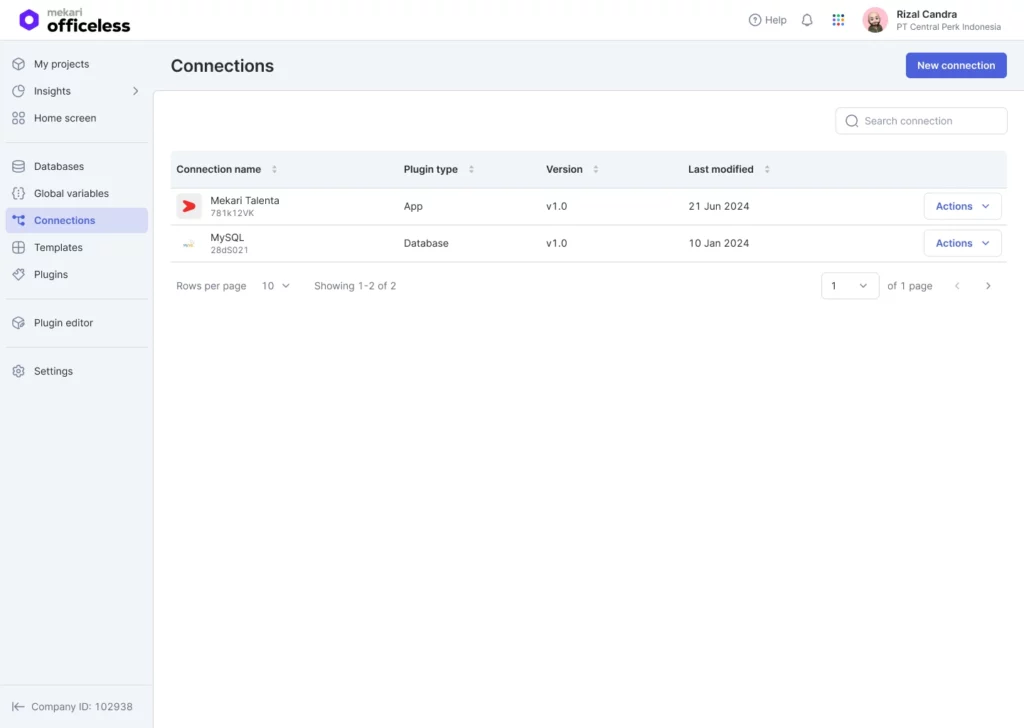
Mekari Officeless is an enterprise application development platform that enables workflow automation, part of Mekari unified software ecosystem, that enables workflow automation, application configuration, and analytics within a unified environment.
Through a low-code/no-code architecture, the platform facilitates cross-functional workflow configuration aligned with governance and operational standards.
Key capabilities of Mekari Officeless:
- Visual workflow configuration (drag-and-drop): Enables the configuration of automated workflows through a structured visual interface, reducing dependency on manual coding.
- Cross-application process orchestration: Eliminates fragmented data handling by connecting multiple applications within a unified and standardized workflow architecture.
- API, event, and webhook support: Facilitates real-time, bidirectional data exchange across systems to maintain data consistency and synchronization.
- Integration with external systems: Orchestrates interoperability with enterprise platforms such as SAP, WhatsApp, Artajasa, Traveloka, and other operational systems.
- Alignment within the Mekari ecosystem: Supports unified integration with Mekari products, enabling coordinated workflows across interconnected systems.
2. Webcon
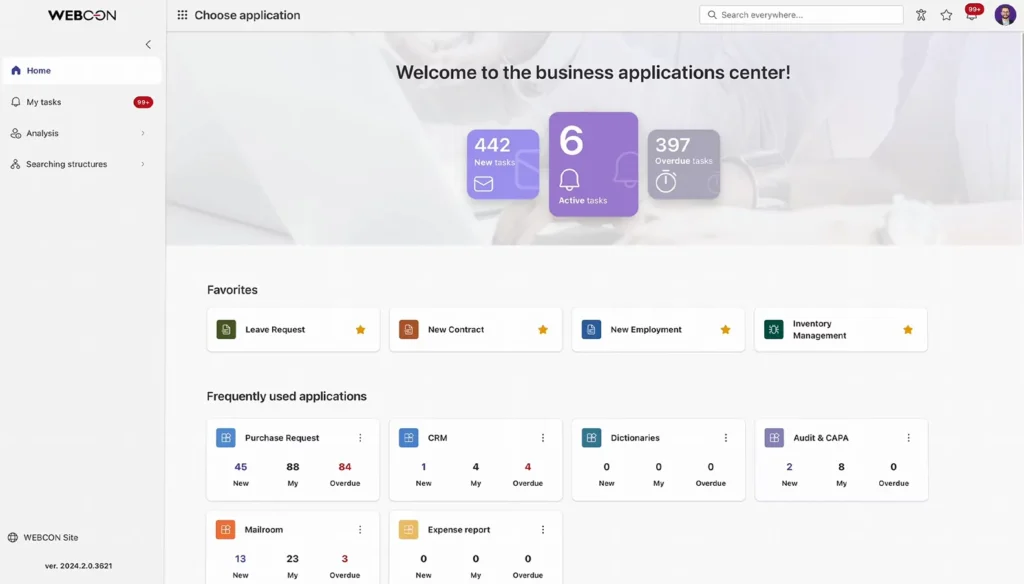
Webcon is an automation platform designed to help organizations manage, optimize, and orchestrate business processes in a centralized environment while aligning them with operational requirements.
Key capabilities:
- Connects data, processes, and users within a single integrated workflow with clear visibility.
- Supports workflow management with strong governance to ensure processes run according to company policies.
- Replaces repetitive and paper-based tasks with more standardized digital workflows.
- Enables organizations to design workflows aligned with specific operational processes.
3. N8N
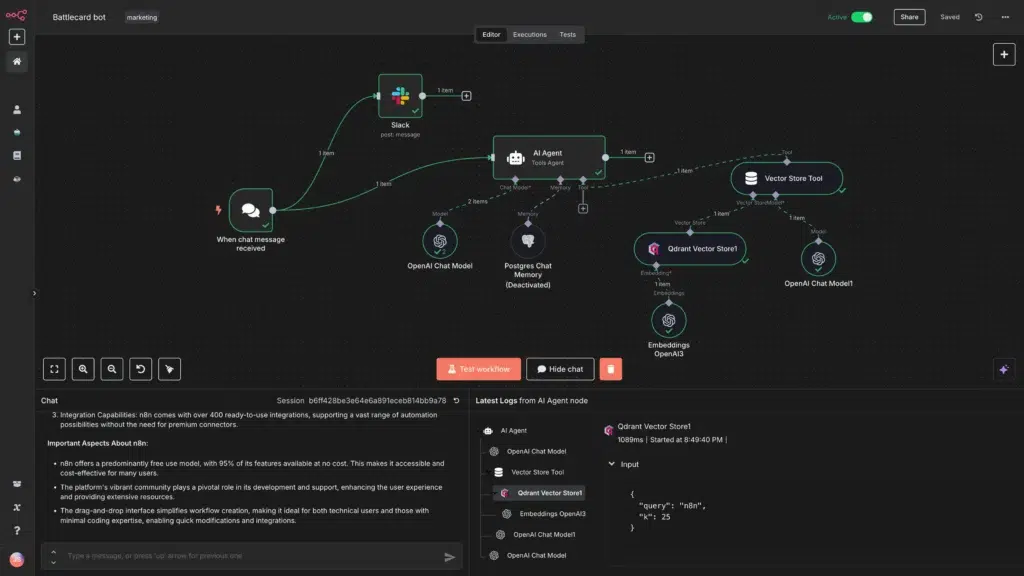
N8N is an open-source workflow automation platform that enables organizations to build and manage workflows, including AI-driven workflows, with a high level of flexibility.
Key capabilities:
- Provides visibility into every process step, including logic and workflow execution.
- Connects various data sources, applications, and AI models within a single workflow.
- Supports direct evaluation of AI performance to ensure workflows operate according to requirements.
- Provides full visibility into each process step, including logic and workflow execution.
4. Activepieces
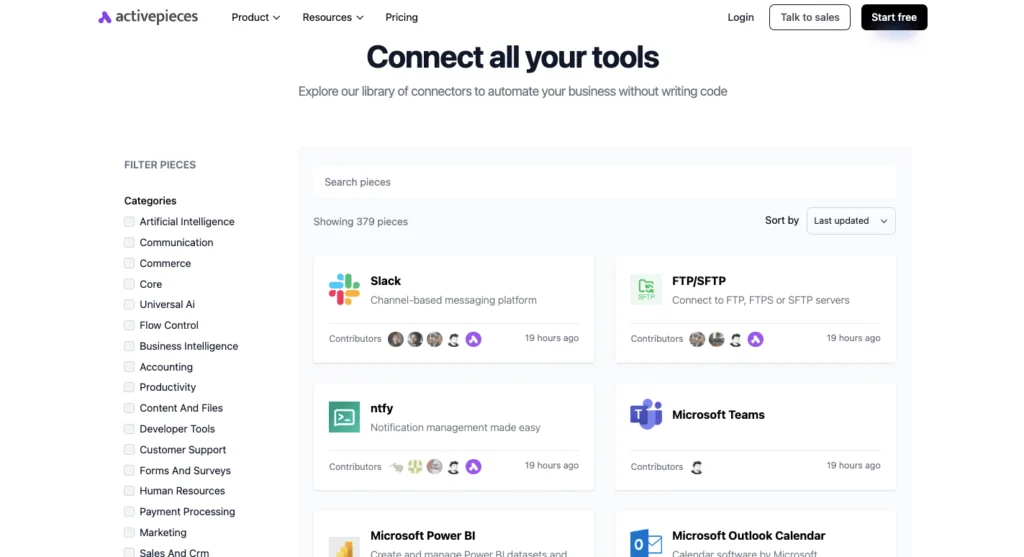
Activepieces is an open-source automation platform designed to provide organizations with full control in building automation without vendor dependency.
Key capabilities:
- Provides organizations with control over data, deployment, and workflow development based on internal requirements.
- Workflows can be built using structured steps and logic that are easy to understand.
- AI can be directly utilized within workflows for use cases such as classification, routing, and decision support without requiring complex additional integration.
- Provides hundreds of templates to accelerate implementation without building from scratch.
5. UiPath
UiPath is an automation platform widely used by enterprises to orchestrate high-volume, rule-based operational tasks.
Key capabilities:
- Provides control over scheduling, monitoring, and access to all automation activities within a single dashboard.
- Connects with various applications through APIs and connectors to support cross-system workflows.
- Enables automation development through a drag-and-drop interface with advanced logic support for complex requirements.
- Identifies automation opportunities based on analysis of user and system activities.
6. Workato
Workato is a platform that combines a low-code approach with extensive integration capabilities to support end-to-end business process orchestration.
Key capabilities:
- Enables business teams to build automation, with options for advanced development to support complex requirements.
- Supports integration with various cloud and on-premise systems through prebuilt and custom connectors.
- Defines triggers, actions, and data flows within a structured workflow.
- Processes integrated data by mapping and transforming it directly within workflows.
7. Make
Make is a visual automation platform that enables organizations to build structured workflow logic, where each step is represented as a module to provide clear process visibility.
Key capabilities:
- Displays the entire workflow within a single canvas to support end-to-end process mapping.
- Supports workflow branching based on defined conditions to handle multiple operational scenarios.
- Enables data transformation, filtering, and aggregation directly within automation processes.
- Connects applications through API and webhook-based integrations.
8. Lindy
Lindy is an AI-based automation platform designed to orchestrate activities across email, calendar, and communication tools using a natural language-based approach.
Key capabilities:
- Workflows can be triggered automatically based on emails, messages, meetings, or other system activities.
- Provides prebuilt templates for common use cases.
- Workflow logic can be defined without scripting, enabling broader usability across teams.
- Enables task configuration using natural language without requiring technical setup.
9. ServiceNow
Key capabilities:
- Enables the creation of visual workflows to manage requests, approvals, and operational processes.
- Connects with enterprise systems such as ERP, CRM, and email through APIs and built-in connectors.
- Uses a unified data model to manage and store data consistently across departments within a single system.
- Distributes tasks automatically based on rules, roles, and workload.
10. Qntrl
Qntrl is a workflow orchestration platform that enables organizations to manage, automate, and optimize business processes through configurable workflow structures aligned with operational requirements.
Key capabilities:
- Provides customizable workflows aligned with operational requirements and business objectives.
- Connects with various tools through APIs, webhooks, and cloud or on-premise integrations.
- Supports custom functions, client-side, and server-side scripting for more advanced requirements.
Best workflow automation software for enterprise
Mekari Officeless is an enterprise software development platform, part of Mekari unified software ecosystem, designed to automate complex workflows across departments through an integrated SaaS platform.
With Mekari Officeless, companies can operationalize enterprise workflow automation through Custom Workflow services by automating workflows across systems. This enables business teams to access, process, and present data within a single dashboard without the need to build integrations from scratch.
With Mekari Officeless, companies can:
- Create and manage workflows without complex processes, enabling usage by both technical and non-technical teams.
- Utilize API, event, and webhook support to ensure data synchronization and automation operate consistently.
- Support integration with various external systems such as SAP and WhatsApp, as well as maintain connectivity across the Mekari ecosystem.
Consult your business automation requirements with Mekari Officeless!
Reference
Aisera. “Creating a New Era for ITSM with Agentic AI”

