




Mekari Insight
- Enterprise application modernization helps companies transform legacy systems into modern application architectures that are more scalable and better prepared to adapt to business changes.
- By leveraging technologies such as cloud computing, microservices, containerization, and AI, enterprise application modernization enables companies to improve system performance while driving digital innovation.
- Mekari Officeless supports enterprise application modernization through a low-code/no-code platform that allows businesses to build and modernize applications without relying heavily on traditional code-based development.
Many companies still rely on legacy systems that were built years ago. As a result, these systems become difficult to update, costly to maintain, and unable to keep up with evolving business needs.
Through an enterprise application modernization (EAM) approach, companies can transform legacy systems into modern architectures that better support sustainable and evolving business requirements.
What is enterprise application modernization?
Enterprise application modernization is the process of transforming legacy technologies into modern systems through a series of engineering efforts, including system redesign, architectural restructuring, and migration to cloud infrastructure.
Modernization typically involves the use of technologies such as cloud computing, microservices, containerization, and artificial intelligence to improve system performance.
Unlike standard updates that only focus on minor improvements, enterprise application modernization involves comprehensive changes to application infrastructure. The goal is not merely to fix existing systems but to ensure that applications can continuously support evolving business needs.
Application modernization often includes migrating systems to public cloud, private cloud, or on-premises environments. This migration process enables companies to improve performance and operational efficiency by leveraging modern technologies.
According to a report by Market Research Future, the application modernization services market is projected to reach $24.8 billion by 2030, with an estimated annual growth rate of around 16.8% from 2022 to 2030. This projection indicates that more companies are recognizing the importance of modernizing their systems to maintain profitability.
Benefits of application modernization
Application modernization provides several benefits for companies, including:
- Scalability: Supports increased transaction volumes and data growth, while allowing companies to adjust capacity based on business needs.
- Adoption of new technologies: Opens opportunities to integrate modern technologies such as cloud computing, microservices, containerization, and AI.
- Stronger security: Enables companies to implement modern security mechanisms to protect sensitive data.
- Agility: Allows development processes to adapt more easily to continuously evolving business requirements.
- Competitive advantage: Leveraging new technologies through modernization helps improve service quality and strengthen a company’s position in the market.
Challenges in the implementation process
Despite its many benefits, implementing enterprise application modernization (EAM) also presents several complex challenges.
- Complex legacy systems: Legacy systems built with outdated technologies make analysis and modernization more difficult, requiring teams to fully understand complex system structures.
- Microservices complexity: Architectural changes require careful planning to avoid orchestration issues or data inconsistencies.
- Data integration during migration: Errors during migration processes can lead to data loss or information corruption.
Baca Juga: Guide to Choose Low Code vs Traditional DevelopmentSigns that legacy systems are hindering business growth
Many companies do not realize that legacy systems can hinder business growth. Therefore, organizations need to understand the characteristics of older applications that require modernization.
One of the most common indicators is a monolithic architecture, where all application components are tightly integrated. As a result, even small changes can affect the entire application. This situation often makes adding new features and improving system performance more complex and costly.
In the IT context, legacy applications typically have several characteristics, including:
- Outdated technology: The system is built using outdated technologies that are no longer compatible with modern standards.
- Suboptimal performance: Slow response times that reduce overall productivity.
- Security vulnerabilities: Weak security systems due to the lack of adequate security updates.
- High maintenance costs: Maintenance becomes expensive because legacy systems require significant resources to operate and maintain.
- Limited scalability: The system is difficult to expand as business needs continue to grow.
- Low adaptability: Legacy systems struggle to adapt to changing business requirements because they still rely on outdated technologies.
Baca Juga: Guide to Choose Traditional vs Web Based Systems DevelopmentApplication modernization strategy framework
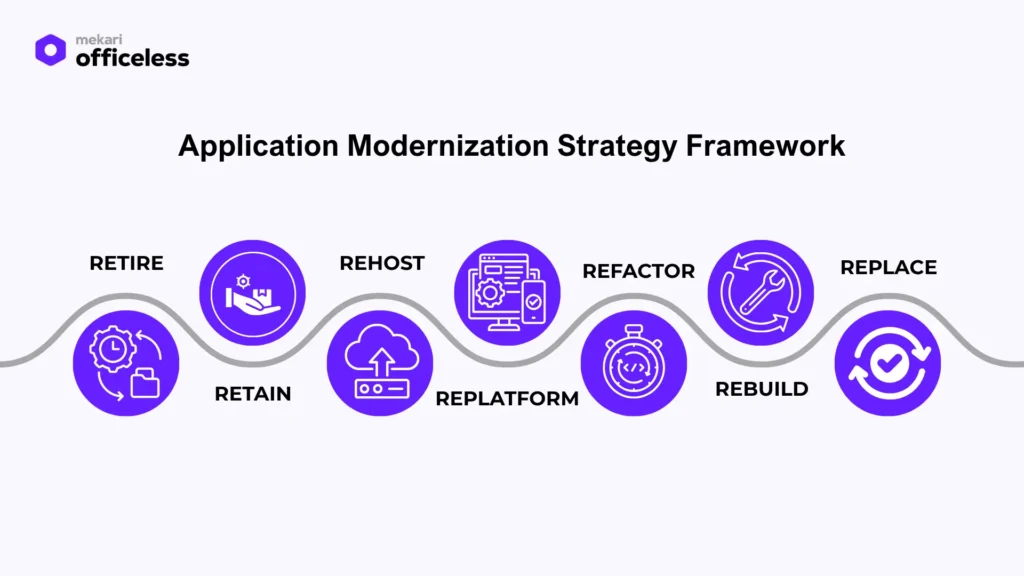
During the implementation process, companies can use the 7R strategy framework from AWS to help determine the most appropriate modernization approach based on business needs.
1. Retire
Deactivate applications that are no longer used and no longer provide value to the organization.
2. Retain
Keep the application as it is if it still functions well or if modernization would introduce excessive risk.
3. Rehost
Move the application to the cloud without modifying the core code, commonly referred to as “lift and shift.”
4. Replatform
Migrate the application to the cloud while making minor adjustments to improve performance.
5. Refactor
Optimize parts of the application code to support new features and reduce technical overhead.
6. Rebuild
Rebuild the application using a new architecture that is easier to scale, such as breaking down a monolithic system into microservices.
7. Replace
Replace the legacy system with a completely new system built using modern technologies.
Key technologies in business application modernization
Enterprise application modernization involves various technologies to build structured and scalable systems, including:
Cloud computing
Cloud computing serves as the foundation of enterprise application modernization. Migrating local infrastructure to the cloud allows companies to build scalable, secure infrastructure that supports operational needs.
Containerization
Containerization packages applications in a standardized format so they can run consistently across different platforms. This approach supports more efficient deployment and structured lifecycle management.
Microservices
Microservices architecture breaks down large applications into smaller, independent services. This allows system updates to be implemented smoothly without affecting the entire application.
Artificial Intelligence
AI-based technologies such as machine learning help companies automate operational processes, perform data-driven analysis, and support more informed decision-making.
DevOps
Within a coordinated workflow, DevOps integrates software development with IT operations. This approach helps organizations improve delivery consistency while maintaining software development quality.
Internet of Things
IoT provides real-time data streams from various devices, enabling companies to build automated systems and improve visibility into business operations.
Low-Code / No-Code
Low-code and no-code platforms allow companies to build applications through a configuration-based approach with minimal reliance on manual coding. They support legacy applications through standardized development and accelerate the implementation process.
Baca Juga: How to Accelerate Agile Software Development with Low CodeRecommended low-code/no-code platform for enterprise application modernization
Low-code and no-code have become key technologies in supporting enterprise application modernization initiatives.
For this reason, Mekari Officeless provides a low-code/no-code platform that enables companies to build and develop business applications within a structured architecture.
Through a visual, configuration-based approach with drag-and-drop functionality, Mekari Officeless allows cross-functional teams to design, customize, and implement applications without relying heavily on traditional code-based development. This helps companies continuously modernize legacy systems in line with evolving business operations.
Some advantages of Mekari Officeless in supporting enterprise application modernization include:
- A self-service solution for managing complex business processes
- Optimized IT resource allocation through configuration-based application development
- Enterprise-ready features and security designed to support business operations
- Flexible deployment options, including on-premise or private cloud based on company infrastructure policies
Consult your enterprise application modernization needs with Mekari Officeless and build business applications that are more standardized and integrated.
Reference
Market Research Future. “Application Modernization Services Market”

