




Mekari Insight
- Revenue forecasting is the process of estimating future business revenue using historical data, sales pipeline analysis, and predictive analytics to support strategic planning.
- Accurate revenue forecasting helps companies avoid mistakes such as over-hiring, inventory shortages, and budget misallocation, while also improving efficiency and business stability.
- With Mekari Expense, businesses can ensure that expense data is accurate and real-time, making the revenue forecasting process more precise, transparent, and reliable.
Errors in revenue forecasting are not just about numbers missing the mark in financial reports.
The impact goes much deeper and is more tangible, poor hiring decisions, disorganized inventory management, and misdirected investments. A single projection error can trigger a chain reaction that harms the entire business operation.
This article will discuss the most reliable forecasting methods, the role of AI in improving accuracy, steps to build a process trusted by finance and sales teams, and how technology can close existing gaps.
What is revenue forecasting?

Revenue forecasting is the process of estimating future revenue using historical data, sales pipeline analysis, market signals, and AI-based predictive models. It is a discipline that requires proper methodology, clean data, and consistent processes.
Simply put, revenue forecasting answers the question: “How much revenue will we generate in the next 3, 6, or 12 months?” and the answer becomes the foundation for nearly every strategic business decision.
There are four business areas directly impacted by the quality of revenue forecasting:
- Budgeting accuracy: Forecasts drive headcount planning and operational budget allocation.
- Investor confidence: Public companies with consistent forecast accuracy tend to receive higher valuation multiples.
- Supply chain planning: Demand forecasts determine inventory levels, supplier orders, and logistics capacity.
- Sales performance management: Accurate pipeline forecasts enable more precise quota-setting and territory planning.
Read more: Generative AI in Financial Services: The $340B OpportunityRevenue forecasting methods for businesses
Below are several commonly used revenue forecasting methods in business:
Top-down forecasting
This method starts from the total addressable market (TAM), then applies market share assumptions to derive estimated revenue.
It is suitable for early-stage companies with limited historical data or those entering new markets. However, it can feel disconnected from day-to-day operational realities.
Bottom-up forecasting
This approach is built from individual sales pipelines, product volume, and pricing assumptions. It works best for businesses with well-defined sales processes and reliable pipeline data.
Its drawback is that it is time-consuming and prone to optimism bias from sales teams if not independently validated.
Historical trend analysis
This method projects growth based on historical data, seasonal patterns, and trends. It is ideal for businesses with consistent revenue data over three years or more.
However, it quickly becomes unreliable when business models or market conditions change drastically.
Scenario-based forecasting
This method models multiple scenarios simultaneously, such as base case, optimistic, and pessimistic scenarios, each based on documented assumptions.
It is best suited for businesses operating in uncertain markets or planning major strategic moves. It requires highly disciplined assumption documentation.
AI-powered predictive forecasting
This approach combines historical data with external signals such as market conditions, seasonality, and economic indicators using machine learning models.
Gartner predicts that 50% of organizations will replace bottom-up forecasting with AI by 2028.
It is most suitable for high-data-volume environments where manual modeling cannot process all available signals.
Read more: 10 Best Budget Forecasting Software for BusinessesHow to build a revenue forecasting process
What differentiates businesses with accurate forecasts from those without is the process, not the tool. Here are six concrete steps to build one:
1. Define objectives and time horizon
Is the forecast for annual budgeting, quarterly guidance, or rolling 13-week cash management? Each objective requires different data inputs and update cadences. Avoid using a single template for all purposes.
2. Consolidate all data sources
Identify every revenue source, such as CRM pipeline, recognized historical revenue, subscription MRR, product usage data, and seasonal indices. Combine them into a single data model to eliminate reconciliation errors across sources.
3. Choose the right method
Start with bottom-up forecasting for daily operational needs. Add AI modeling when pipeline volume exceeds what the finance team can realistically analyze manually.
4. Document every assumption explicitly
Every forecast must clearly document key assumptions such as growth rate, conversion rate, churn assumptions, and market size.
Without documented assumptions, variance analysis after closing becomes impossible, and forecasting quality cannot improve from cycle to cycle.
5. Build structured cross-functional reviews
Revenue forecasting is not just a finance function. It requires input from sales, marketing, and operations. Establish clear review cadences, such as weekly pipeline calls and monthly variance reviews, with defined owners for each revenue stream. Without this, forecasting becomes a siloed project that does not reflect business reality.
6. Automate variance tracking and alerts
Set up automated alerts when actual performance deviates from the forecast beyond a defined threshold. Early deviation signals give leadership time to respond before the quarter closes.
Revenue forecasting by business type
There is no one-size-fits-all approach. Here is how forecasting applies across different business models:
SaaS and subscription businesses
Forecasting focuses on MRR/ARR growth, churn, expansion revenue, and new bookings pipeline.
AI models that predict churn probability at the individual customer level can significantly improve net revenue retention forecast accuracy, as undetected churn is a major source of negative surprises at the end of a quarter.
Enterprise B2B sales
Pipeline-weighted forecasting with deal-level probability scoring. AI enhances human judgment by correcting historical bias.
Retail and FMCG
Revenue forecasting is demand-based and directly connected to inventory and pricing models. AI-based forecasting can also reduce stockouts and lost sales.
Professional services and project-based businesses
Revenue is forecasted based on project backlog, utilization rate, and milestone-based billing timelines. AI improves accuracy by predicting project delay probabilities based on historical completion patterns something often missed in manual models
Read more: Enterprise Data Integration: Methods & SolutionsHow Mekari Expense supports revenue forecasting
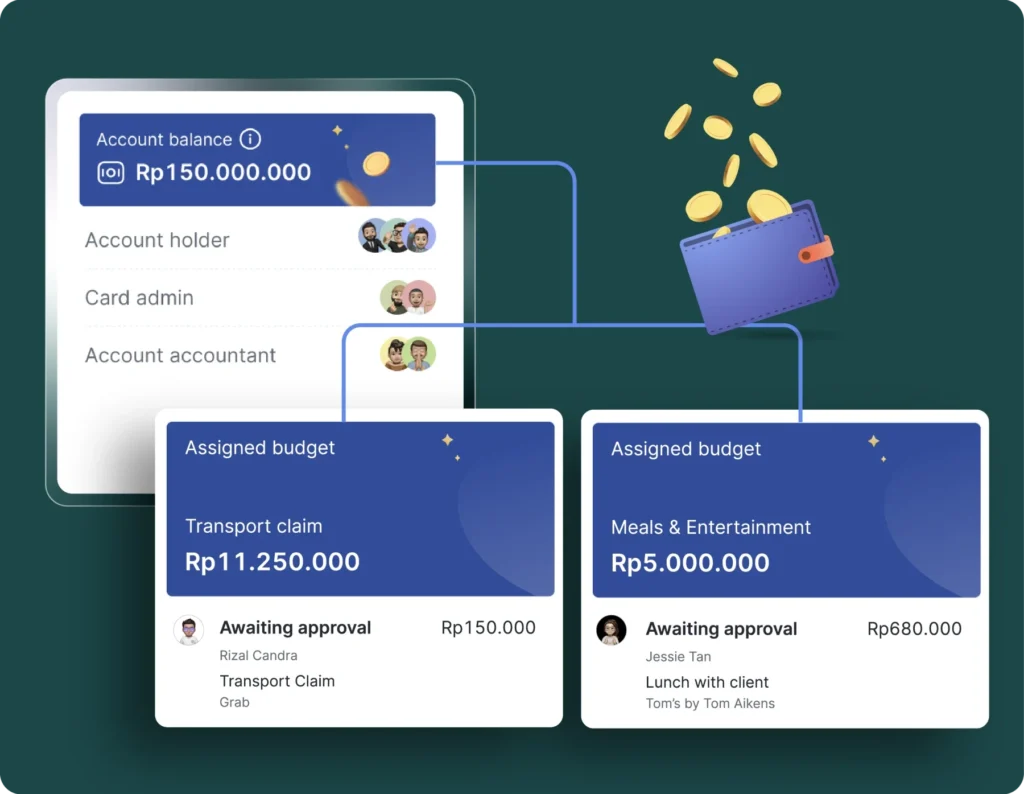
Accurate forecasts require accurate financial data and accurate financial data requires controlled and automated expense management.
When expense data is scattered across manual spreadsheets and physical receipts, finance teams cannot build reliable cost models. Budget-versus-actual comparisons become guesswork. As a result, the entire revenue forecasting process is affected, because inaccurate cost baselines distort margin and cash flow projections.
Mekari Expense as a spend management software and part of the Mekari unified software ecosystem, provides a strong financial data foundation to support better forecasting through five core capabilities:
- Real-time expense tracking and categorization: Finance teams have up-to-date cost data without waiting for end-of-month consolidation, ensuring every forecasting decision is based on fresh data.
- Budget control and expense visibility: Define budget limits per department, project, or cost center and monitor actuals anytime in real-time.
- Automated AP and invoice processing: OCR-based invoice capture ensures complete and accurate accounts payable data for cost forecasting, without error-prone manual entry.
- Multi-level approval workflows: Enforce spending controls that prevent budget overruns before they happen, not after the damage is done.
- Integration with Mekari Jurnal: Seamless connection for reconciliation between expense management and the general ledger, ensuring financial reports and forecasting models always remain consistent.
Generate accurate and reliable revenue forecasting with Mekari Expense!
Reference
Gartner. “Gartner Predicts That 90% of Finance Functions will Deploy at Least One AI-enabled Technology Solution by 2026”

