



Mekari Insight
- Low-code platforms accelerate Agile practices through visual interfaces and ready-to-use components. Short sprints become more efficient because teams can quickly build prototypes without complex manual coding.
- Cross-team collaboration also becomes stronger, as low-code enables more people to contribute. Agile requires intensive communication, and low-code helps make this possible, even for non-technical teams such as marketing or HR.
- Mekari Officeless is an ideal Low Code No Code (LCNC) solution for agile development. With its drag-and-drop system, extensive integrations, and enterprise-grade security, the platform accelerates development up to 5× faster without requiring a large IT team.
Agile software development with low-code/no-code platforms is transforming how companies build and deliver software. Agile software development itself is an iterative and collaborative approach to building software, where projects are divided into short-term sprints that allow teams to quickly adapt to changes and deliver value incrementally.
Today, many companies accelerate their Agile practices using Low Code No Code (LCNC) platforms. With visual interfaces and drag-and-drop functionality, LCNC simplifies prototyping, iteration, and cross-team collaboration—even without a large IT team.
It’s no surprise that 85% of companies now rely on these platforms to launch prototypes faster and more efficiently within Agile cycles. How does it work? Let’s explore further.
What is agile development?
Agile software development is a methodology that builds software iteratively and incrementally. Teams work in short sprints to deliver functional features on a regular basis.
This method encourages strong team collaboration, rapid adaptation to changing requirements, and consistent delivery of results.
Core principles of agile development
- Customer-focused development: Prioritize delivering useful features early and continuously based on user needs.
- Adaptability to change: Changing requirements during development are not obstacles but opportunities to improve the product.
- Iterative progress: Work is divided into short sprints (typically 1–4 weeks), allowing regular evaluation and quick adjustments.
- Self-organizing and cross-functional teams: Teams have the authority and capability to plan, execute, and review their own work.
- Direct communication: Regular meetings, either in person or online to ensure quick and clear alignment.
- Continuous improvement: At the end of each sprint, teams evaluate their workflow and implement improvements for the next sprint.
Benefits of agile development
- Faster time-to-market: Products can be launched earlier and improved over time.
- Better adaptability: Teams can easily adjust to changing requirements without disrupting the development process.
- Stronger collaboration: Frequent communication improves alignment between teams and stakeholders.
- Reduced risk: Small iterations help detect and fix issues earlier.
- Improved product quality: Agile emphasizes testing, good design, and technical excellence.
Baca Juga: 10 Top No-Code Database Software Builder for BusinessesUnderstanding low code and no code
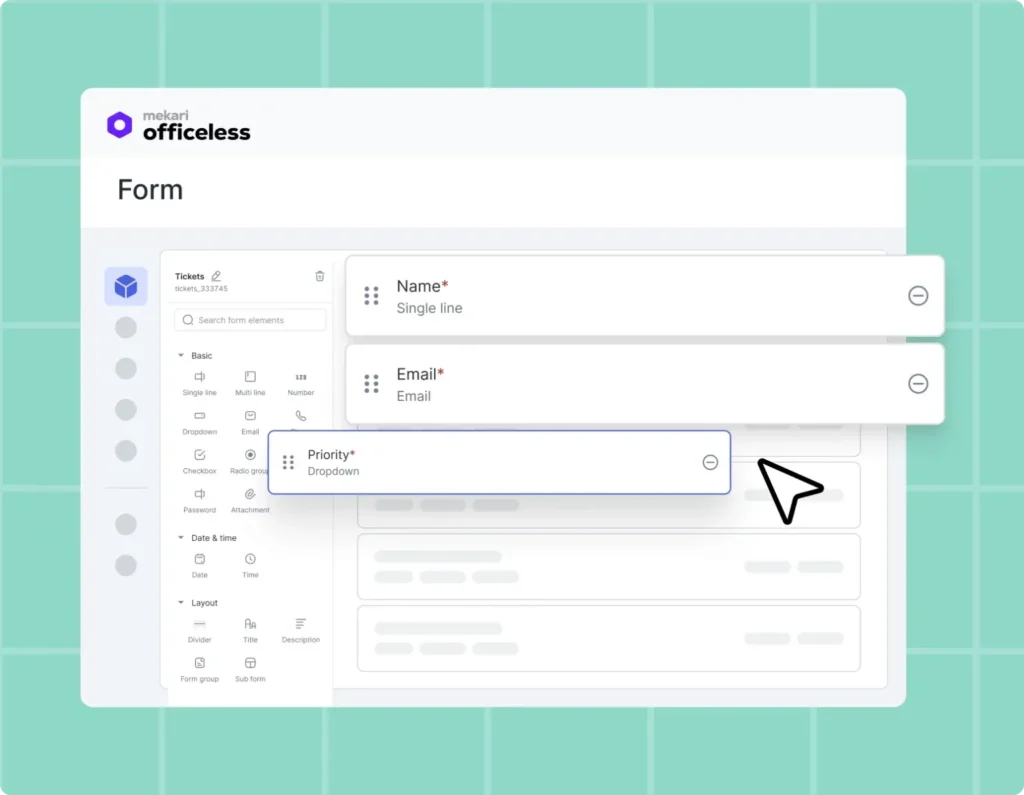
Low code and no code are modern approaches to application development that allow anyone even without a technical background to build applications using visual interfaces and drag-and-drop features.
- Low code still requires some technical knowledge, usually for specific logic or integrations, but it is significantly simpler than traditional coding.
- No code platforms can be used entirely by non-technical users because all components are pre-built and ready to use without writing a single line of code.
By using low code no code platforms, organizations gain several benefits:
- Faster application development
- Non-technical teams such as HR, marketing, or finance can build applications without waiting for IT teams
- Cost and resource efficiency
- Flexible integrations
- Maintained security and governance
Combining agile and low code to accelerate software development
Agile and Low Code/No Code (LCNC) are complementary approaches. Agile helps teams break projects into manageable sprints and adapt quickly to changes. Meanwhile, LCNC simplifies execution through visual interfaces and drag-and-drop components without requiring complex coding.
When combined, these approaches enable faster application development—even with limited resources.
Benefits of combining Agile with LCNC:
- Faster development and deployment: Agile promotes rapid iterations, while LCNC allows teams to build and modify applications without complex coding.
- More inclusive cross-team collaboration: Agile encourages open communication, and LCNC enables non-technical team members to participate directly in development.
- Easier adaptation and revisions from feedback: Agile prioritizes adaptability, while LCNC enables quick changes without long development cycles.
- Faster idea validation: Agile encourages early experimentation, and LCNC enables prototypes to be built in days, helping teams test features before final implementation.
Baca Juga: Visual Programming: A Faster Way to Build Enterprise AppsHow low code accelerates agile development
The combination of Agile methodology and low-code platforms is an effective solution for companies that want to build applications faster without dealing with long and complex development processes.
This approach allows teams to launch applications quickly while maintaining quality and flexibility.
1. Faster development cycles
Agile divides projects into short, repeating cycles. With low code, teams can build prototypes within days because components are pre-built and simply require drag-and-drop configuration.
Iterations and feature changes can be implemented immediately without rewriting code from scratch. As a result, products can be tested and delivered to users much faster.
2. Easier cross-team collaboration
Low code makes the development process more accessible. Non-technical teams such as marketing or HR can also participate in building applications without coding skills.
Because everything is visual and centralized, collaboration between developers and business users becomes smoother and minimizes miscommunication. Agile processes that rely on fast feedback also become more effective.
3. More practical testing and deployment
Low-code platforms typically include automated testing features and one-click deployment.
Whenever updates are made, teams can immediately test and release them without time-consuming manual processes. This aligns perfectly with Agile principles that emphasize rapid delivery and responsiveness to changing user needs.
4. Adaptive and scalable development
Low-code applications are flexible and easy to modify as business needs evolve. Teams can quickly adjust features without rebuilding the application.
Since most low-code platforms are cloud-based, scalability is rarely an issue. Adding users or features is often as simple as a few clicks.
How to integrate agile methods with low-code platforms
If you want to build applications faster while maintaining adaptability, combining Agile methodology with low-code platforms is a powerful strategy. Here are the steps to integrate them:
1. Identify needs and choose the right platform
Start by identifying which processes or applications can benefit from low-code solutions. Then choose a platform that fits your business needs. Make sure it supports Agile workflows, provides collaboration features, and can be used by both technical and non-technical teams.
2. Build a team and provide initial training
Introduce Agile principles and the low-code tools that will be used. Teams may include developers, business users, and anyone directly involved in the process. The most important thing is ensuring everyone understands the workflow and their responsibilities.
3. Create a backlog and set priorities
Develop a list of features, improvements, or ideas to build. Prioritize them so they can be divided into smaller sprints. This backlog will serve as your project roadmap and can be adjusted based on future feedback.
4. Implement Agile processes in development
Use frameworks such as Scrum or Kanban to manage workflows. Conduct sprint planning, daily stand-ups, and retrospectives regularly to maintain communication and continuous evaluation.
5. Encourage cross-functional collaboration
Leverage the user-friendly nature of low-code platforms so all team members—including non-technical ones, can contribute actively. This approach ensures faster development while keeping solutions aligned with real business needs.
6. Iterate quickly and continuously adapt
Monitor progress using simple metrics such as velocity or the number of completed features. If something isn’t working, evaluate and adjust the backlog or workflow.
Use low-code tools to create prototypes or MVPs within days. Gather feedback, revise quickly, and release updates. This approach allows teams to keep moving forward without waiting for a “perfect” application from the start.
Recommended low-code platform for agile development
In Agile software development with low-code/no-code platforms, speed and flexibility are critical for successful application delivery. Teams need to quickly adapt to changes, test ideas, and release improvements within short sprint cycles.
For this reason, Mekari Officeless is designed as a Low Code No Code platform that strongly supports Agile development processes for both small teams and large enterprises.
With a visual approach and drag-and-drop system, Mekari Officeless allows anyone even non-technical teams to build, customize, and launch applications independently. Iteration cycles become faster without relying entirely on IT teams.
Key advantages of Mekari Officeless:
- Instant solutions for complex business processes without complicated coding
- Cost-efficient, as a single platform supports multiple business needs
- Secure and efficient big data capacity suitable for enterprise scale
- Development up to 5× faster, reducing IT team workload
- Seamless integration with legacy systems such as SAP, Oracle, and Salesforce
- Ready-to-use local integrations including WhatsApp, Traveloka, and Artajasa
- Advanced security to support large-scale enterprise operations
- Flexible usage across platforms, from web applications to native mobile apps
- Flexible deployment options, including on-premise and private cloud
With these capabilities, Mekari Officeless not only accelerates Agile development but also helps companies drive end-to-end digital transformation—making operations more efficient, secure, and scalable.
References
Relinns. ‘’How Does Agile Low Code Development Speed Up Apps?”
Quixy. ‘’A Guide to No-Code Low-Code and Agile Optimization’’
